
Official statement
What you need to understand
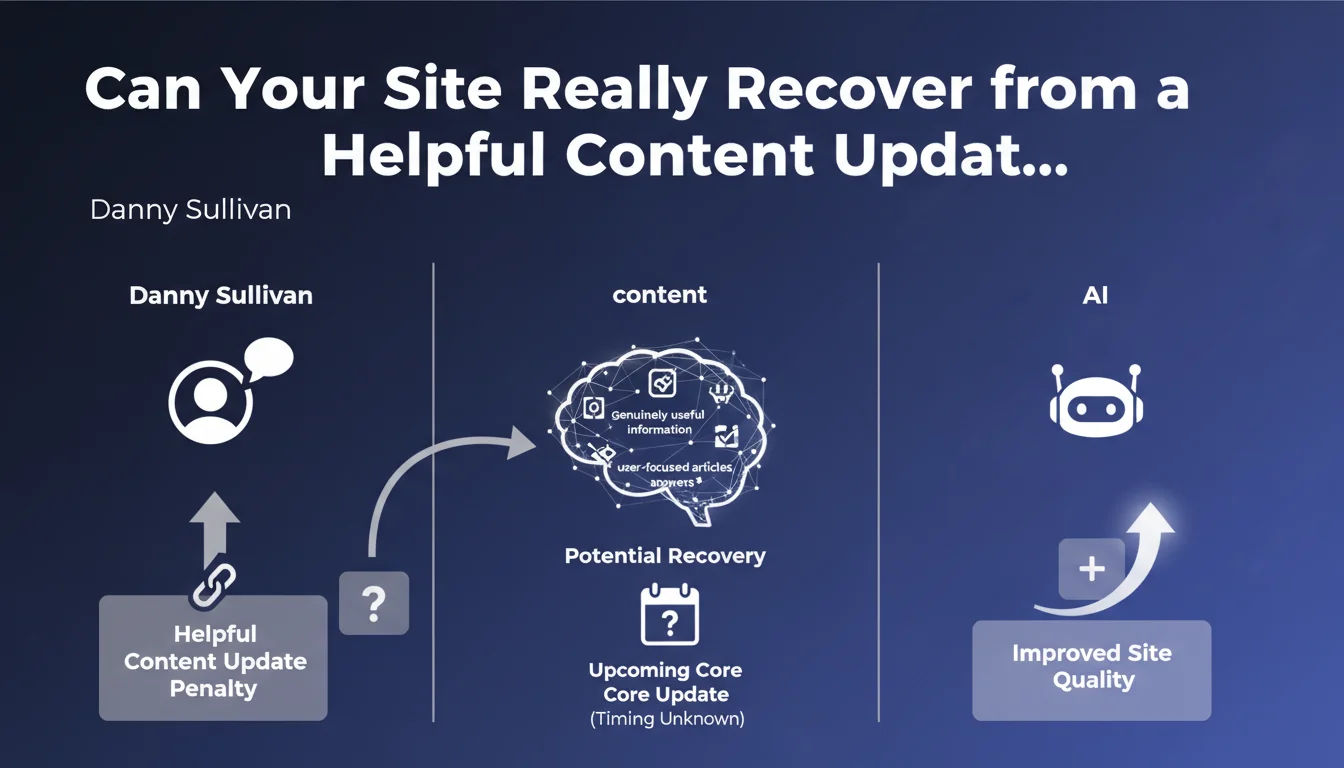
Google has confirmed that a site penalized by the Helpful Content Update (HCU) can recover its rankings, but only during a future Core Update. This clarification is crucial: recovery is not automatic or gradual, but rather a complete reassessment during a major update.
The interval between two Core Updates typically ranges from 3 to 6 months, which means an impacted site must exercise patience while actively working on improvements. Google provides no specific timeline for these major updates.
The essential prerequisite for hoping to recover remains substantial content improvement focused on genuine usefulness to users. This isn't about superficial cosmetic adjustments but a profound overhaul of the editorial approach.
- Recovery is only possible during a major Core Update
- No guarantee of recovery even after content improvements
- Focus must be on helpful, user-centered content
- Waiting period can extend several months without clear visibility
- Improvements must be substantial and measurable
SEO Expert opinion
This statement indeed reflects what we've been observing in the field since the HCU rollout. Affected sites experience an extended freeze period where even significant improvements produce no immediate results. Recovery happens abruptly during a Core Update, never gradually.
However, some nuance is needed: certain sites have experienced partial recoveries rather than complete ones, even after considerable efforts. Google evaluates not only the absolute quality of content but also its relative relevance compared to competition in your niche. If your sector evolved during your penalty period, the expected standards may have risen.
We also observe that sites with mixed problems (HCU + technical or link issues) have lower recovery rates. The HCU acts as a powerful filter that amplifies other site weaknesses.
Practical impact and recommendations
- Audit your editorial intent: For each piece of content, ask yourself whether you created it for search engines or to address a real user need
- Remove low-value content: Identify and delete (or consolidate) pages created solely to target keywords without providing expertise
- Strengthen your EEAT: Add identifiable authors with demonstrated expertise, cite reliable sources, showcase your practical experience
- Prioritize experience-based content: Incorporate case studies, testimonials, proprietary data, and unique insights rather than generalities
- Analyze behavioral signals: Examine pages in Search Console with low CTR or insufficient engagement rates
- Restructure your content architecture: Organize your content around thematic hubs demonstrating deep expertise rather than superficial coverage
- Document your improvements: Keep a detailed log of modifications to measure their impact during the next Core Update
- Don't rush: Avoid massive, panicked changes; favor a methodical, quality-focused approach
- Monitor official announcements: Google typically communicates on Twitter a few days before a Core Update rollout
In summary: Recovery after an HCU is a lengthy and uncertain process requiring a strategic overhaul of your content approach. Results will only be visible during the next Core Update, making the interim period particularly challenging for business planning.
Given the complexity of this diagnosis and the business stakes involved in successful recovery, many companies choose to work with a specialized SEO agency experienced in content issues and post-penalty recovery. An external, experienced perspective can identify blind spots and develop a personalized recovery strategy, thus maximizing your chances during the next window of opportunity.
💬 Comments (0)
Be the first to comment.