
Official statement
What you need to understand
Since the shift to mobile-first indexing, Google now primarily uses the mobile version of a website to analyze it and rank it in its search results. This major transition has prompted many SEO practitioners to focus exclusively on mobile optimization.
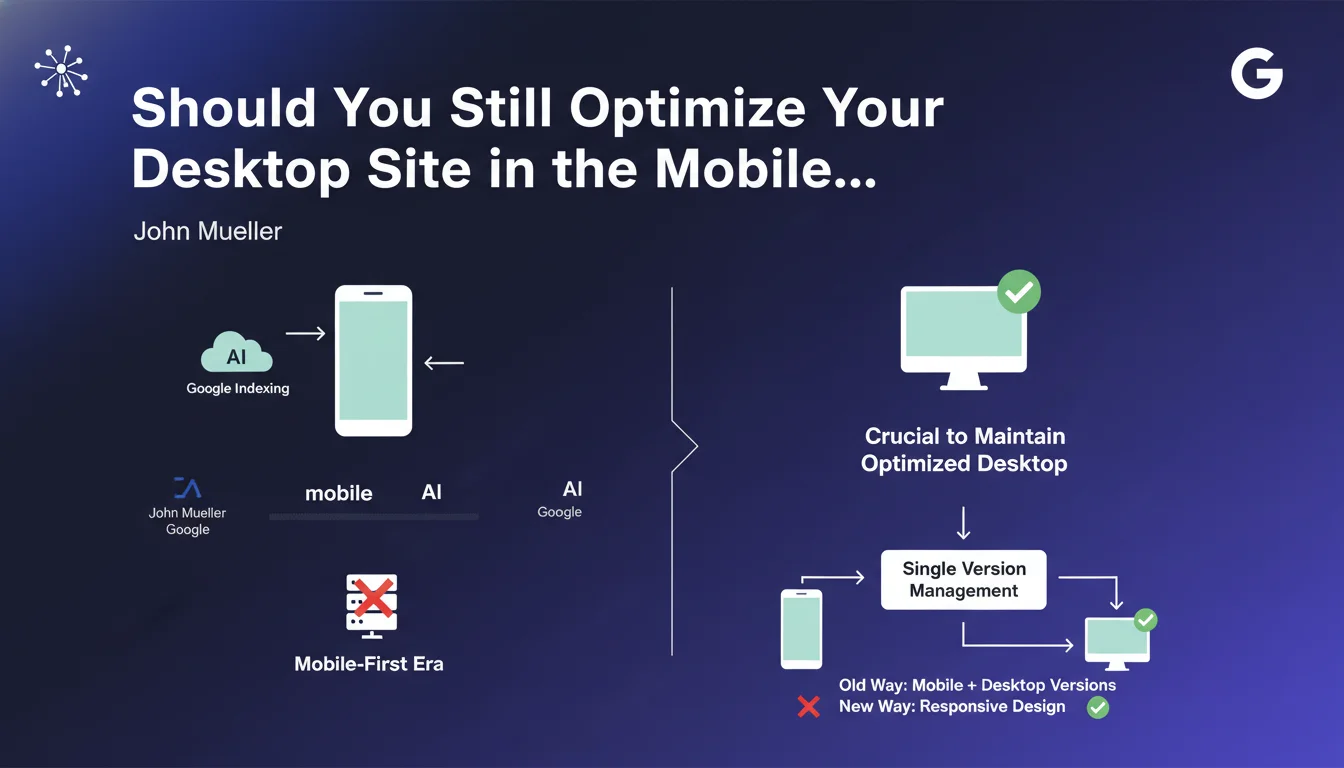
However, this statement reminds us of a fundamental principle: mobile-first indexing does not mean mobile-only. Google continues to crawl and evaluate desktop versions, even though they are no longer the primary reference for indexing.
It is essential to understand that desktop user experience remains critical for your conversions and bounce rate. A neglected desktop version can negatively impact your overall performance, even with an excellent mobile version.
- Google indexes mobile-first, but still crawls desktop versions
- Responsive design is the recommended solution for unified management
- A significant portion of traffic still comes from desktop computers
- Other search engines continue to favor desktop versions
- Desktop experience directly influences performance metrics and conversions
SEO Expert opinion
This position from Google is completely consistent with real-world data. In many sectors (B2B, finance, education), desktop traffic still represents 40 to 60% of visits. Neglecting this audience would be a major strategic mistake.
The recommendation for responsive design is particularly relevant because it eliminates content parity issues between mobile and desktop versions. However, an important nuance: some complex sites (e-commerce with extensive catalogs, SaaS platforms) may legitimately have functional differences between versions, provided that essential content and internal links remain consistent.
In my practice, I observe that sites that have maintained excellence across both formats consistently outperform, particularly on transactional queries where users often switch between mobile and desktop during their purchasing journey.
Practical impact and recommendations
- Regularly audit both versions of your site (mobile and desktop) to identify content, performance, or functionality gaps
- Favor responsive design rather than separate URLs (m.site.com) to simplify maintenance and ensure consistency
- Test loading speed on desktop with PageSpeed Insights and optimize Core Web Vitals for both formats
- Verify that your images, videos, and rich content are properly displayed and optimized on computers
- Analyze your traffic by device in Google Analytics to understand your audience's actual behavior
- Ensure desktop navigation remains intuitive and that complex menus are fully functional
- Don't sacrifice content on mobile under the guise of simplification: this content must be accessible, even if the display differs
- Optimize desktop experience for conversion: forms, checkout funnels, personal spaces must be perfectly ergonomic
- Monitor your competitors on both formats to identify improvement opportunities
💬 Comments (0)
Be the first to comment.