
Official statement
What you need to understand
Google now requires heightened vigilance regarding the quality of content automatically translated by artificial intelligence. This position reflects a growing concern about the proliferation of multilingual sites generated massively without quality control.
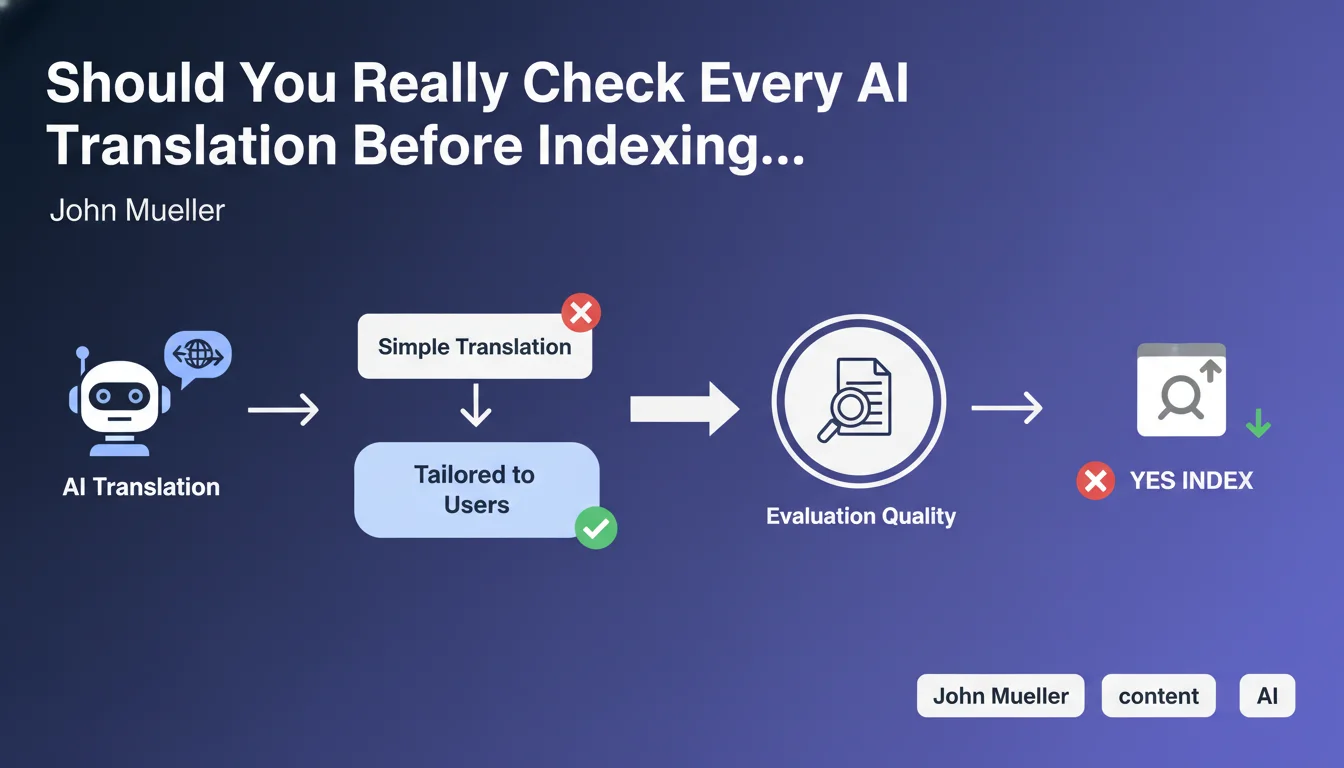
The important nuance here is that Google does not condemn the use of AI for translation, but insists that these translations must be "tailored to users." This means that a simple word-for-word transposition is not enough.
The search engine expects translations that take into account the cultural, linguistic and contextual specificities of each target market. A literal translation can be grammatically correct while being totally unsuited to local usage.
- Translation AI can be used as a starting point, not as a final solution
- Content must be reviewed and culturally adapted before indexing
- Poor quality translation negatively impacts user experience and ranking
- Google evaluates content relevance for each specific language and market
- The goal is to provide local added value, not simply to duplicate content
SEO Expert opinion
This recommendation fits perfectly into Google's current logic, which prioritizes actual user experience rather than content volume. In my analyses of multilingual sites, I regularly observe that unrevised automatic translations generate high bounce rates and low session durations.
The important nuance concerns the type of content involved. For standardized product sheets with technical specifications, a well-configured AI translation may suffice with minimal validation. On the other hand, for editorial content, category pages or blog articles, cultural adaptation becomes critical.
In practice, the best-performing multilingual sites are those that adopt a hybrid approach: AI for the first pass, then human review for local adaptation, optimization of key expressions and adjustment of editorial tone according to the cultural codes of each country.
Practical impact and recommendations
- Audit your existing translations: examine your translated pages with native speakers to identify quality issues
- Implement a validation workflow: never publish an AI translation directly without qualitative proofreading
- Adapt idiomatic expressions: replace literal translations with culturally appropriate equivalents
- Localize examples and references: adapt practical cases, currencies, units of measurement and cultural references
- Optimize keywords by market: research terms actually used locally, not simply translated
- Check hreflang tags: ensure that Google properly understands the multilingual structure of your site
- Analyze engagement metrics: compare bounce rates, session time and conversions across languages
- Prioritize according to strategic importance: focus revision efforts on pages with high commercial potential
- Train your teams: educate writers and translators about the SEO specificities of each market
- Test before mass deployment: validate your process on a few key pages before extending it
In summary: AI is an excellent accelerator for translation, but requires a layer of human expertise to guarantee quality and SEO performance. The challenge is to find the right balance between scalability and local relevance.
Implementing a high-performing multilingual strategy involves coordinating technical, linguistic and cultural aspects in a coherent approach. Given the complexity of these cross-market optimizations and the specialized resources they require, support from an SEO agency experienced in international deployments can prove valuable in effectively structuring your approach and avoiding costly pitfalls.
💬 Comments (0)
Be the first to comment.