
Official statement
Other statements from this video 14 ▾
- □ Why do so many SEO professionals still confuse robots.txt and no-index? Here's what you need to know
- □ Should you really optimize your entire site after an algorithmic update?
- □ Is Search Console finally giving you the AI visibility you need—or just keeping you in the dark?
- □ Do you really need to optimize your site differently for Google's AI Overviews?
- □ Is Google Trends really a strategic tool to guide your SEO editorial strategy?
- □ Can Search Console truly reveal what your audience is really searching for?
- □ Is SEO really dead or just undergoing a transformation right before our eyes?
- □ Does content quality directly impact your Google indexation rate more than you think?
- □ Does a sitemap really guarantee that Google will index all your pages?
- □ Is your CDN or firewall silently blocking Googlebot without you even knowing it?
- □ Does Google really use the Knowledge Graph to identify topics in Trends, or is it just keyword grouping?
- □ Does Google's search index really have a hard capacity limit?
- □ Does traditional marketing really matter for ranking higher on Google?
- □ Does structured data really have no impact on your SEO rankings?
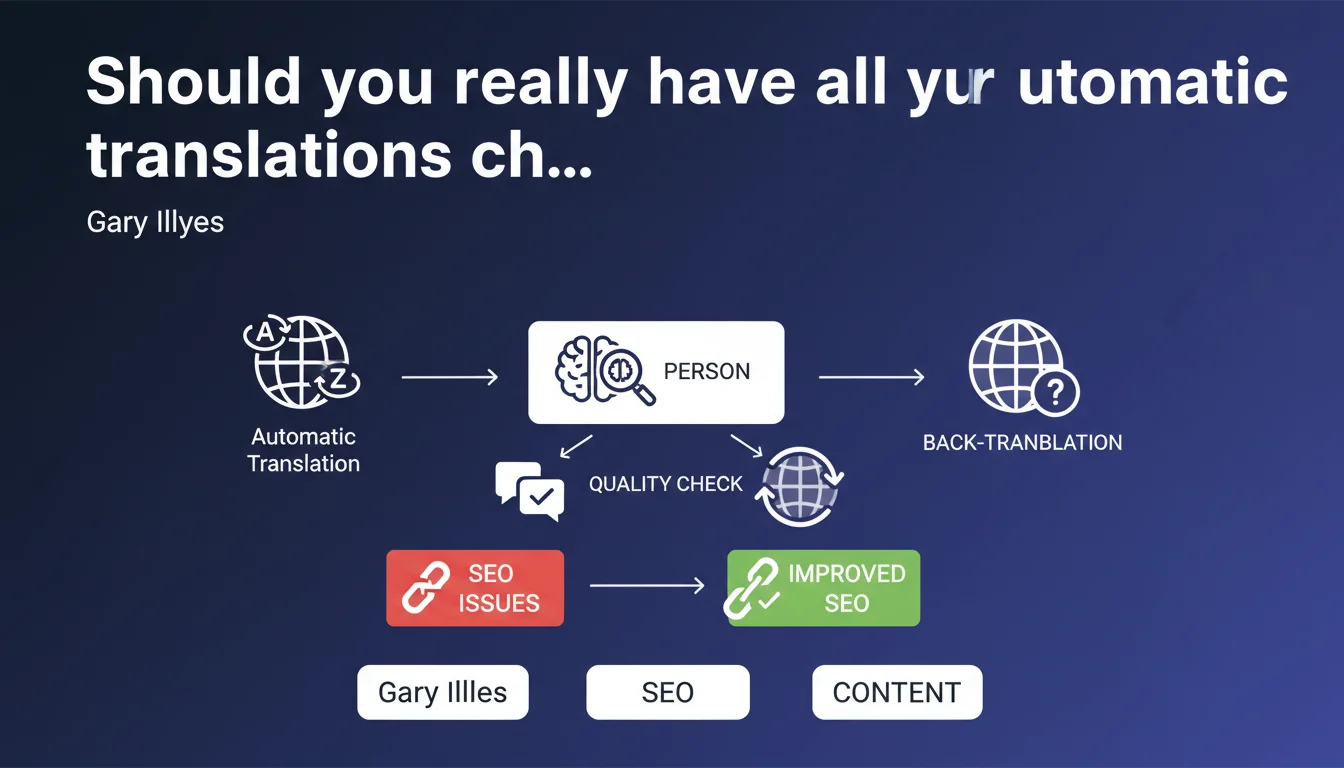
Google requires that a person verifies the quality of automatic translations to ensure at least their comprehensibility. Back-translation is proposed as a simple control method, even though it does not preserve linguistic nuances. The message is clear: machine-translated content without human validation risks being considered low quality.
What you need to understand
Why does Google care about the quality of automatic translations?
Google has been handling billions of multilingual pages for years, an increasingly large proportion of which relies on machine translation. The search engine has always maintained that low-quality content, regardless of how it's produced, harms user experience.
This statement formalizes an implicit position: an incomprehensible or confusing translation falls into the category of low-value content, even if the source text is excellent. Google doesn't ban machine translation per se, but it establishes a minimum threshold — comprehensibility.
What is the back-translation method being recommended?
Back-translation involves taking the machine-translated text and translating it back to the source language. If the general meaning remains coherent, the initial translation is probably acceptable.
Google itself acknowledges that this approach does not guarantee the preservation of linguistic nuances — cultural subtleties, register, idiomatic expressions. It's a basic coherence test, not a comprehensive editorial review.
What does it concretely mean when "a person verifies quality"?
Google doesn't precisely define the level of validation expected. Is it a quick review to spot obvious syntactic errors, or a thorough revision by a native speaker?
The phrasing "at least comprehensible" suggests a minimum threshold. But this ambiguity leaves room for interpretation — and risk for those who settle for superficial verification.
- Google doesn't ban machine translation, but requires human validation of comprehensibility
- Back-translation is proposed as a simple method, but limited to general coherence checks
- The quality threshold remains unclear: "comprehensible" doesn't mean "optimized" or "native-quality"
- This position aligns with the Helpful Content logic: the production method matters less than the final value for users
SEO Expert opinion
Is this requirement realistic at scale?
Let's be honest: for an e-commerce site with 10,000 product sheets translated into 8 languages, systematic human verification represents considerable cost. Google knows this perfectly well.
This statement probably targets the most abusive practices — entirely AI-generated multilingual sites with zero quality control, where translation errors make content laughable or incomprehensible. Nevertheless, it places all stakeholders before a real operational constraint.
The problem is that back-translation is a fragile indicator. It can validate grammatically correct but tonally inappropriate translations, or miss subtle misunderstandings that go unnoticed during the double automatic pass.
What's the difference between "comprehensible" and "quality"?
Google sets a floor here, not a target. A "comprehensible" page can very well be perceived as mediocre by a native speaker — awkward wording, generic vocabulary, lack of naturalness.
We know that user signals (bounce rate, time on page, engagement) indirectly influence rankings. A technically acceptable translation but not very engaging risks underperforming, even if it passes Google's test.
This is where nuance matters: complying with the directive is not enough to guarantee good positioning. You need to aim beyond comprehensibility to compete with natively written content.
Should we fear a penalty if we use DeepL without validation?
Google never mentions automatic penalties for unverified machine translation. It would be technically complex to detect — how to distinguish validated machine translation from poor human translation?
The risk lies elsewhere: content translated without validation, if judged of low value by users, will likely be treated like any weak content — less visibility, less crawl budget, less long-term domain trust.
Practical impact and recommendations
How to implement effective validation without exploding budgets?
For an editorial content site, validation can go through part-time native proofreaders, or specialized freelancers who correct obvious errors without rewriting everything.
For e-commerce, a sampling approach can work: validating high-traffic pages first (categories, bestsellers) as a priority, and applying standard fixes to similar product sheets.
Back-translation can serve as a first automated filter to identify the most problematic pages before targeted human intervention. But it should never be the only step.
What mistakes should you avoid in managing multilingual content?
Never deploy a machine-translated version without even a quick human check. The most obvious errors — misunderstandings, absurd phrasings — immediately damage site credibility.
Also avoid translating content that's already weak in its original version. Translation amplifies flaws: vague or hollow text will remain so, plus linguistic awkwardness on top.
Pay attention to cultural or legal elements that don't translate literally — legal notices, currencies, units of measure, cultural references. These details escape automated tools and require manual adaptation.
What should you do concretely right now?
- Audit existing machine-translated pages, prioritizing those that generate traffic or conversions
- Implement a human validation process, even light, before publishing any new machine translation
- Test back-translation on a sample to identify major inconsistencies
- Train teams to spot signs of poor translation quality: awkward syntax, inappropriate vocabulary, non-idiomatic phrasings
- Document recurring errors and adjust translation tool prompts or settings to limit their repetition
- Integrate a dedicated budget for linguistic review into multilingual projects, rather than treating it as optional
🎥 From the same video 14
Other SEO insights extracted from this same Google Search Central video · published on 18/12/2025
🎥 Watch the full video on YouTube →
💬 Comments (0)
Be the first to comment.