
Official statement
Other statements from this video 14 ▾
- □ Robots.txt vs no-index : pourquoi tant de pros SEO mélangent encore ces deux mécanismes ?
- □ Faut-il vraiment optimiser tout le site après une mise à jour algorithmique ?
- □ Search Console intègre les données IA : mais savez-vous vraiment ce que vous mesurez ?
- □ Faut-il vraiment optimiser différemment son site pour les AI Overviews de Google ?
- □ Google Trends est-il vraiment un outil stratégique pour orienter sa ligne éditoriale SEO ?
- □ Comment Search Console peut-il vraiment révéler ce que cherche votre audience ?
- □ Le SEO est-il vraiment mort ou juste en train de muter sous nos yeux ?
- □ Comment la qualité du contenu influence-t-elle directement le taux d'indexation par Google ?
- □ Un sitemap suffit-il vraiment à garantir l'indexation de vos pages ?
- □ Votre CDN ou firewall bloque-t-il Googlebot sans que vous le sachiez ?
- □ Comment Google Trends utilise-t-il réellement le Knowledge Graph pour identifier les topics ?
- □ Le marketing traditionnel est-il devenu indispensable pour ranker sur Google ?
- □ Les données structurées sont-elles vraiment inutiles pour le classement SEO ?
- □ Faut-il vraiment faire vérifier toutes vos traductions automatiques pour le SEO ?
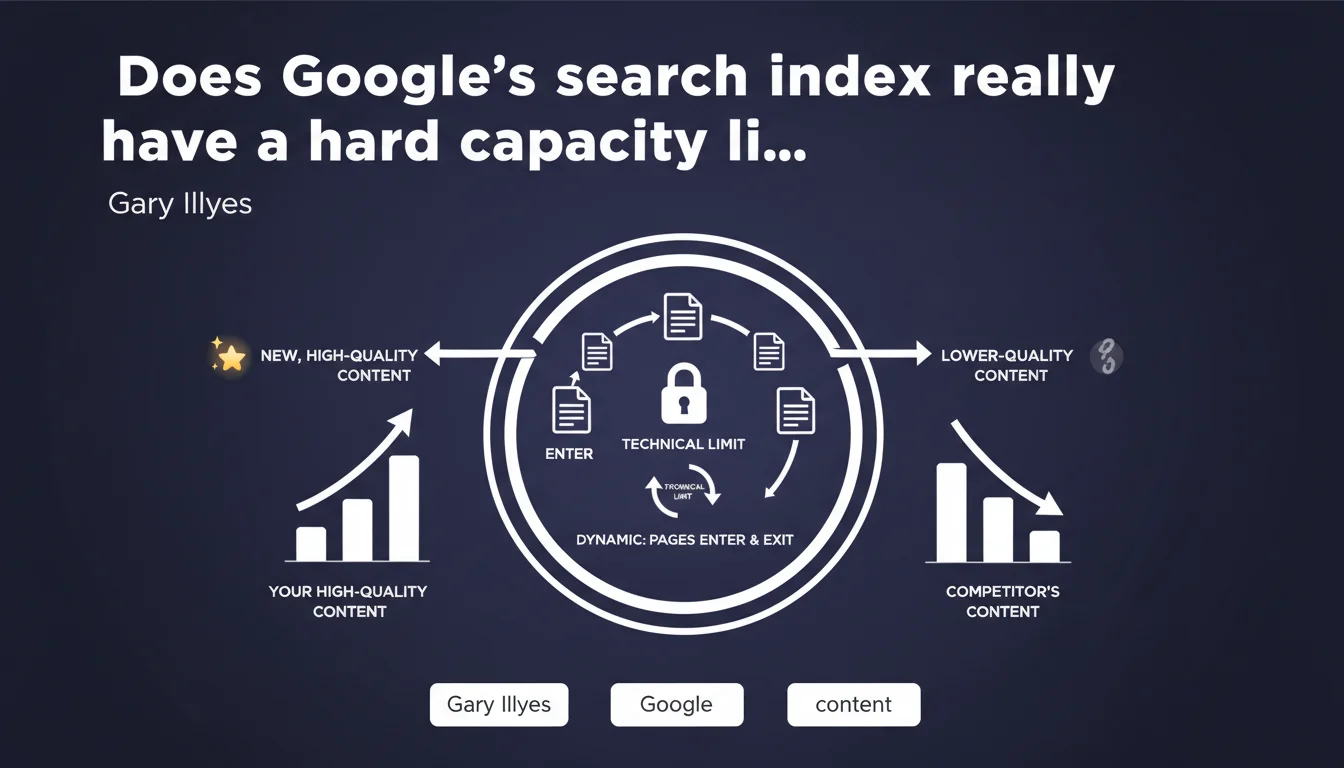
Google's index is not infinite and functions as a space with limited capacity. Pages enter and exit dynamically based on their relative quality: publishing content superior to a competitor's can push theirs out of the index to make room for yours. It's a battle for space occupation, not just a race to get indexed.
What you need to understand
What does it concretely mean for an index to have a "technical limit"?
Google cannot store and index the entire web. There are physical constraints: servers, data centers, processing capacity.
But the real limit isn't so much absolute as relative. Google constantly chooses which pages deserve to occupy that precious space. If your content doesn't offer anything more than what already exists, it can be excluded — or never enter in the first place.
How does this "dynamic" entry-exit mechanism work?
The index is not static. Pages disappear from the index even if they are technically accessible and crawlable. Others enter after being ignored for months.
Gary Illyes is talking here about a principle of direct competition: if you publish better content than a competitor on a given topic, your page can take their place. This isn't about ranking (position in search results), it's about indexation itself.
Why is this statement being made now?
Because too many SEO professionals still imagine that "crawled = indexed". Wrong. The Googlebot can crawl your page without ever putting it in the index if it doesn't meet the quality threshold.
With the explosion of AI-generated content, Google must manage a tsunami of mediocre pages. This statement sets an explicit framework: we only keep content that has real differentiated value.
- Google's index has limited capacity, it's not a bottomless warehouse
- Pages enter and exit based on their relative quality compared to competitors
- Crawling a page does not guarantee its indexation
- Competition isn't just played out at the ranking level, but at the indexation level itself
SEO Expert opinion
Does this statement contradict what we know about how Google works?
No, but it makes official what many of us have been observing for years. The mysterious disappearances of pages from the index, the "Crawled - currently not indexed" statuses exploding in Search Console — it all makes sense.
What's new is the frankness of the message. Google openly admits there is a form of rationing. That being indexed isn't an acquired right, but a privilege earned.
What nuances should we add to this claim?
Let's be honest: Google won't deindex Amazon or Wikipedia because you published a better article. The "quality" Gary is talking about isn't absolute — it also depends on context, domain authority, and history.
A new site with excellent content may take months to earn its place, even if it objectively surpasses the competition. Domain trust remains a determining factor. And that's where it gets tricky: the mechanism described by Gary is real, but it doesn't apply with the same speed or equity everywhere.
Another nuance: pages exit and re-enter the index. It's not always permanent. A page can disappear temporarily, then return — sometimes without us understanding why.
Isn't this discourse a way to justify the search engine's incompetence?
You could see it that way. "Sorry, we're out of space" sounds like an easy excuse when your legitimate content isn't indexed while AI content farms swarm through the index.
But the technical reality is there: Google can't keep everything. The problem is that their sorting criteria are opaque and sometimes inconsistent. They tell you "produce quality content", but the definition of that quality remains vague.
Practical impact and recommendations
What should you concretely do to secure your presence in the index?
First, stop publishing for the sake of publishing. Every new page must bring differentiated value compared to what already exists — including on your own site.
Then consolidate your existing content. If you have weak pages that serve no purpose, delete them or merge them. Better to have 50 solid pages in the index than 500 pages where 400 are being ignored.
Monitor Search Console like a hawk. "Crawled - currently not indexed" or "Discovered - currently not indexed" statuses are warning signals. If these statuses explode, it means Google considers your content low-priority.
How do you avoid being kicked out of the index by a competitor?
Keep your content updated. A page that's 5 years old and never touched is an easy target. Regularly refresh your strategic articles, add recent data, improve structure.
Strengthen authority signals: coherent internal linking, solid topic clustering, quality backlinks. If two pages are competing for a spot in the index, the one with better authority context wins.
And above all, differentiate yourself. Don't just rewrite the same thing as everyone else with different words. Bring a unique angle, exclusive data, real expertise. Generic content is a dying species.
- Regularly audit indexation statuses in Search Console
- Delete or consolidate pages with low added value
- Refresh strategic content at least every 6-12 months
- Strengthen internal linking to priority pages
- Avoid publishing generic or duplicate content
- Monitor the emergence of new competitors on your key queries
- Invest in differentiated content (exclusive data, studies, expertise)
What mistakes should you avoid given this reality of a limited index?
Don't panic if some pages temporarily drop from the index. It's sometimes temporary. Wait a few weeks before making radical decisions.
Avoid multiplying near-identical pages. Endless e-commerce facets, minor content variations — all of this can hurt you in a rationed index context.
And don't think that technical optimization alone will save you. A technically perfect site with mediocre content will be ejected in favor of a technically average site with exceptional content.
🎥 From the same video 14
Other SEO insights extracted from this same Google Search Central video · published on 18/12/2025
🎥 Watch the full video on YouTube →
💬 Comments (0)
Be the first to comment.