
Official statement
Other statements from this video 14 ▾
- □ Robots.txt vs no-index : pourquoi tant de pros SEO mélangent encore ces deux mécanismes ?
- □ Faut-il vraiment optimiser tout le site après une mise à jour algorithmique ?
- □ Search Console intègre les données IA : mais savez-vous vraiment ce que vous mesurez ?
- □ Faut-il vraiment optimiser différemment son site pour les AI Overviews de Google ?
- □ Google Trends est-il vraiment un outil stratégique pour orienter sa ligne éditoriale SEO ?
- □ Comment Search Console peut-il vraiment révéler ce que cherche votre audience ?
- □ Le SEO est-il vraiment mort ou juste en train de muter sous nos yeux ?
- □ Comment la qualité du contenu influence-t-elle directement le taux d'indexation par Google ?
- □ Un sitemap suffit-il vraiment à garantir l'indexation de vos pages ?
- □ Votre CDN ou firewall bloque-t-il Googlebot sans que vous le sachiez ?
- □ Comment Google Trends utilise-t-il réellement le Knowledge Graph pour identifier les topics ?
- □ L'index Google a-t-il vraiment une limite de capacité ?
- □ Le marketing traditionnel est-il devenu indispensable pour ranker sur Google ?
- □ Faut-il vraiment faire vérifier toutes vos traductions automatiques pour le SEO ?
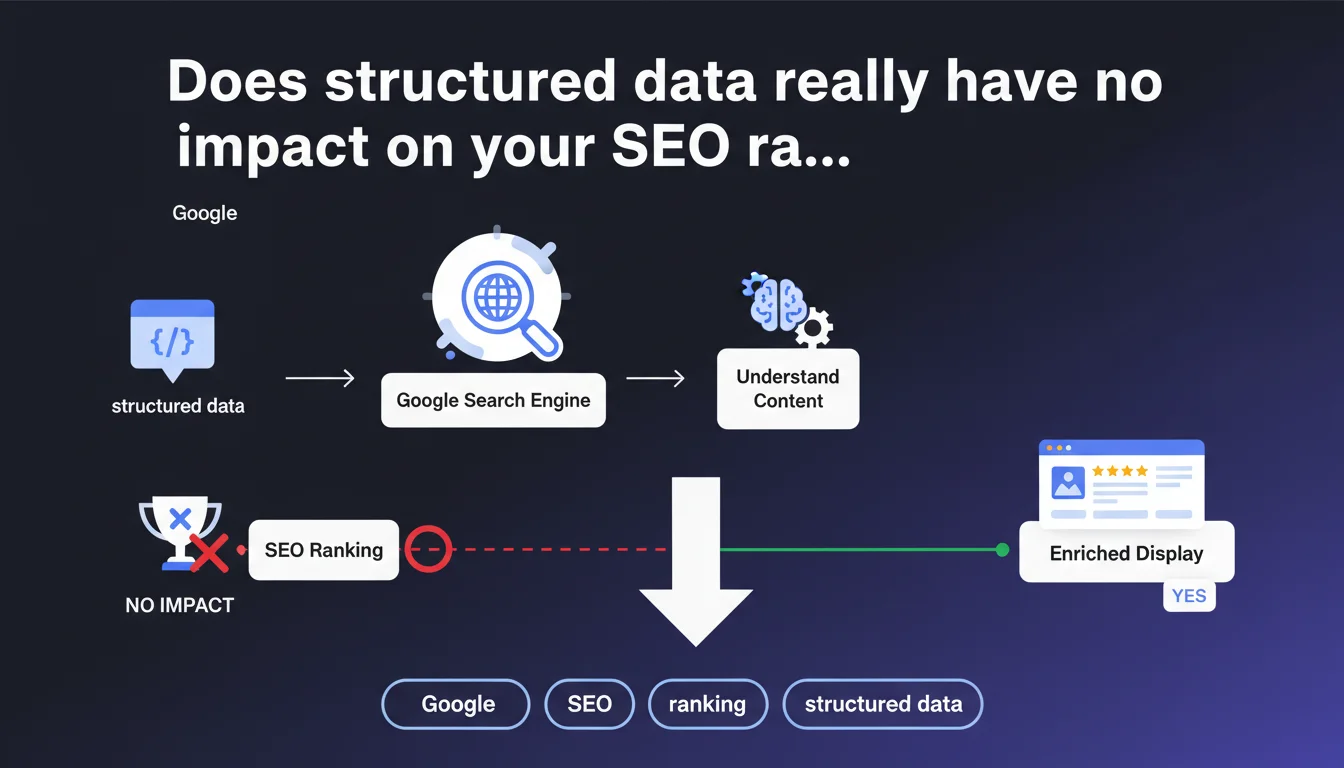
Google claims that structured data has no direct impact on page rankings. Its role is limited to improving content understanding and generating rich results in the SERPs. Yet this statement deserves nuance when compared to real-world observations.
What you need to understand
What exactly does Google mean by "no influence on rankings"?
Google makes a distinction between direct ranking factors and indirect effects. Structured data is not part of the ranking algorithm in the same way that content quality or backlinks are.
It primarily serves to parse and categorize information present on your pages. Schema.org enables the engine to identify whether a block of text represents a recipe, an event, or a product — without artificially boosting the position of that page.
Why does Google insist on this distinction?
This communication is meant to prevent publishers from viewing structured data as a lever for manipulating rankings. Google wants to discourage abusive or deceptive Schema implementation solely in hopes of ranking higher.
The underlying message: implement semantic markup because it's relevant to your content, not because you expect a direct algorithmic boost.
So what is the real function of structured data?
It powers rich snippets, featured snippets, knowledge panels and other enriched formats in search results. A properly marked-up product will display its price, availability, and ratings directly in the SERP.
This increased visibility mechanically generates a better click-through rate — which, in cascade, can indirectly influence traffic and potentially rankings via behavioral signals.
- Structured data is not a direct ranking factor in Google's algorithm
- Its primary role is to improve content understanding by the search engine
- It enables the display of enriched results (rich snippets, carousels, knowledge panels)
- The real impact manifests through improved CTR and user experience
- Google explicitly discourages manipulative use of semantic markup
SEO Expert opinion
Does this statement match what we observe in the real world?
Let's be honest: Google's official position is technically correct but practically misleading. Yes, structured data is not a ranking signal in the same way PageRank is. No, it's not "without influence" on your visibility.
I've observed hundreds of cases where Schema implementation coincided with significant traffic gains — not because pages ranked better, but because they captured more clicks. An e-commerce site displaying price, inventory, and star ratings absolutely crushes a competitor ranked at the same position without these enrichments.
Improved CTR generates more visits, which sends positive engagement signals to Google. These signals influence rankings. The loop is closed — yet Google can technically claim that "Schema is not a direct ranking factor."
What are the limitations of this official statement?
Google conveniently omits that certain result types are inaccessible without structured data. Try appearing in the recipe carousel without Recipe Schema. It's impossible.
So yes, Schema won't make you rank at position 1 instead of position 5. But it determines whether you're eligible for premium SERP placements: featured snippets, People Also Ask, product panels, events in the knowledge graph.
Saying it doesn't influence rankings is like saying having a storefront on a busy street rather than a side alley doesn't influence your sales — technically your product is the same, but exposure radically changes results.
In which cases does this rule not really apply?
There are contexts where structured data has nearly direct impact on visibility. Google Jobs, for example, only indexes job postings properly marked up with JobPosting Schema. No markup = no presence in the jobs module.
Same logic for events (Event Schema), online courses (Course Schema), or local products (LocalBusiness + Product). These verticals have become closed ecosystems where Schema is the entry key, not just a bonus.
On high-volume transactional queries, a competitor optimizing their product rich snippets can capture 40-50% additional CTR. At that point, it matters little what Google calls it — the business impact is massive.
Practical impact and recommendations
Should you continue implementing structured data despite this announcement?
Absolutely. This Google announcement changes nothing about the strategy any serious site should adopt. Structured data remains essential for maximizing your actual visibility in the SERPs.
The mistake would be interpreting this message as "no point bothering with Schema." Google is simply telling you not to implement bogus markup just to manipulate the algorithm. Which is a good thing — clean, relevant implementations come out ahead.
What are the implementation priorities to respect?
Start with Schema types that actually correspond to your business. An e-commerce site must prioritize Product, Offer, Review, AggregateRating. A media outlet should focus on Article, NewsArticle, Author, Organization.
Avoid ridiculous over-optimization: marking up every paragraph as an FAQ when it's not a real FAQ, creating fake breadcrumbs just for markup, inventing fictional reviews. Google detects these abuses and can remove your rich snippets — or even apply manual penalties in extreme cases.
Prioritize consistency: a marked-up product must have the same information in Schema and visible HTML. Prices must match, availability must be current. Google cross-references the data.
- Audit relevant Schema types for your industry and content
- Implement as priority the markups that unlock specific rich results (products, recipes, events, FAQ)
- Validate your implementation with Rich Results Test and Search Console
- Check consistency between structured data and visible page content
- Monitor actual rich snippet appearance in SERPs via tracking tools
- Never implement deceptive or irrelevant Schema to artificially gain enrichments
- Keep data current, especially prices, inventory, and availability
How do you measure the real impact on your performance?
Search Console offers a dedicated rich results report. Track the evolution of impressions and clicks on your rich snippets. Compare average CTR between pages with strong enrichments vs without.
In Google Analytics, segment organic traffic by landing page type and observe whether pages with strong Schema generate superior engagement (time on page, bounce rate, conversions).
Structured data doesn't boost your ranking directly, but it radically transforms your visibility and CTR in search results. Ignoring Schema in 2025 means letting your competitors capture the traffic you deserve.
Technical implementation requires fine understanding of Schema.org specifications, Google guidelines, and interactions between different markup types. Implementation errors can backfire. If you lack technical resources internally or want to quickly maximize the impact of your structured data, engaging an SEO-specialized agency helps avoid common pitfalls and accelerates achievement of strategic rich results for your business.
🎥 From the same video 14
Other SEO insights extracted from this same Google Search Central video · published on 18/12/2025
🎥 Watch the full video on YouTube →
💬 Comments (0)
Be the first to comment.