
Official statement
Other statements from this video 14 ▾
- □ Robots.txt vs no-index : pourquoi tant de pros SEO mélangent encore ces deux mécanismes ?
- □ Faut-il vraiment optimiser tout le site après une mise à jour algorithmique ?
- □ Search Console intègre les données IA : mais savez-vous vraiment ce que vous mesurez ?
- □ Faut-il vraiment optimiser différemment son site pour les AI Overviews de Google ?
- □ Google Trends est-il vraiment un outil stratégique pour orienter sa ligne éditoriale SEO ?
- □ Le SEO est-il vraiment mort ou juste en train de muter sous nos yeux ?
- □ Comment la qualité du contenu influence-t-elle directement le taux d'indexation par Google ?
- □ Un sitemap suffit-il vraiment à garantir l'indexation de vos pages ?
- □ Votre CDN ou firewall bloque-t-il Googlebot sans que vous le sachiez ?
- □ Comment Google Trends utilise-t-il réellement le Knowledge Graph pour identifier les topics ?
- □ L'index Google a-t-il vraiment une limite de capacité ?
- □ Le marketing traditionnel est-il devenu indispensable pour ranker sur Google ?
- □ Les données structurées sont-elles vraiment inutiles pour le classement SEO ?
- □ Faut-il vraiment faire vérifier toutes vos traductions automatiques pour le SEO ?
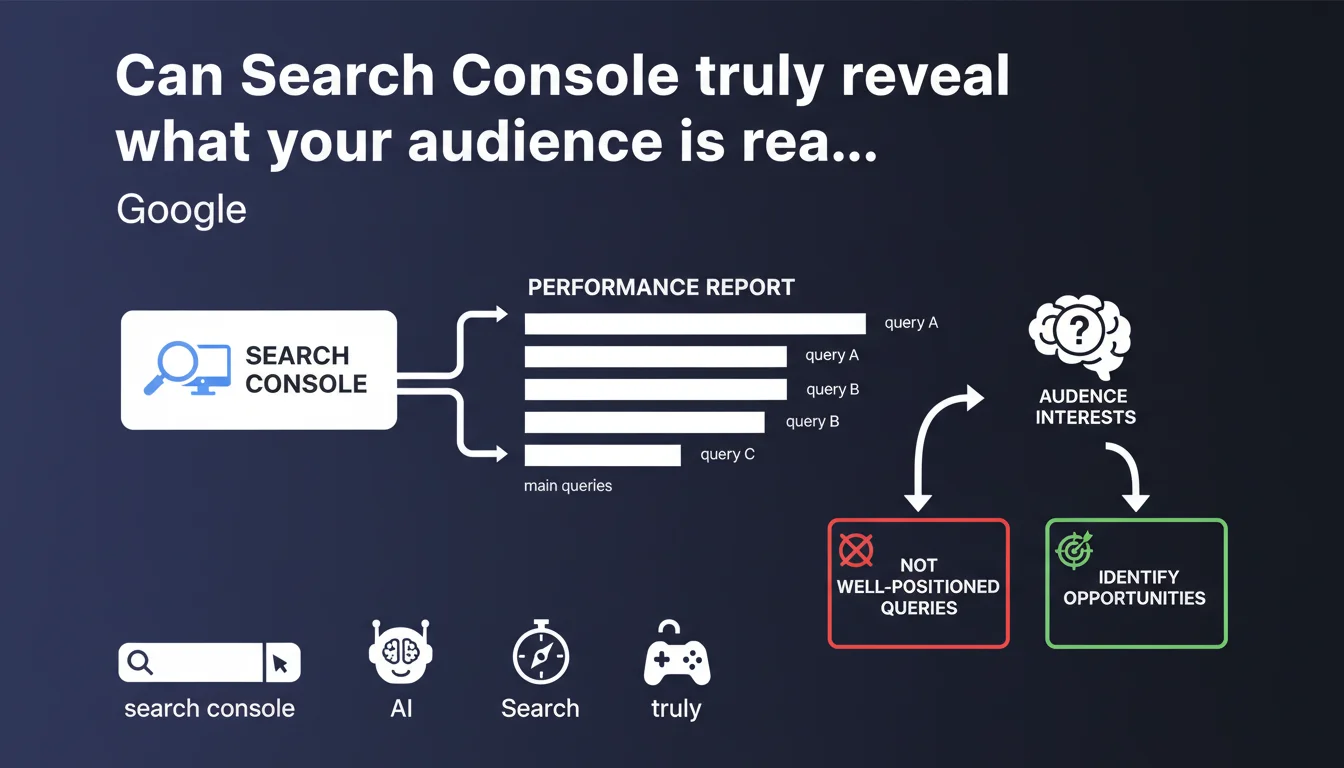
Google emphasizes that the Search Console performance report displays the main queries driving traffic to your site, allowing you to infer your audience's interests. The tool also identifies queries for which you should rank but don't — that's where your missed opportunities are hiding.
What you need to understand
What exactly is Google telling us with this statement?
Google is highlighting a basic Search Console feature that's often underutilized: the performance report as a behavioral analysis tool. By cross-referencing the queries that actually drive traffic with those showing your site without clicks, you get a map of your audience's real interests.
The idea is not to settle for checking average positions. You need to dig into impressions without clicks, queries with low CTR, positions between 5 and 20 — anything signaling insufficient presence on topics where you should belong.
Why speak of "inferred" interests rather than measured ones?
Because Search Console doesn't give you access to users' deeper intentions, only the queries actually typed that triggered an impression of your site. It's a behavioral proxy, not psychographic analysis.
You infer centers of interest by observing which formulations, angles, and variations generate engagement. It's indirect, but it's what Google offers you — and it's already huge if you know how to leverage it.
What's the difference from classical keyword analysis?
The planned keyword approach (via Keyword Planner, Semrush, Ahrefs) relies on estimated search volumes and CPCs. Search Console, on the other hand, shows you what actually works for your domain, with your current content, in your competitive context.
It's the difference between a projection and a diagnosis. One anticipates, the other corrects. Both are complementary, but Search Console grounds you in reality — what users actually do, not what they might do.
- The performance report displays real queries generating impressions and clicks on your site
- Identifying low-ranking queries reveals missed content opportunities
- It's a behavioral diagnostic tool, not a volume projection tool
- Audience interests are inferred through observation, not directly measured
- Complementary to classical keyword research tools, but grounded in your actual performance
SEO Expert opinion
Is this statement consistent with practices observed in the field?
Absolutely. But let's be honest: 95% of Search Console users just look at the top 10 queries and 5 most-viewed pages. They miss the tool's true potential, which lies in the intermediate layers — queries showing between 100 and 1,000 impressions per month with a CTR below 2%.
That's where topics hide for which you have budding legitimacy, but lack editorial depth or on-page optimization. Google is telling you: "We're showing you, but nobody's clicking — why?"
What nuances should be added to this official advice?
Google doesn't specify that interpreting Search Console data requires critical filtering. Some queries generate impressions because your site is vaguely relevant, not because you should rank for them. Not every impression is an opportunity.
Then there's the problem of query variant grouping. Search Console sometimes displays queries in singular, plural, with typos — all separately. If you can't intelligently aggregate them, you'll drown in statistical noise.
In what cases does this rule not apply fully?
On highly specialized sites where the audience is already ultra-targeted, off-topic queries can generate impressions without signaling a real opportunity. A tax law precedent site doesn't necessarily benefit from creating mainstream content about "how to pay less taxes."
Same for sites with strong brand notoriety: Search Console will show you tons of informational queries related to your name, but that says nothing about your deep thematic positioning. You then need to filter by intent type, not just by volume.
Practical impact and recommendations
What should you concretely do with this data?
Export the performance report for the last 12 months, then filter queries that generated over 50 impressions and fewer than 5 clicks. You get a list of topics where you're visible but not compelling — that's your priority editorial roadmap.
Next, cross-reference these queries with your existing pages. Does a page already cover the topic? If yes, optimize it (title, H1, structure, internal linking). If no, create dedicated content. Don't just "target" the query — answer the underlying intent.
What mistakes should you avoid when analyzing the performance report?
Don't focus solely on average positions. A position 8 can be excellent on an ultra-competitive query, catastrophic on a long-tail one. Context matters more than the raw number.
Another classic trap: confusing impression volume with search volume. Search Console tells you how many times you were displayed, not how many times the query was typed. If you're on page 5, you're capturing a tiny fraction of real volume.
And above all, don't treat all opportunities the same way. Prioritize based on thematic proximity, conversion potential, and ranking feasibility — not just impression volume.
How to verify you're exploiting Search Console correctly?
Ask yourself this question: how many editorial decisions have been made in the last 3 months based on Search Console data? If the answer is zero, you're not using it correctly.
Proper usage involves monthly monitoring of emerging queries (those jumping from 0 to hundreds of impressions), quarterly analysis of positioning gaps, and systematic correlation with your SEO actions (content updates, internal linking, technical optimizations).
- Export the performance report over 12 months for solid temporal vision
- Filter queries with high impressions + low CTR to identify quick-win opportunities
- Cross-reference with your existing pages to decide between optimization and content creation
- Aggregate query variants to avoid statistical noise
- Prioritize based on thematic proximity and business potential, not just volume
- Establish monthly monitoring of emerging queries to detect trends early
- Systematically correlate position changes with your recent SEO actions
🎥 From the same video 14
Other SEO insights extracted from this same Google Search Central video · published on 18/12/2025
🎥 Watch the full video on YouTube →
💬 Comments (0)
Be the first to comment.