
Official statement
Other statements from this video 14 ▾
- □ Robots.txt vs no-index : pourquoi tant de pros SEO mélangent encore ces deux mécanismes ?
- □ Faut-il vraiment optimiser tout le site après une mise à jour algorithmique ?
- □ Faut-il vraiment optimiser différemment son site pour les AI Overviews de Google ?
- □ Google Trends est-il vraiment un outil stratégique pour orienter sa ligne éditoriale SEO ?
- □ Comment Search Console peut-il vraiment révéler ce que cherche votre audience ?
- □ Le SEO est-il vraiment mort ou juste en train de muter sous nos yeux ?
- □ Comment la qualité du contenu influence-t-elle directement le taux d'indexation par Google ?
- □ Un sitemap suffit-il vraiment à garantir l'indexation de vos pages ?
- □ Votre CDN ou firewall bloque-t-il Googlebot sans que vous le sachiez ?
- □ Comment Google Trends utilise-t-il réellement le Knowledge Graph pour identifier les topics ?
- □ L'index Google a-t-il vraiment une limite de capacité ?
- □ Le marketing traditionnel est-il devenu indispensable pour ranker sur Google ?
- □ Les données structurées sont-elles vraiment inutiles pour le classement SEO ?
- □ Faut-il vraiment faire vérifier toutes vos traductions automatiques pour le SEO ?
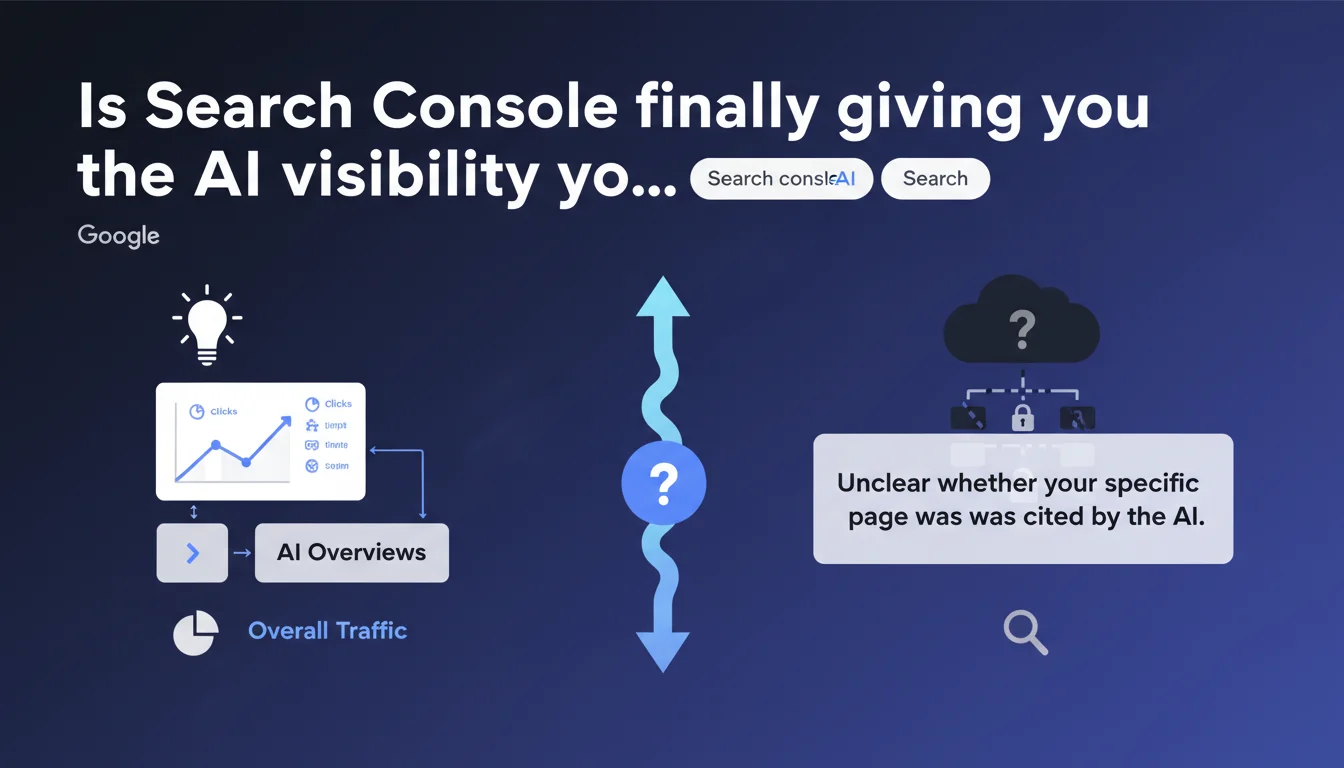
Search Console now shows clicks and impressions from AI features like AI Overviews. The problem: you can't tell if your page was specifically cited by the AI. You see overall traffic, but remain unclear about the exact nature of your visibility in these enriched results.
What you need to understand
What exactly does this Search Console update change for your strategy?
Google now integrates performance metrics related to AI features into Search Console, particularly AI Overviews that appear at the top of certain search queries. You can view clicks, impressions, CTR, and average position for your pages generating traffic through these channels.
The addition covers all traffic from these AI features. But—and this is where it gets tricky—you can't determine whether your page was explicitly cited by the AI or simply appears in the organic results below the Overview.
Why is this limitation a real problem for SEO professionals?
When your page generates impressions or clicks from a page with an AI Overview present, you don't know if it's because of the citation in the Overview or despite its presence. This opacity seriously complicates impact analysis.
In practice? You could see your impressions skyrocket without understanding whether the AI is promoting you or whether you're simply capturing residual traffic from users scrolling past the Overview.
What data is now accessible in the console?
- Clicks and impressions from pages with active AI features
- CTR and average position for these specific queries
- Total aggregated traffic, with no distinction between AI citation and standard organic results
- No metrics enabling you to identify an explicit citation in the AI Overview
SEO Expert opinion
Is this partial visibility consistent with Google's typical approach?
Absolutely. Google has always operated through gradual disclosure: you get access to data, but rarely at the maximum granularity you'd want. Remember the shift to "not provided" for organic keywords, or the persistent opacity around featured snippets.
This time, Google shows you there's AI-related traffic—likely to dodge accusations of silent cannibalization—but without letting you precisely assess the value of your citation. It's transparency with a catch: just enough to calm concerns without providing genuinely actionable optimization levers.
What risks does this lack of clarity pose to your analysis?
The main danger is over-interpreting trends. You spot a rise in impressions on queries where AI is active? Hard to know if it's a positive signal (you're being cited) or neutral (simple search volume increase).
Even worse: if your clicks stagnate while impressions climb, is it because the AI Overview answers the intent without a click, or because your organic position has slipped? Impossible to say with certainty.
Should you expect improvements to this tool?
Likely. Google tests, observes feedback, then refines. If industry SEO pressure is strong enough—and it is—we could see segmentation filters distinguishing AI citations from standard organic results emerge.
Until then, treat this update as a first step. Imperfect data beats no data—but keep its limitations in mind when reporting findings to clients or leadership.
Practical impact and recommendations
How can you leverage these new data points despite their shortcomings?
Start by identifying queries where you're generating traffic alongside AI Overviews. Compare their performance (CTR, bounce rate, conversions) against similar queries without active AI. That gives you an indirect measure of real impact.
Next, monitor trends over time. If your clicks drop sharply on these queries while impressions hold steady, that's probably a sign the Overview is cannibalizing your traffic—even if you can't prove it formally.
What mistakes should you avoid when interpreting these metrics?
Don't treat an impression spike as automatic success. Without context on the nature of your visibility (AI citation vs organic position), it's a misleading metric. Same goes for average position, which loses relevance when an AI block effectively occupies position zero.
Also avoid directly comparing these metrics to pre-AI Overview data. The search context has shifted: users see the AI first, then potentially your result. Click behavior is no longer the same.
What concrete steps should you implement right now?
- Enable query tracking generating traffic with AI features in Search Console
- Create dedicated segments in Analytics to isolate this traffic and analyze its behavior
- Document CTR variations on these queries compared to your historical baseline
- Test different content formats (structured FAQs, lists, clear definitions) to maximize citation chances
- Set up monthly monitoring to detect AI Overview emergence on your strategic queries
- Systematically cross-reference this data with third-party tools (SEMrush, Ahrefs) to validate observed trends
🎥 From the same video 14
Other SEO insights extracted from this same Google Search Central video · published on 18/12/2025
🎥 Watch the full video on YouTube →
💬 Comments (0)
Be the first to comment.