
Official statement
Other statements from this video 14 ▾
- □ Robots.txt vs no-index : pourquoi tant de pros SEO mélangent encore ces deux mécanismes ?
- □ Search Console intègre les données IA : mais savez-vous vraiment ce que vous mesurez ?
- □ Faut-il vraiment optimiser différemment son site pour les AI Overviews de Google ?
- □ Google Trends est-il vraiment un outil stratégique pour orienter sa ligne éditoriale SEO ?
- □ Comment Search Console peut-il vraiment révéler ce que cherche votre audience ?
- □ Le SEO est-il vraiment mort ou juste en train de muter sous nos yeux ?
- □ Comment la qualité du contenu influence-t-elle directement le taux d'indexation par Google ?
- □ Un sitemap suffit-il vraiment à garantir l'indexation de vos pages ?
- □ Votre CDN ou firewall bloque-t-il Googlebot sans que vous le sachiez ?
- □ Comment Google Trends utilise-t-il réellement le Knowledge Graph pour identifier les topics ?
- □ L'index Google a-t-il vraiment une limite de capacité ?
- □ Le marketing traditionnel est-il devenu indispensable pour ranker sur Google ?
- □ Les données structurées sont-elles vraiment inutiles pour le classement SEO ?
- □ Faut-il vraiment faire vérifier toutes vos traductions automatiques pour le SEO ?
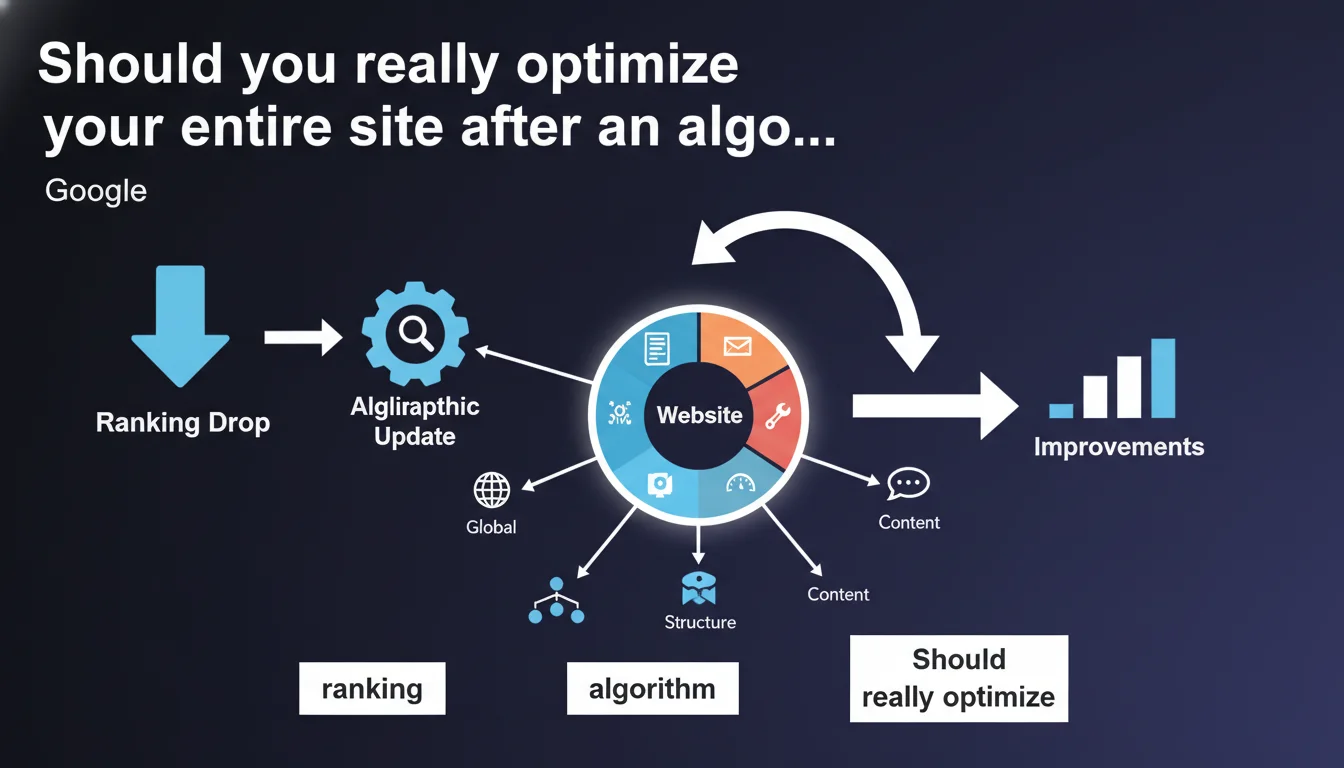
Google says that after a ranking drop caused by an algorithmic update, you need to work on your entire site, not just fix the impacted pages. A piecemeal approach isn't enough — overall quality is what matters. This vision requires a comprehensive audit and structural improvements rather than page-by-page patching.
What you need to understand
Why does Google insist on a global approach rather than a targeted one?
Major algorithmic updates — Core Updates, Helpful Content — now evaluate a site's overall quality, not just isolated pages. Google seeks to measure trustworthiness, expertise, and editorial consistency at the domain level.
In practice? If your site mixes solid content with weak or opportunistic pages, the algorithm can penalize the entire domain. Fixing three pages that dropped won't solve anything if the rest of the site continues to drag you down.
What does "improving your entire site" actually mean?
Google isn't saying "improve everything at random." It's about identifying systemic weaknesses: thin content mass-produced, duplicate pages, lack of updates, incoherent editorial structure, an abundance of low-value pages.
The goal is to raise the average quality level — and that often involves cleanup. Removing or consolidating weak content can be more effective than rewriting it.
Does this approach apply to all types of drops?
No. If your drop is tied to a technical issue (indexation, crawl), a manual penalty, or toxic backlinks, the global approach isn't the priority. Google is specifically talking about algorithmic drops related to content quality.
But be careful — even in this context, some highly specialized niches can suffer a targeted drop without the rest of the site being at fault. It's rare, but it happens.
- Core Updates evaluate a domain's overall quality, not page by page
- Fixing only impacted pages won't help if the entire site is perceived as mediocre
- Improvement often comes through cleanup and consolidation, not just rewriting
- This logic applies to algorithmic drops, not technical issues or manual penalties
SEO Expert opinion
Is this statement consistent with what we see in the field?
Yes — and it's actually one of the few points where Google is transparent. Since 2022, post-Core Update recovery cases show that global work performs better than a surgical approach.
I've seen sites recover after removing 30% of their pages and restructuring their architecture, without touching the pages that dropped. Conversely, sites that spent months optimizing their impacted pages one by one never recovered — because the problem was elsewhere.
What nuances should be added to this message?
Google isn't saying "do everything at once." A global audit doesn't mean launching a massive project overnight. Prioritize by impact: start by identifying the areas dragging you down most — zombie content, cannibalization, orphaned pages.
Another point — this global approach doesn't exempt you from deep work on strategic pages. If your main content is hollow or outdated, no peripheral cleanup will save you.
In what cases doesn't this rule fully apply?
On very large sites — media outlets, massive e-commerce — it's sometimes impossible to audit and fix "the entire site" in a few months. In that case, proceed by priority segments: strategic categories, high-traffic sections, identified low-quality zones.
But even then, you need a holistic view. Working in silos without understanding the site's overall dynamics remains ineffective.
Practical impact and recommendations
What should you do concretely after an algorithmic drop?
First, audit before acting. Identify weak pages, duplicate content, underperforming sections, zombie pages (zero traffic, zero backlinks). Cross-reference with your Analytics and Search Console data to spot problem areas.
Next, establish an action plan by priority: deletion/consolidation of weak content, rewriting strategic pages, improving editorial structure. Don't touch everything at once — but have an overall logic.
What mistakes should you absolutely avoid?
Don't just fix pages that lost traffic. This is the classic trap — you spend weeks optimizing three URLs when the problem stems from a mass of mediocre content elsewhere.
Also avoid mass deletion without analysis. Some pages seem weak but play a role in internal linking or capture useful long-tail traffic. Delete methodically, not reflexively.
How do you verify that improvements are working?
Monitor your overall organic traffic and impressions evolution in Search Console, not just a few pages. Post-Core Update recovery often takes several months — sometimes until the next update.
Also watch traffic distribution: if your strategic pages recover but others drop, your work isn't done.
- Conduct a comprehensive audit of content and editorial structure
- Identify and address zombie pages, duplicates, or low-value content
- Prioritize actions by potential impact, not ease of execution
- Develop editorial consistency and perceived site expertise
- Monitor overall organic traffic evolution over several months
- Don't rush — wait for the next update to measure real impact
🎥 From the same video 14
Other SEO insights extracted from this same Google Search Central video · published on 18/12/2025
🎥 Watch the full video on YouTube →
💬 Comments (0)
Be the first to comment.