
Official statement
Other statements from this video 14 ▾
- □ Why do so many SEO professionals still confuse robots.txt and no-index? Here's what you need to know
- □ Should you really optimize your entire site after an algorithmic update?
- □ Is Search Console finally giving you the AI visibility you need—or just keeping you in the dark?
- □ Do you really need to optimize your site differently for Google's AI Overviews?
- □ Is Google Trends really a strategic tool to guide your SEO editorial strategy?
- □ Can Search Console truly reveal what your audience is really searching for?
- □ Does content quality directly impact your Google indexation rate more than you think?
- □ Does a sitemap really guarantee that Google will index all your pages?
- □ Is your CDN or firewall silently blocking Googlebot without you even knowing it?
- □ Does Google really use the Knowledge Graph to identify topics in Trends, or is it just keyword grouping?
- □ Does Google's search index really have a hard capacity limit?
- □ Does traditional marketing really matter for ranking higher on Google?
- □ Does structured data really have no impact on your SEO rankings?
- □ Should you really have all your automatic translations checked for SEO purposes?
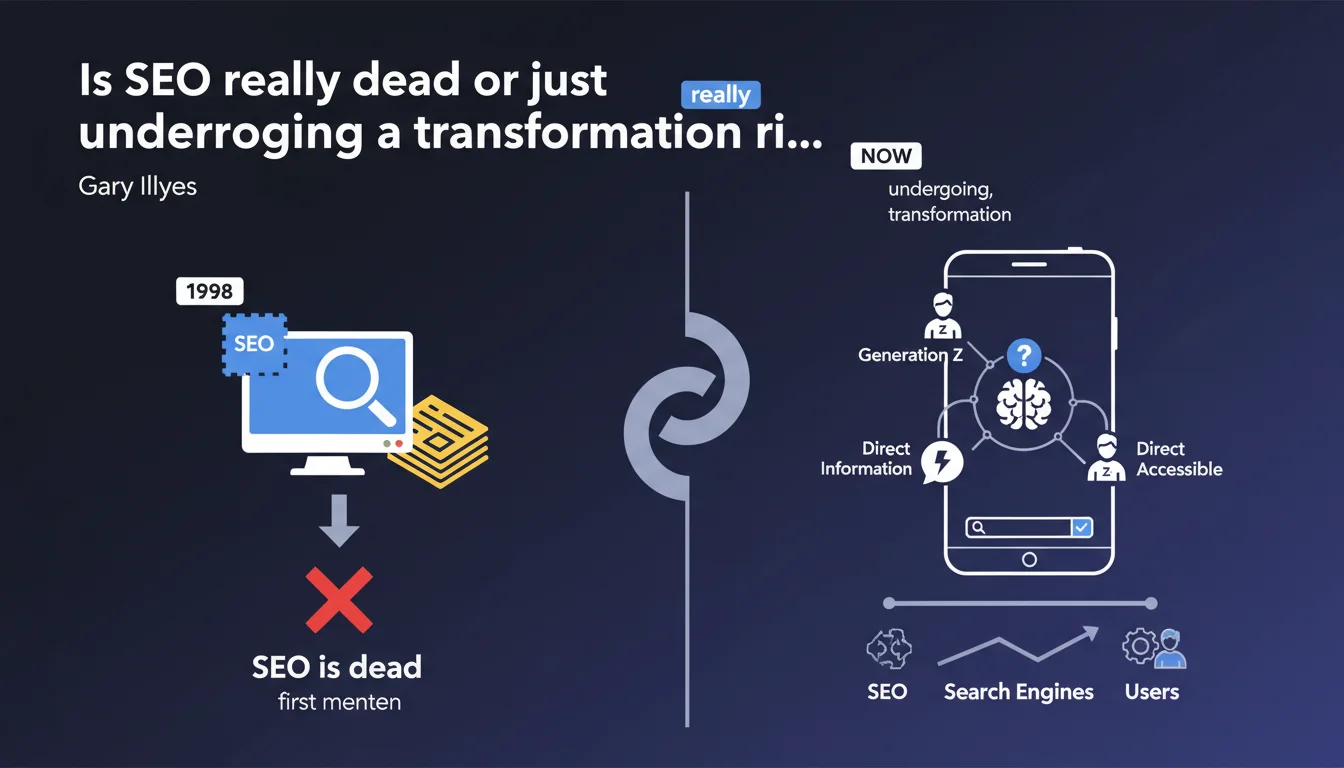
Google has been repeating what we've heard since 1998: SEO is not dead, it's transforming. This time, Gen Z is driving the changes, with a demand for more direct and accessible information. For practitioners, this means adapting content formats and rethinking user experience — not revolutionizing the entire discipline.
What you need to understand
Why is Google making this statement now?
Because the announcement of AI Overviews and the massive integration of generative AI into the SERP have reignited the anxiety-fueled debate: will SEO disappear? Gary Illyes reminds us that this fear is not new. It resurfaces with every major technological disruption.
Except this time, Google points to a specific player: Generation Z. This generation searches on TikTok, Reddit, or directly through AI assistants. They want fast, digestible, visual content — not necessarily a list of 10 blue links.
What does this actually change for us?
It confirms that the format of information becomes just as critical as its quality. Expert content that's difficult to digest risks losing to a short, clear, and well-structured answer. User experience takes precedence over pure semantic density.
Between the lines, Google is telling us: adapt to new modes of information consumption. If your audience is young, think video, infographics, FAQs, snippets. If it's professional, maintain depth but add breathing room.
SEO is evolving, but towards what exactly?
Towards a more multi-channel and multi-format SEO. We're no longer talking exclusively about text optimized for Googlebot. You need to think YouTube SEO, optimization for Reddit, presence on social platforms, and most importantly: visibility in AI-generated answers.
SEO becomes a discipline that must integrate content distribution, conversational UX, and data structuring to feed language models. It's less "dead" than "hybrid".
- Traditional SEO (links, content, technical) remains the foundation but is no longer sufficient on its own
- Short, visual, and interactive formats are gaining importance
- Gen Z is boosting voice search, video, and searches on third-party platforms
- Visibility in AI Overviews becomes a new SEO challenge
- Optimization must adapt to search behaviors, not the other way around
SEO Expert opinion
Is this statement consistent with what we observe in the field?
Yes — and no. Google's message is reassuring, but it masks a harsher reality: organic traffic is stagnating or declining for many sites since AI Overviews arrived. Clicks are increasingly captured upstream, in the SERP itself.
Saying that "SEO is evolving" is technically true. But concretely, it means that the rules of the game are changing without us having all the answers. Google is experimenting, formats are shifting, and meanwhile, some sites are losing 30 to 50% of their traffic without understanding why.
Is Gen Z really the primary driver of this transformation?
It's a convenient argument for Google, but it's reductive. Gen Z plays a role, certainly. But the real drivers of change are language models, monetization through direct answers, and competition from other platforms (TikTok, ChatGPT, Perplexity).
Google is using Gen Z as a narrative justification for transformations that primarily serve its own economic interests. Making information access simpler is good — but it's also a way to keep users within the Google ecosystem without them clicking elsewhere.
What opportunities are hidden behind this discourse?
If everyone panics and wonders if SEO has a future, those who anticipate new formats have a head start. Optimizing for featured snippets, structuring data for AI Overviews, creating indexable video content — all of this becomes differentiating.
The other opportunity is to diversify channels. If Google becomes less reliable as a traffic source, it's better to build your own audience through newsletters, YouTube, or a community on Discord/Reddit. SEO remains useful, but it should no longer be the only pillar.
Practical impact and recommendations
What should you do concretely right now?
First, audit your content to identify pieces that could be cannibalized by AI Overviews. If you have purely informational pages (definitions, basic guides), they risk losing traffic. Transform them into richer content with unique angles or exclusive data.
Next, test new formats: short videos, carousels, FAQs structured in schema.org. Data structuring becomes critical — if your content isn't understandable by language models, you won't exist in new search interfaces.
What mistakes should you avoid in this context of rapid evolution?
Don't panic and question everything at once. Technical SEO, quality backlinks, topical authority — all of this remains fundamental. Just because Google is introducing AI doesn't mean you should abandon the basics.
Another mistake: thinking that "adapting to Gen Z" means creating superficial content. Even young people seek depth and credibility when the subject matters. What they don't want is a poorly structured wall of text. Add whitespace, use illustrations, create hierarchy — but maintain substance.
How do you verify that your strategy remains aligned with these evolutions?
Track your visibility metrics in new SERP features: featured snippet appearances, presence in AI Overviews (when Google rolls them out widely), video coverage on YouTube. If you're only present in classic organic results, you're vulnerable.
Also analyze your click-through rates by query type. If your CTR drops on simple informational queries, it's because Google is answering directly in the SERP. Redirect your efforts toward higher-value queries.
- Audit your content most exposed to AI Overviews
- Strengthen data structuring (schema.org, FAQ, HowTo)
- Test short and visual formats for mainstream topics
- Diversify traffic sources (newsletters, YouTube, social media)
- Monitor CTR by query type and adjust editorial strategy
- Invest in topical authority and differentiating content
- Don't neglect fundamentals: technical SEO, backlinks, user experience
🎥 From the same video 14
Other SEO insights extracted from this same Google Search Central video · published on 18/12/2025
🎥 Watch the full video on YouTube →
💬 Comments (0)
Be the first to comment.