
Official statement
Other statements from this video 14 ▾
- □ Why do so many SEO professionals still confuse robots.txt and no-index? Here's what you need to know
- □ Should you really optimize your entire site after an algorithmic update?
- □ Is Search Console finally giving you the AI visibility you need—or just keeping you in the dark?
- □ Is Google Trends really a strategic tool to guide your SEO editorial strategy?
- □ Can Search Console truly reveal what your audience is really searching for?
- □ Is SEO really dead or just undergoing a transformation right before our eyes?
- □ Does content quality directly impact your Google indexation rate more than you think?
- □ Does a sitemap really guarantee that Google will index all your pages?
- □ Is your CDN or firewall silently blocking Googlebot without you even knowing it?
- □ Does Google really use the Knowledge Graph to identify topics in Trends, or is it just keyword grouping?
- □ Does Google's search index really have a hard capacity limit?
- □ Does traditional marketing really matter for ranking higher on Google?
- □ Does structured data really have no impact on your SEO rankings?
- □ Should you really have all your automatic translations checked for SEO purposes?
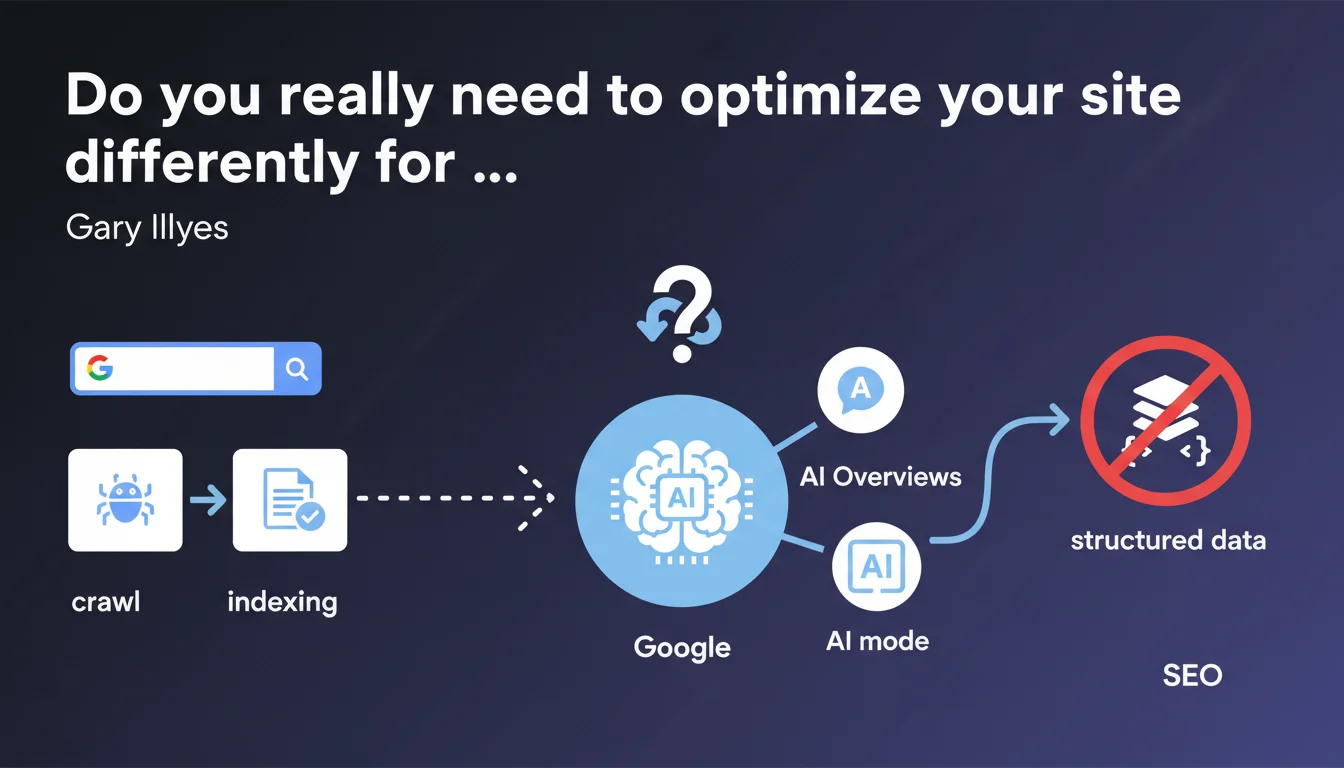
Google states that no specific SEO optimization is required to appear in AI Overviews or AI mode. The technical infrastructure remains identical to traditional search: crawling, standard indexing, no additional structured data needed. In short: what works for classic SEO works for AI.
What you need to understand
Google says "no additional optimization" — what does that actually mean in practice?
Gary Illyes' statement is crystal clear: the technical infrastructure underlying AI Overviews relies on the same crawling and indexing system as traditional organic search. No special crawler, no dedicated indexing queue, no secret new signals.
In other words, if your site is already properly indexed and crawled, it can potentially feed the answers generated by Google's AI. There is no separate technical silo for AI — it's the same engine running behind the scenes.
Why this clarification now?
Because the arrival of AI Overviews sparked predictable panic: some players started selling "AI optimization" services, miracle training programs, specific audits. Google is shutting down this drift.
The message is clear: no need to reinvent the wheel. SEO fundamentals — quality content, clean technical structure, authority — remain the pillars. AI doesn't change the technical game.
Which structured data is affected?
None new. Standard structured data (Schema.org, JSON-LD) continue to play their usual role: helping Google understand the context and content of your pages. But there is no specific "AI Overview" markup.
If you've already correctly implemented your schemas (FAQ, HowTo, Article, Product...), you're good. No new layer to add.
- Same technical infrastructure for crawling and indexing as classic SEO
- No additional structured data needed for AI Overviews
- No proprietary signals reserved for AI — standard quality criteria apply
- SEO fundamentals remain priority: content, technical, authority
SEO Expert opinion
Is this statement consistent with what we observe in the field?
Yes and no. On paper, Google is right: there is no exclusive technical lever to force an appearance in AI Overviews. But in practice, certain types of content are overrepresented.
Pages that frequently appear in AI Overviews share common traits: clear structure, direct answers, short paragraphs, well-formatted lists. This isn't "AI optimization" — it's common editorial sense. But denying that patterns exist would be dishonest.
Where is the nuance Google doesn't mention?
Google claims there's no "additional" optimization. Fair enough. But that doesn't mean all content has the same probability of being cited by the AI.
AI Overviews favor content that directly answers a question, that is factual, verifiable, structured. If your content is buried in corporate storytelling or indigestible walls of text, you'll miss out — even if technically you're indexed.
The real challenge is therefore not technical, but editorial and structural. And that's where many sites will need to revisit their copy.
Should you continue implementing structured data?
Absolutely. Even though Google claims there's no "AI Overview" schema, standard structured data remains a signal of quality and context. They facilitate semantic understanding — and therefore indirectly, information extraction by AI.
On the other hand, no need to launch into exotic or experimental implementations hoping for a magic effect. Focus on standard, well-documented, well-implemented schemas.
Practical impact and recommendations
What should you do concretely right now?
First step: audit the editorial quality of your content. Ask yourself: if an AI were to extract an answer from this page, which one would it extract? If the answer isn't obvious, you have a structure problem.
Second axis: verify that your technical fundamentals are solid. Crawlability, indexability, server response time, Core Web Vitals. If Google can't crawl or properly index your pages, the AI will never see them.
What mistakes to avoid at all costs?
Don't fall into the trap of "AI optimizations" sold as miracle solutions. No magic plugin, no secret tag. Google was clear: the infrastructure is the same.
Also avoid neglecting your existing content on the grounds that it already ranks well. Content can be well-positioned in classic organic but structurally unsuitable for AI extraction — too verbose, too vague, too promotional.
- Verify that all your strategic pages are properly indexed (Search Console, index coverage)
- Audit editorial structure: do your contents clearly answer specific questions?
- Ensure your standard structured data (FAQ, HowTo, Article) are properly implemented
- Test the clarity of your answers: can a human (or AI) extract the info in 2 seconds?
- Optimize crawlability: crawl budget, response time, internal linking
- Continue working on authority signals (backlinks, E-E-A-T) which remain decisive
How do you verify your site is ready for AI Overviews?
Test your content with typical queries in Google Search (activating AI mode if available in your region). Look at which sites appear in AI Overviews on your topics — and compare their editorial structure to yours.
If you spot a gap, it's often a problem of clarity and information breakdown, not pure technique. Restructure your content accordingly: short paragraphs, explicit subheadings, direct answers.
Google's statement is reassuring on one point: no need to revolutionize your technical stack to exist in AI Overviews. But it doesn't exempt you from revisiting your editorial and structural requirements.
Sites that will succeed are those that managed to combine solid SEO fundamentals with editorial clarity. These optimizations may seem simple on paper, but their implementation at scale — especially on complex or editorially fragmented sites — often requires expert insight and proven methodology. If you feel your organization lacks the resources or experience to carry out these projects in-house, calling on a specialized SEO agency can prove to be a strategic investment to secure your visibility in this changing environment.
🎥 From the same video 14
Other SEO insights extracted from this same Google Search Central video · published on 18/12/2025
🎥 Watch the full video on YouTube →
💬 Comments (0)
Be the first to comment.