
Official statement
Other statements from this video 14 ▾
- □ Why do so many SEO professionals still confuse robots.txt and no-index? Here's what you need to know
- □ Should you really optimize your entire site after an algorithmic update?
- □ Is Search Console finally giving you the AI visibility you need—or just keeping you in the dark?
- □ Do you really need to optimize your site differently for Google's AI Overviews?
- □ Can Search Console truly reveal what your audience is really searching for?
- □ Is SEO really dead or just undergoing a transformation right before our eyes?
- □ Does content quality directly impact your Google indexation rate more than you think?
- □ Does a sitemap really guarantee that Google will index all your pages?
- □ Is your CDN or firewall silently blocking Googlebot without you even knowing it?
- □ Does Google really use the Knowledge Graph to identify topics in Trends, or is it just keyword grouping?
- □ Does Google's search index really have a hard capacity limit?
- □ Does traditional marketing really matter for ranking higher on Google?
- □ Does structured data really have no impact on your SEO rankings?
- □ Should you really have all your automatic translations checked for SEO purposes?
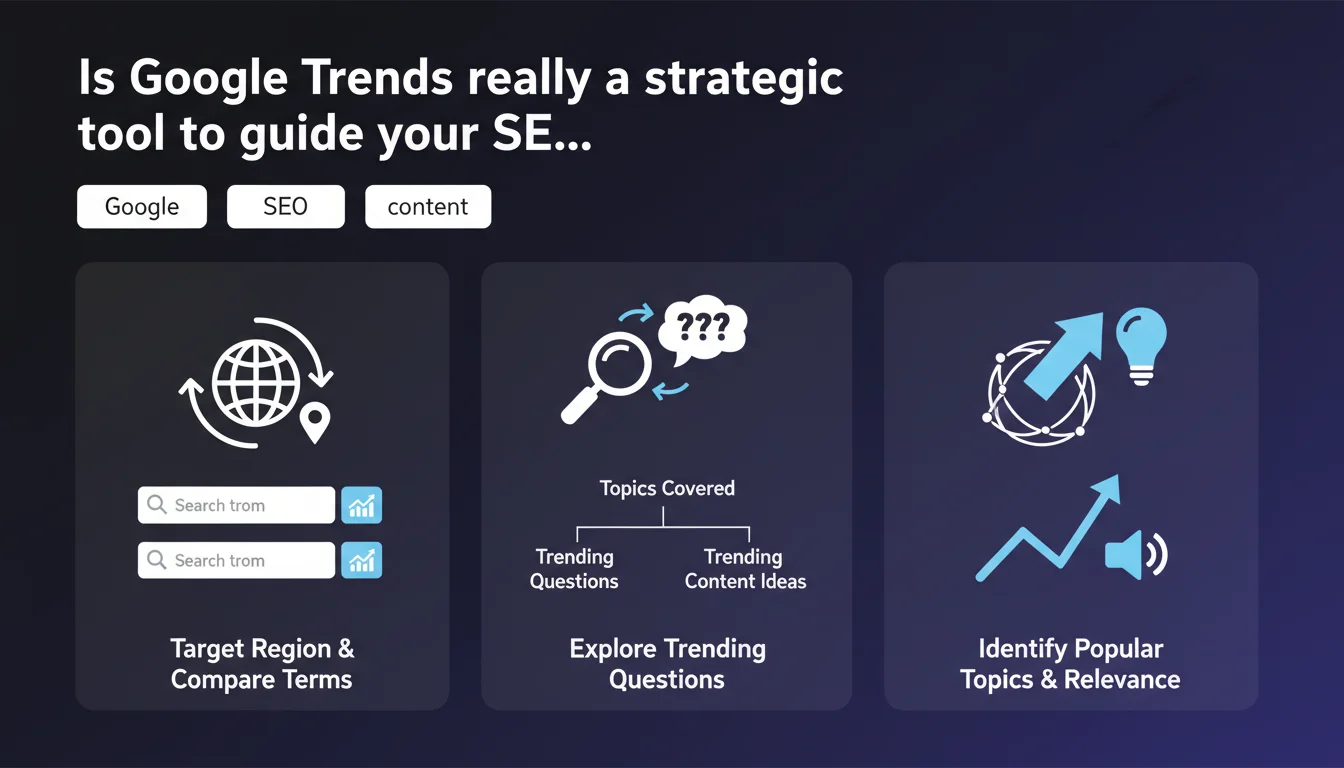
Google officially recommends content creators use Trends to identify topics that interest their audience. The tool allows you to configure a target region, compare terms, and explore trending questions. An indirect validation that editorial alignment with actual search queries remains a priority lever.
What you need to understand
Why is Google pushing this tool to content creators?
Google has a vested interest in ensuring creators produce content aligned with actual search intentions. Trends becomes a bridge between what users are searching for and what sites are publishing.
By steering editorial strategies toward topics that are actually being searched, Google narrows the gap between supply and demand — and mechanically improves the quality of indexed results. It's a win for everyone, except those producing blindly.
What features does Trends concretely offer to SEO professionals?
The tool enables three things: configure a target region to refine geographic relevance, compare terms and subjects to arbitrate between different editorial angles, and explore trending questions related to a topic.
This last feature is particularly useful for structuring FAQ content or identifying editorial angles that are underexploited. Trends becomes an opportunity radar rather than just a popularity barometer.
Does this official recommendation change anything for seasoned SEO professionals?
Not really. Most practitioners already use Trends — or more powerful tools. What changes is that Google explicitly legitimizes this approach.
This confirms that alignment with search trends is not a borderline technique, but an encouraged practice. For decision-makers who still doubt the usefulness of data-driven editorial monitoring, here's an authoritative argument.
- Trends allows you to identify popular topics among a specific audience
- Regional configuration refines the relevance of collected data
- Comparing terms helps prioritize topics to cover
- Trending questions reveal exploitable editorial angles
- Google officially validates the use of Trends as a strategic tool
SEO Expert opinion
Is Trends really enough to build a solid editorial strategy?
No. Trends gives you a macro view of trends, but it lacks the granularity needed for fine-tuned decisions. Search volumes are not displayed in absolute figures, only in relative indices.
For a robust editorial strategy, you need to cross-reference Trends with tools that provide actual volumes, difficulty levels, and SERP analysis. Trends is a scout, not a GPS.
What biases should you keep in mind when using Trends?
First pitfall: confusing ephemeral trends with evergreen topics. A search spike doesn't necessarily mean you should produce content about it — especially if the spike has already passed by the time your article is published.
Second pitfall: ignoring seasonality. Some topics explode at specific times of year. If you produce out of season, you risk publishing stillborn content that won't find its audience until six months later.
Third point: Trends doesn't distinguish between commercial and informational intent. A topic can be trending without offering interesting conversion potential.
Does this recommendation hide a Google strategy?
Probably. By pushing creators toward Trends, Google encourages them to produce reactive and demand-aligned content. This feeds the index with fresh content on hot topics.
But let's be honest: Google doesn't need to manipulate much. Creators who produce relevant, sought-after content will always have an edge. Trends is simply a tool that democratizes this approach.
Practical impact and recommendations
How do you integrate Trends into an existing editorial workflow?
Start by identifying your main topics, then set up alerts or weekly reviews on Trends for these subjects. The idea: detect weak signals before they become mainstream.
Then cross-reference Trends data with your Search Console. Look at whether trending terms match queries you're already ranking for — but poorly. These editorial quick-wins can quickly boost your visibility.
Finally, use the trending questions to enrich your existing content. Rather than systematically creating new pages, inject these questions into already-indexed articles. You increase their semantic coverage without diluting your architecture.
What mistakes should you avoid with Trends?
First mistake: producing content solely because a topic is trending, without checking the competition. If the SERP is saturated with ultra-authoritative sites, you're wasting your time.
Second mistake: ignoring consistency with your editorial line. Riding a trending wave outside your niche to capture traffic can harm your topical authority — and confuse your audience.
Third mistake: neglecting production time. If your editorial process takes three weeks, an ephemeral trend will already be dead before publication. Adapt your responsiveness to your operational constraints.
What should you do concretely today?
Set up a structured editorial monitoring process by integrating Trends into your routine. Don't consult it haphazardly — schedule regular reviews with clear selection criteria.
Document your editorial decisions. Note why you chose one topic over another, and measure the results. This allows you to refine your intuition over time.
- Configure Trends with your primary target region
- Systematically compare multiple terms before deciding
- Leverage trending questions to structure your content
- Cross-reference Trends with Search Console to identify quick-wins
- Check the SERP and competition before producing
- Stick to your editorial line — don't ride every trending wave
- Adapt your editorial responsiveness to the nature of detected trends
- Measure the impact of each piece of content produced from Trends
🎥 From the same video 14
Other SEO insights extracted from this same Google Search Central video · published on 18/12/2025
🎥 Watch the full video on YouTube →
💬 Comments (0)
Be the first to comment.