
Official statement
Other statements from this video 14 ▾
- □ Why do so many SEO professionals still confuse robots.txt and no-index? Here's what you need to know
- □ Should you really optimize your entire site after an algorithmic update?
- □ Is Search Console finally giving you the AI visibility you need—or just keeping you in the dark?
- □ Do you really need to optimize your site differently for Google's AI Overviews?
- □ Is Google Trends really a strategic tool to guide your SEO editorial strategy?
- □ Can Search Console truly reveal what your audience is really searching for?
- □ Is SEO really dead or just undergoing a transformation right before our eyes?
- □ Does content quality directly impact your Google indexation rate more than you think?
- □ Does a sitemap really guarantee that Google will index all your pages?
- □ Is your CDN or firewall silently blocking Googlebot without you even knowing it?
- □ Does Google really use the Knowledge Graph to identify topics in Trends, or is it just keyword grouping?
- □ Does Google's search index really have a hard capacity limit?
- □ Does structured data really have no impact on your SEO rankings?
- □ Should you really have all your automatic translations checked for SEO purposes?
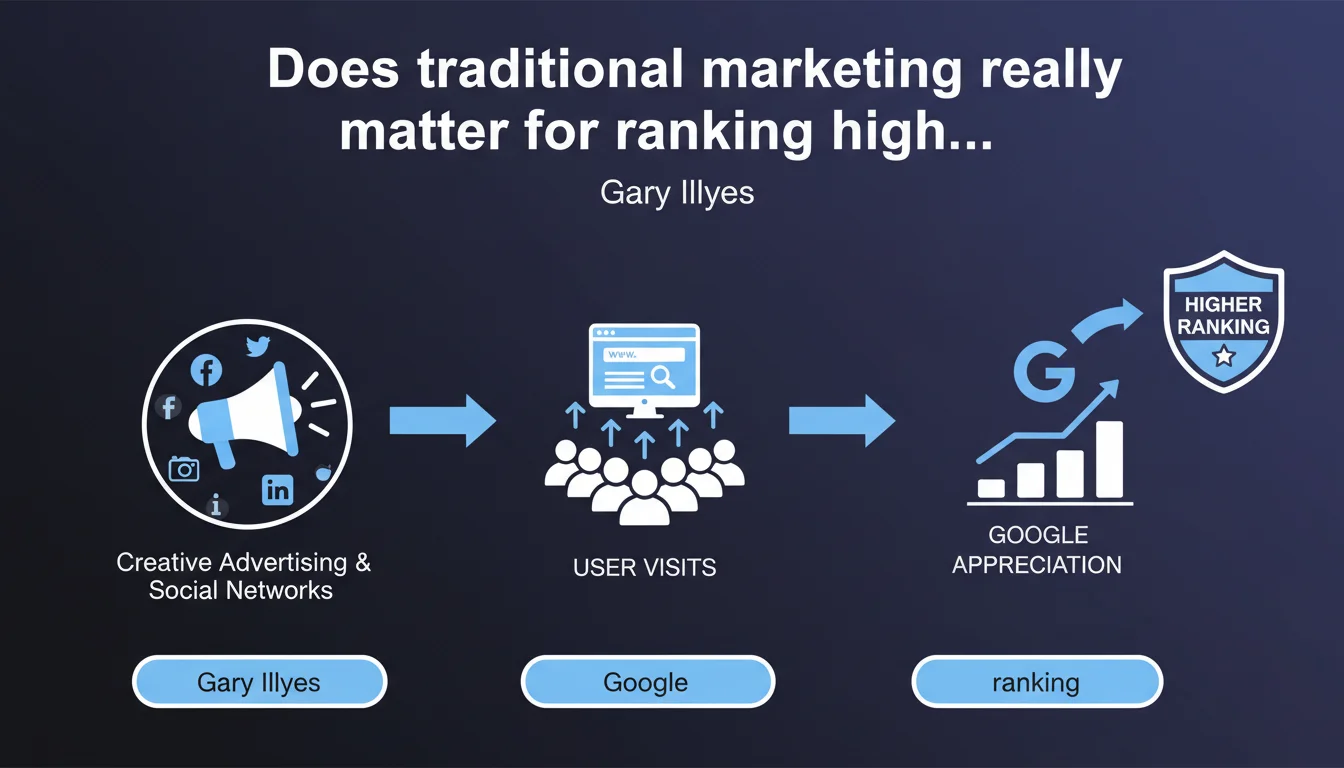
Google suggests that attracting direct traffic through classic marketing channels (social media, advertising) positively influences how the search engine perceives your site. In other words: if people visit your site 'naturally,' Google would be more inclined to appreciate it. A statement that blurs the line between SEO and traditional digital marketing.
What you need to understand
Does Google really reward direct traffic?
Gary Illyes suggests that organic visits — those that don't come from a Google query — can influence how the search engine perceives your site. The idea: a site that generates traffic through other channels demonstrates a certain authority and legitimacy.
Concretely? If your audience arrives via social networks, advertising campaigns, newsletters, or word-of-mouth, Google would see this as a trust signal. The underlying message: a good site doesn't depend solely on the search engine to exist.
What behavioral signals does Google really exploit?
Google has never officially confirmed using direct traffic as a ranking factor. Yet this statement opens the door to a hypothesis: behavioral data (via Chrome, Analytics, Android) could fuel indirect quality signals.
Repeat visits, time spent, interactions — all of this forms a bundle of clues. It's hard to prove direct causality, but the idea that Google completely ignores these metrics seems naive.
Why this statement now?
Context matters: competition is exploding, SERPs are saturated, and Google itself is pushing its own content (SGE, featured snippets, People Also Ask). Result: relying solely on SEO becomes risky.
Google is therefore officially encouraging diversification of traffic sources. An elegant way of saying: "Don't put all your eggs in our basket."
- Google suggests a link between direct traffic and how the engine appreciates your site
- Behavioral signals (repeat visits, engagement) could play an indirect role
- This position reflects a context of SERP saturation and increased competition
- Diversifying acquisition channels becomes a strategic necessity, not a bonus
SEO Expert opinion
Is this statement consistent with what we observe in the field?
Yes and no. On one hand, sites that generate traffic outside of Google often have better SEO performance. But is this cause or effect? A popular site naturally produces quality content, attracts backlinks, generates engagement — all of which boost SEO.
On the other hand, the idea that Google directly "rewards" social or paid traffic remains vague and unverifiable. No study proves that artificially boosting your direct traffic improves rankings. Correlation ≠ causality.
What risks does this approach carry?
Let's be honest: if you read this statement as "I'm going to buy bot traffic to simulate direct visits," you're on the wrong track. Google has the means to detect artificial patterns. What matters is traffic quality, not just volume.
Another common pitfall: diluting your efforts. Traditional marketing is expensive — in time, budget, and energy. If your basic SEO is shaky (fragile technical foundation, average content, questionable backlinks), investing heavily in paid social to "please Google" is like putting a band-aid on a broken leg.
In what cases does this logic really apply?
For established sites that already have a healthy SEO foundation, diversifying channels makes sense. You strengthen your resilience against algorithm updates, you build your own audience, you create diffuse authority signals.
However, for a new site or a project with limited resources, betting on paid marketing before you have solid SEO is like burning cash. Prioritize technical, content, and backlinks first. The rest will follow.
Practical impact and recommendations
What specifically should you do to take advantage of this dynamic?
First reflex: audit your current traffic sources. If 95% of your visits come from Google, you're in a fragile position. Develop complementary channels: newsletters, social media presence, partnerships, niche communities.
Second axis: create content that circulates outside Google. Infographics, original studies, free tools — anything that generates natural sharing and direct visits. The goal: build your own audience that returns without running a search query.
Third lever: exploit your behavioral data. If you have Analytics, look at engagement metrics (bounce rate, session duration, pages per visit). Optimize the experience to turn external visitors into repeat users.
What mistakes should you absolutely avoid?
Don't confuse quantity with quality. Buying 10,000 bot visits through a shady service will do nothing but pollute your stats and potentially trigger alerts at Google.
Another classic mistake: investing heavily in paid social without a conversion strategy. If visitors arrive and leave immediately, you're spending for nothing. External traffic must be qualified and engaged, otherwise it serves no purpose — neither for Google nor for you.
Finally, don't neglect message consistency. If your Instagram ad promises one thing and your landing page delivers another, bounce rate skyrockets. Google picks up on these signals.
How do you measure the impact of these efforts on your SEO?
Track the evolution of your organic rankings in correlation with your external traffic spikes. If you launch a successful social campaign, observe whether your positions improve in the following weeks. Warning: the effect is never immediate.
Use Google Search Console to spot queries where you're gaining impressions without modifying content. This can indicate a gain in authority linked to external signals.
Also monitor your backlinks. Good content shared on social networks often generates natural links — and that's pure SEO.
- Diversify your traffic sources: newsletters, social media, partnerships
- Create content designed to circulate outside Google (infographics, studies, tools)
- Optimize engagement of external visitors to encourage repeat visits
- Never confuse traffic volume with quality — Google detects artificial patterns
- Measure impact via Search Console, organic rankings, and behavioral data
- Ensure consistency between your marketing messages and landing pages
🎥 From the same video 14
Other SEO insights extracted from this same Google Search Central video · published on 18/12/2025
🎥 Watch the full video on YouTube →
💬 Comments (0)
Be the first to comment.