
Official statement
Other statements from this video 16 ▾
- □ Faut-il vraiment supprimer les balises meta keywords de votre site ?
- □ Faut-il modifier la date lastmod du sitemap à chaque mise à jour mineure ?
- □ Faut-il vraiment séparer les sitemaps news et généraux pour éviter les doublons d'URLs ?
- □ Pourquoi Google ignore-t-il votre meta description alors que vous l'avez soigneusement rédigée ?
- □ Faut-il vraiment nettoyer les backlinks spammés de votre profil de liens ?
- □ Faut-il encore optimiser la densité de mots-clés pour le SEO ?
- □ Le désaveu de liens suffit-il à récupérer vos positions perdues après une pénalité ?
- □ Pourquoi les redirections 301 restent-elles le nerf de la guerre lors d'un changement de domaine ?
- □ Un code 404 ciblé sur Googlebot peut-il bloquer l'indexation de vos pages ?
- □ Faut-il vraiment avoir le même contenu sur mobile et desktop pour l'indexation mobile-first ?
- □ Faut-il vraiment demander la suppression des URLs redirigées de l'index Google ?
- □ Vérifier son site dans Search Console améliore-t-il vraiment son référencement ?
- □ Pourquoi Google refuse-t-il le contenu multilingue dynamique sur une même URL ?
- □ Les liens footer « Made by X » sont-ils vraiment sans danger pour votre SEO ?
- □ Comment configurer correctement les balises canonical et alternate pour un site m-dot ?
- □ Les données EXIF des images sont-elles inutiles pour le SEO ?
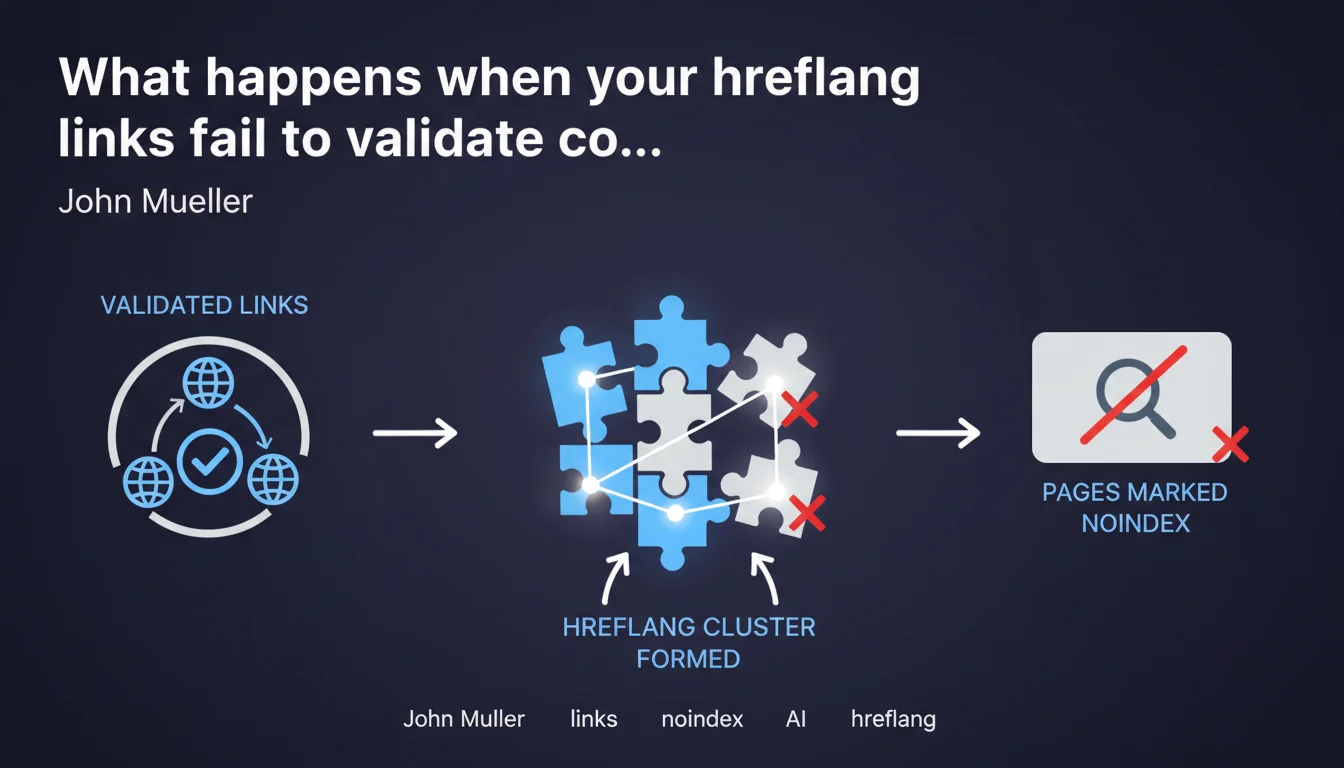
Google forms hreflang clusters only with the links it successfully validates. A broken or invalid hreflang link is simply excluded from the cluster — but it doesn't prevent cluster creation with the other valid links. Pages marked noindex are never eligible, even with correct hreflang tags.
What you need to understand
How does Google build an hreflang cluster?
Google treats hreflang attributes as clustering signals: each page declares its language or regional variants, and the engine attempts to form a coherent set.
If a page references five variants via hreflang, but only one fails validation (inaccessible URL, redirect, missing return tag), Google doesn't give up. It forms the cluster with the four validated links and silently ignores the fifth.
Why might an hreflang link fail validation?
The reasons are multiple: the target page returns a 404 or 5xx error, it redirects without confirming the return link, or the reciprocal tag is missing or malformed. Google requires bidirectional validation — each page must point back to the other.
An orphaned hreflang link (not confirmed by the target page) is treated as unreliable and disappears from the cluster. But the other links remain operational.
What about pages marked noindex?
A page marked noindex is excluded from Google's index — it cannot therefore appear in an hreflang cluster. Even if the tags are technically correct, Google cannot offer a variant it refuses to index.
This is a common mistake: deploying hreflang on staging or pre-production pages still marked noindex. The cluster remains incomplete until all variants are indexable.
- Hreflang clusters form with validated links only
- An invalid link is simply ignored, without blocking others
- Pages marked
noindexare never eligible for clusters - Validation is bidirectional: each page must confirm the return link
SEO Expert opinion
Is this statement consistent with real-world observations?
Yes — and that's reassuring. Too many SEO professionals still think a single broken hreflang link can collapse the entire system. In reality, Google handles errors in a granular manner: it doesn't penalize the whole setup for one failing variant.
That said, Search Console doesn't always clearly report which specific link failed. You sometimes see generic alerts without details about the problematic page or language — which complicates debugging. [To verify]: the granularity of GSC reports varies by site; some benefit from more detailed logs than others.
What nuances should be noted?
This statement says nothing about the validation timeline. If you fix a broken hreflang link, how long before Google attempts revalidation? Field observations show it can take several weeks, especially on sites with limited crawl budget.
Another point: Mueller mentions "validation" but doesn't specify whether Google tolerates 301/302 redirects in the hreflang chain. Field tests suggest yes — but with caution. A redirect to a URL that itself redirects elsewhere can break validation.
When does this rule not apply?
If no hreflang link validates — for example, on a new site where all variants are still noindex — then no cluster exists. Google treats each page in isolation.
Similarly, if you mix HTML <link> tags and HTTP headers, inconsistencies can appear. Google generally prioritizes HTTP headers, but in case of conflict, behavior becomes unpredictable. It's better to choose one method and stick with it.
Practical impact and recommendations
What should you check first on your hreflang clusters?
Start by identifying links that fail validation. Search Console offers an "Internationalization" report — but it often lacks detail. Supplement with a full crawl (Screaming Frog, OnCrawl) to detect error URLs, redirects, or missing tags.
Also verify that all declared variants are indexable: no noindex, no canonical to another language, no robots.txt blocking. Any single one of these conflicting signals is enough to break validation.
How do you fix an incomplete hreflang cluster?
For each invalid link detected, trace back: does the target page exist? Does it return a 200 HTTP status? Does it contain the reciprocal hreflang tag pointing back to the source page?
If a variant is temporarily unavailable, remove it from the hreflang tags rather than leaving a dead link. Google will form a cluster with the active variants — you can reintegrate the missing variant later, once it's stabilized.
- Audit hreflang tags via Search Console + technical crawl
- Verify that each declared URL returns a 200 status
- Confirm the presence of reciprocal tags on each variant
- Eliminate any
noindex, cross-language canonical, or robots.txt blocking - Test redirects: limit to 1 hop maximum in the hreflang chain
- Re-audit after fixes: Google may take several weeks to revalidate
An incomplete hreflang cluster doesn't block valid variants — but it deprives your users of important language alternatives. The key: maintain strict consistency across all declared pages.
On complex multilingual architectures (multiple ccTLDs, subdomains, hybrid subdirectories), these checks quickly become time-consuming. If your setup includes more than ten languages or you encounter recurring errors that are hard to diagnose, working with an SEO agency specialized in internationalization can save you precious time — and prevent traffic losses from poorly formed clusters.
❓ Frequently Asked Questions
Un lien hreflang cassé peut-il pénaliser tout mon cluster ?
Peut-on utiliser hreflang sur une page en noindex ?
Combien de temps faut-il pour qu'un lien hreflang corrigé soit validé ?
Les redirections 301 cassent-elles la validation hreflang ?
Faut-il déclarer toutes les variantes sur toutes les pages ?
🎥 From the same video 16
Other SEO insights extracted from this same Google Search Central video · published on 31/01/2023
🎥 Watch the full video on YouTube →
💬 Comments (0)
Be the first to comment.