
Official statement
What you need to understand
Why Does This Page Load Time Question Lead to Confusion?
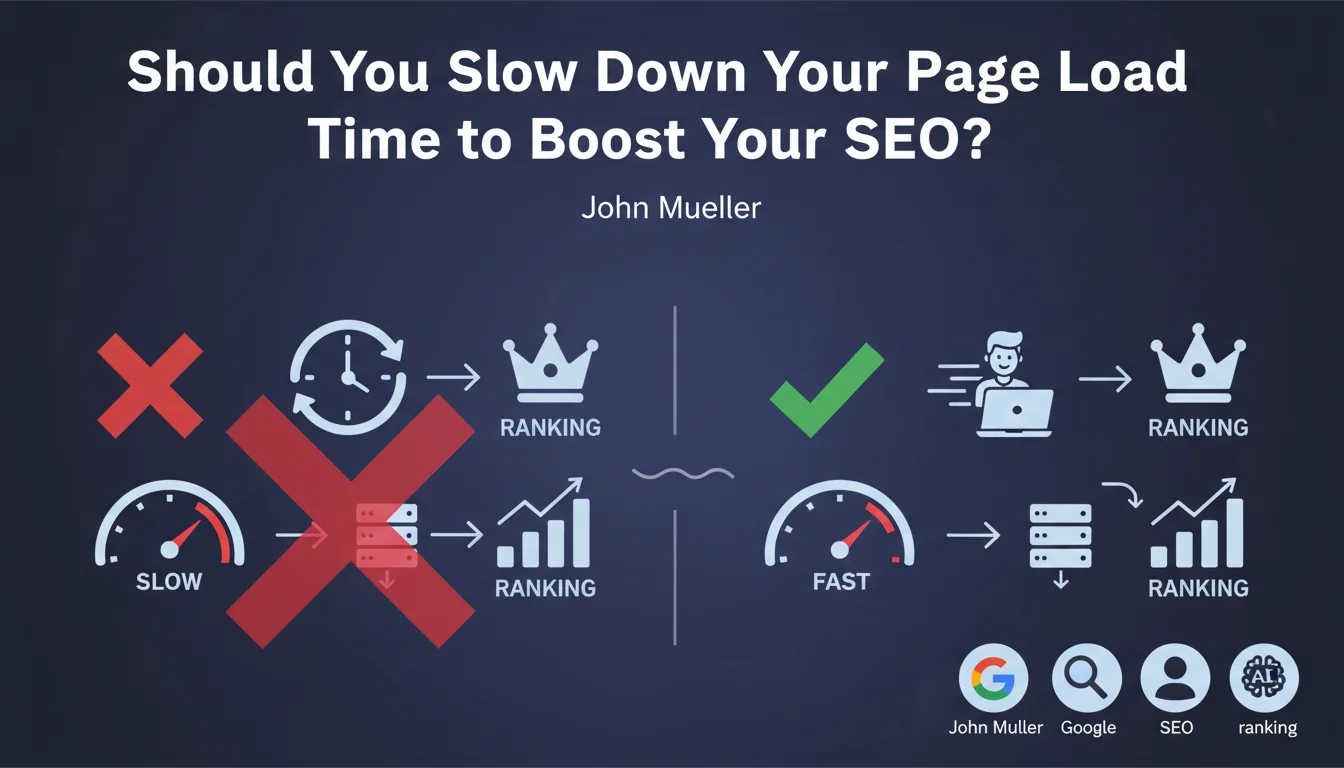
A persistent myth circulates in the SEO community: deliberately slowing down page loading to increase time spent on site and thus improve rankings. This confusion stems from a misinterpretation of user engagement signals.
Google has debunked this idea numerous times. Fast load time is actually a positive factor for SEO, while time spent on a page is not directly used as a ranking criterion.
What Is Google's Official Stance on Load Time?
Google is categorical: a fast site provides a better user experience. Core Web Vitals, integrated into ranking signals since 2021, specifically reward sites that load quickly.
The goal is to minimize user wait time, not to artificially increase it. Slow loading generates frustration, increases bounce rate, and degrades the overall experience.
Is Time Spent on Site Really a Ranking Factor?
No, session duration is not a direct ranking factor. Google uses more sophisticated signals to evaluate the relevance and quality of a page.
However, quality content that naturally retains users' attention sends indirect positive signals. The important thing is that this retention is organic, never artificial.
- Loading speed is a confirmed ranking factor (Core Web Vitals)
- Time spent on page is not a direct ranking criterion
- Deliberately slowing down a site harms user experience and SEO
- Engagement signals must be natural and organic
- Google always prioritizes speed and performance
SEO Expert opinion
Does This Statement Align with Real-World Observations?
Absolutely. My 15 years of experience confirm that fast sites perform better in SERPs. I've observed significant ranking improvements after speed optimizations, never the opposite.
Analytics data also shows an inverse correlation: the slower a site, the higher the bounce rate. Users leave pages before they even finish loading, which sends negative signals to Google.
What Nuances Should Be Applied to This Rule?
Speed should not sacrifice content quality. An ultra-fast site that's empty of substance won't rank better than a slightly slower competitor rich in relevant content.
The optimal balance consists of combining technical performance and informational value. Core Web Vitals are one factor among others, not the sole ranking criterion.
In What Contexts Is This Confusion Particularly Dangerous?
E-commerce sites are particularly vulnerable to this myth. Some think that slowing down the purchase journey will increase time spent and improve SEO. Exactly the opposite happens.
Media sites can also fall into this trap by adding artificial delays or superfluous animations. Every millisecond counts, especially on mobile where users' patience is even more limited.
Practical impact and recommendations
What Should You Do Concretely to Optimize Speed?
Focus on improving Core Web Vitals: LCP (Largest Contentful Paint), FID (First Input Delay), and CLS (Cumulative Layout Shift). These metrics measure the actual performance perceived by the user.
Use tools like PageSpeed Insights, Lighthouse, or WebPageTest to identify bottlenecks. Optimize images, reduce unnecessary JavaScript, enable caching, and use a CDN.
For content, prioritize quality and relevance rather than tricks to artificially retain visitors. Engaging content speaks for itself.
What Mistakes Should You Absolutely Avoid?
Never intentionally slow down your site under the pretext of increasing session time. It's counterproductive and directly penalizes your SEO.
Avoid intrusive popups, heavy animations, or multiple redirects that degrade user experience. Google penalizes these practices, particularly on mobile.
Don't neglect continuous monitoring of your performance. A fast site today can become slow tomorrow with the addition of new plugins or content.
- Regularly measure your Core Web Vitals via Google Search Console
- Optimize images (compression, WebP formats, lazy loading)
- Minimize and defer loading of non-critical JavaScript
- Enable Gzip/Brotli compression on your server
- Implement an effective caching system
- Use a CDN to distribute your static content
- Test speed on mobile and desktop regularly
- Create quality content that naturally retains attention
- Monitor bounce rate and real engagement metrics
- Prioritize user experience in all your technical decisions
💬 Comments (0)
Be the first to comment.