
Official statement
What you need to understand
What Was the Question Asked to John Mueller?
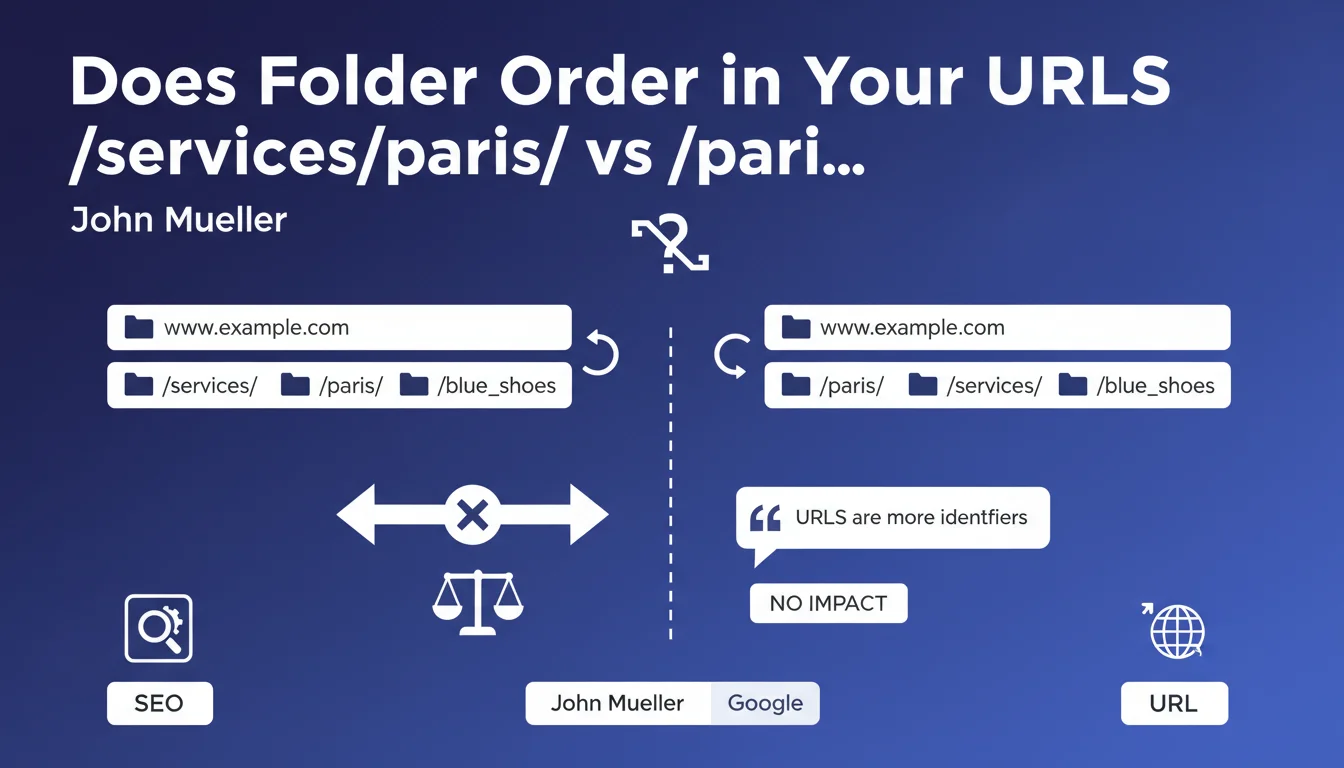
An SEO practitioner asked John Mueller about the impact of folder order in URL structure. Specifically: should you prioritize /services/location/ or /location/services/ to optimize your ranking?
Mueller's answer is clear: the order of directories in the URL does not matter to Google. He specifies that URLs are primarily used as unique identifiers, with a few rare exceptions.
How Does Google Really Interpret URLs?
Google considers URLs primarily as resource identifiers, not as complex hierarchical indicators. The algorithm does not give more weight to a folder placed before or after another in the structure.
This approach considerably simplifies URL management for webmasters. Google focuses on page content and contextual signals rather than on the position of segments in the URL.
What Are the "Rare Exceptions" Mentioned?
Mueller mentions exceptions without detailing them precisely. These specific cases likely concern keywords present in the URL (which have a slight impact), the overall length, and user readability.
- Folder order (/a/b/ vs /b/a/) does not impact SEO according to Google
- URLs primarily serve as unique identifiers for pages
- Google focuses on content and context rather than directory structure
- A few exceptions exist regarding keyword presence and readability
- This clarification simplifies information architecture decisions
SEO Expert opinion
Is This Statement Consistent with Practices Observed in the Field?
After 15 years of experience, I can confirm that folder order has never shown measurable impact in my tests. Sites with /city/service/ do not systematically outperform those with /service/city/, and vice versa.
What truly matters is the overall consistency of your architecture. A site that constantly changes its URL structure will create canonicalization and duplicate content problems, far more damaging than segment order.
What Important Nuances Should Be Added to This Statement?
Caution: saying that order doesn't matter does not mean that URL structure is negligible. Keywords present in the URL still have a slight relevance signal, even though their weight has decreased over the years.
URL depth (number of levels) also remains a factor. A page at 6 levels (/a/b/c/d/e/f/) will generally be considered less important than a page at 2 levels (/a/b/), regardless of the chosen order.
In What Contexts Could This Rule Have Exceptions?
For multilingual or multi-country sites, the position of the language/country code (/fr/ vs /fr-ca/) can have implications for geographic targeting. Google uses these indicators to determine the geographic target of content.
For very large sites (e-commerce, marketplaces), URL structure can influence crawl budget. A logical hierarchy helps Googlebot understand the relative importance of sections, even if the specific order of folders remains secondary.
Practical impact and recommendations
What Should You Concretely Optimize in Your URLs if Order Doesn't Matter?
Focus on readability and consistency. Your URLs should be understandable by a human reading them in search results or in the address bar.
Include relevant descriptive keywords without over-optimization. A URL like /plumber-paris-15/ is clear, while /plumber-cheap-emergency-paris-15-repair/ is counterproductive.
Favor a flat structure when possible. The fewer levels between the root and your page, the better for crawling and understanding page importance.
What Common Mistakes Should You Absolutely Avoid?
Never change your existing URL structure just to modify folder order. The benefits would be zero, but you would lose link equity and create redirection problems.
Avoid URLs that are too long (more than 75-80 characters), even if order doesn't matter. Excessive length harms user experience and can be truncated in SERPs.
Don't use unnecessary dynamic parameters (?id=123&sort=asc) when a static, clean URL is possible. Google handles them, but they complicate crawling and reduce click-through rate.
How Can You Audit and Improve Your Existing URL Structure?
Use Screaming Frog or a similar tool to extract all your URLs and analyze their structure. Identify inconsistencies, overly long URLs, and pages too deep in the hierarchy.
Check in Search Console which URLs are actually indexed and crawled. Focus your optimization efforts on strategic sections of your site.
- Adopt a consistent naming convention for all your URLs and document it
- Limit depth to 3-4 levels maximum for your important pages
- Include 1-2 descriptive keywords in each URL without over-optimization
- Use hyphens (-) as separators, never underscores (_)
- Avoid special characters, accents, and uppercase letters in your URLs
- Implement permanent 301 redirects if you need to modify URLs
- Create an XML sitemap that faithfully reflects your URL structure
- Test readability: a URL should be memorable and easily pronounceable
💬 Comments (0)
Be the first to comment.