
Official statement
What you need to understand
Where does this confusion between email and SEO come from?
Many website owners wonder if using business emails different from their domain name could harm their rankings. This concern stems from confusion between trust signals and direct ranking factors.
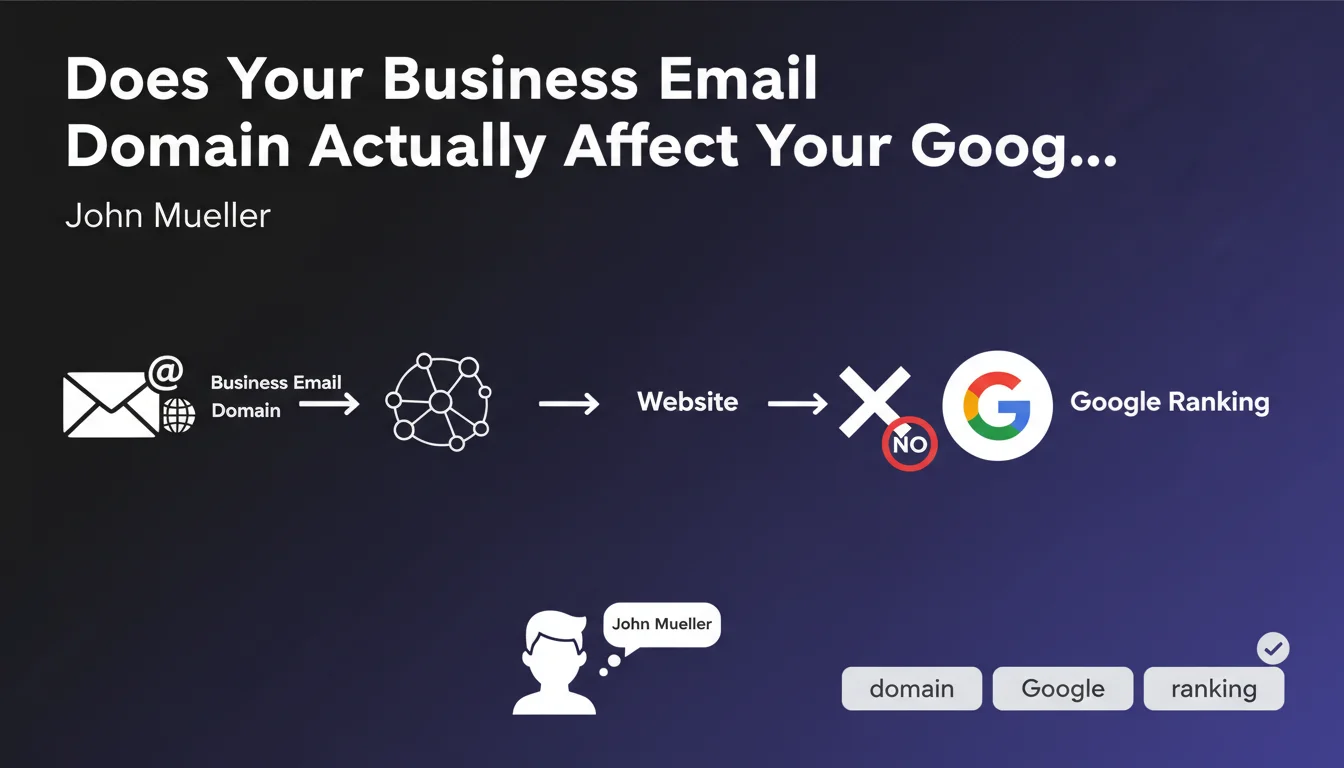
John Mueller clarified this point on Reddit: Google does not penalize a site whose professional email addresses use a different domain from the main website.
Why is this practice so widespread without consequences?
In reality, many businesses use third-party solutions for their email (Gmail, Outlook, etc.) with different domains. Others own multiple brands with distinct domains.
Google fully understands this entrepreneurial reality. Its algorithm focuses on quality signals far more relevant than matching email and website domains.
What are the real trust factors for Google?
- Content quality and its relevance to users
- Natural backlinks from authoritative sites
- User experience and Core Web Vitals
- Site security (HTTPS, absence of malware)
- E-E-A-T signals: experience, expertise, authoritativeness, and trustworthiness
- Consistency of NAP information (name, address, phone) for local SEO
SEO Expert opinion
Is this statement consistent with practices observed in the field?
After 15 years of observation, I completely confirm this position. I've audited hundreds of well-ranked sites using external emails (Gmail, Protonmail, etc.) without any measurable negative impact.
The positive correlations observed between professional emails and good rankings are explained differently: serious sites generally invest in all aspects of their online presence, including professional emails, but this is not a causal factor.
Are there cases where email can indirectly affect SEO?
While email is not a direct ranking factor, it can have indirect impacts in certain specific contexts. The nuance is important to understand.
For local SEO, information consistency on Google Business Profile matters. For E-E-A-T, a professional email reinforces credibility perceived by users. For outreach campaigns, a consistent email improves response rates for backlink acquisition.
What are the real SEO priorities you shouldn't neglect?
This clarification allows you to refocus your efforts on what truly matters. Too many webmasters waste time on details without impact at the expense of fundamentals.
Focus on your content quality, technical optimization, natural link acquisition, and user experience improvement. These elements generate measurable results, unlike cosmetic details.
Practical impact and recommendations
What should you actually do with this information?
If you were already using third-party emails (Gmail, Outlook), continue without worry. Your time and budget will be better invested in optimizing truly impactful factors.
If you were hesitating to invest in professional email hosting solely for SEO, this expense is not a priority. Prioritize investments in content creation or technical improvements.
How can you reallocate your SEO resources effectively?
This clarification allows you to redefine your budget priorities. Money saved on non-impactful aspects can fund truly effective actions.
- Audit your existing content and identify pages to optimize or update
- Analyze your Core Web Vitals and fix technical performance issues
- Develop a content strategy based on actual search intent
- Invest in acquiring quality backlinks through natural partnerships
- Optimize your internal linking for better link equity distribution
- Improve mobile user experience and conversion rate
What strategic mistakes should you avoid in SEO?
This statement illustrates a common trap: focusing on micro-optimizations without impact at the expense of overall strategy. SEO myths persist and divert attention from real levers.
Be wary of unsourced advice and focus on official statements from Google. Always validate the actual impact of an optimization before dedicating significant resources to it.
💬 Comments (0)
Be the first to comment.