
Official statement
Other statements from this video 9 ▾
- □ Why is Google finally giving you hourly performance data in Search Console?
- □ Should you really monitor new Search Console recommendations to avoid indexation penalties?
- □ Why does Google set the crawl alert threshold at 5% in Search Console?
- □ Why is Google deploying two separate core updates at the same time?
- □ Does Google's new website abuse policy actually change the rules of the SEO game?
- □ What exactly is a Google spam update and how can you effectively protect your site from it?
- □ Should you remove Sitelink Search Box structured data now that Google ignores it?
- □ Why do 84% of websites actually have a robots.txt file?
- □ Is your crawl budget being wasted? Here's what Google just revealed about how Googlebot really explores your pages
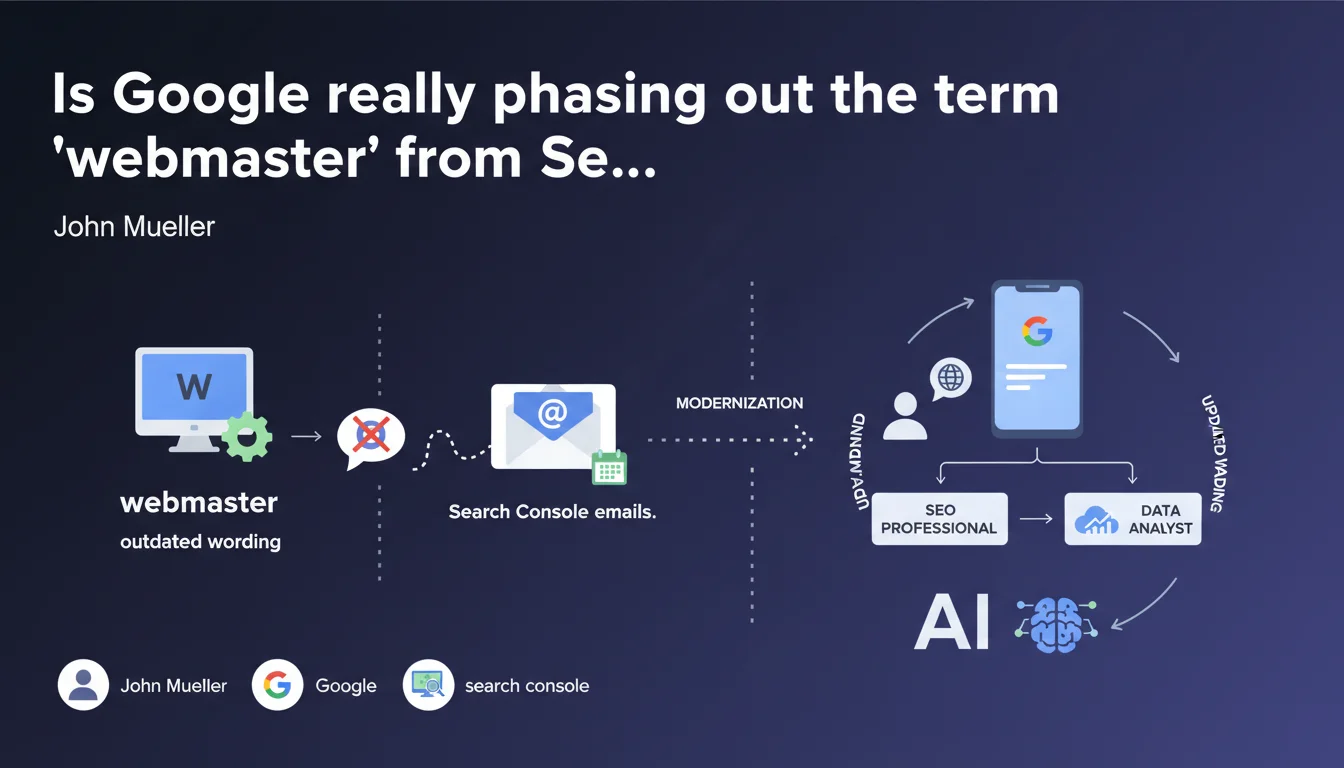
Google is modernizing the design of its Search Console emails and gradually removing the term 'webmaster' from its communications. This cosmetic change reflects the evolution of industry terminology, but brings no functional modifications to the tool. Bottom line: your notifications will have a fresh new look, that's it.
What you need to understand
Google has decided to refresh the appearance of emails sent via Search Console. Stated objective: a more unified and modern design. At the same time, the company is revising its wording to abandon the term "webmaster", deemed outdated.
For an SEO practitioner, this is an operational non-event. No impact on the data reported, alerts, or Search Console functionality. Just a fresh coat of paint.
Why is Google dropping the term 'webmaster'?
The word "webmaster" evokes an era when a single person managed a website from A to Z — code, content, technical aspects. Today, SEO teams are specialized: developers, content managers, analysts. The term no longer reflects the reality of the profession.
Google is aligning with this semantic evolution. The company now prefers neutral terms like "site owner" or "administrator". This is consistent with its desire to make its tools accessible to a wider audience.
Does this change modify how Search Console operates?
No. Zero functional modifications. The notifications you receive — indexing, errors, penalties — remain strictly identical in their content and triggers.
Only the packaging changes: fonts, colors, layout. If you've configured email filters based on keywords like "webmaster", verify that they will continue to work with the new wording.
What are the key takeaways?
- The design of Search Console emails is modernized for more consistent rendering
- The term "webmaster" is gradually disappearing from Google's official terminology
- No modifications to data, alerts, or Search Console features
- Check your email filters if you use automated rules based on specific keywords
- This change reflects the evolution of the profession toward specialized teams
SEO Expert opinion
Is this announcement really necessary?
Let's be honest: it's noise. Google is communicating about an aesthetic cleanup that has zero impact on our daily work. The fact that John Mueller takes the trouble to mention it mainly shows that Google wants to control its messaging, even on cosmetic details.
Behind this innocuous announcement may lie a desire to appear "modern" and "inclusive" — values that major tech companies love to display publicly. But for a hands-on SEO professional, it's a waste of time.
Does the term 'webmaster' really deserve to be abandoned?
On this one, I'm torn. On one hand, it's true that "webmaster" sounds very 2005. Teams are now split between developers, writers, UX designers, SEO specialists. Nobody "masters" the entirety of a modern website anymore.
On the other hand, the term remained universal and understood by everyone. "Site owner"? That could be the client who never touches the code. "Administrator"? That mainly evokes IT staff. In short, not sure the new wording will be any clearer. [To be verified]: we'll have to see what Google ultimately chooses as replacement vocabulary.
Is there a hidden catch in this announcement?
No, not at all. Rare as it is, this time Google says exactly what it's doing: visual redesign, terminology change. No subtext, no disguised algorithmic modification.
The only micro-risk concerns automated email filters. If you have rules that sort your Search Console notifications by specific terms, test them after full deployment. But honestly, that's anecdotal.
Practical impact and recommendations
What should you do concretely after this announcement?
Almost nothing. You can continue working normally. Emails will arrive with a new look, that's all. No SEO action to take, no strategy to revise.
If you document your internal processes or train junior staff, update your terminology: replace "webmaster" with "site owner" or "Search Console administrator". Just to stay aligned with Google's new semantic universe.
What mistakes should you avoid with these new emails?
The classic mistake: ignoring an important notification because it arrives in a new format and goes unnoticed. Even if the design changes, critical alerts (manual penalty, massive indexing issues) remain a priority.
Another point: don't get distracted by visual details. Some SEOs spend time analyzing every word from Google — here, it's really superficial stuff. Focus on the data, not the cosmetics.
How do you verify that your systems still work?
- Test your automated email filters after the full deployment of the new design
- Verify that notifications still arrive in the right inbox (not spam as a result of a potential sender change)
- Update your internal documentation and training materials if you still use the term "webmaster"
- Inform your team of the change to avoid confusion when receiving the first new emails
- Monitor the first emails received to detect any potential rendering issues (rare, but possible)
This change is purely cosmetic and requires no specific SEO action. Only caution: verify that your email automations continue to work. Beyond that, you can keep focusing on what really matters: performance, indexing, content.
However, if you manage multiple sites or if your monitoring infrastructure is complex, these small adjustments can add up and become time-consuming. In that case, working with a specialized SEO agency can free up your time to refocus on strategy rather than technical maintenance.
❓ Frequently Asked Questions
Les anciennes notifications Search Console vont-elles cesser de fonctionner ?
Dois-je mettre à jour mes filtres Gmail ou Outlook ?
Google va-t-il renommer l'outil 'Search Console' ?
Ce changement affecte-t-il les données historiques dans Search Console ?
Quel terme Google utilise-t-il pour remplacer 'webmaster' ?
🎥 From the same video 9
Other SEO insights extracted from this same Google Search Central video · published on 14/01/2025
🎥 Watch the full video on YouTube →
💬 Comments (0)
Be the first to comment.