
Official statement
Other statements from this video 9 ▾
- □ Why is Google finally giving you hourly performance data in Search Console?
- □ Should you really monitor new Search Console recommendations to avoid indexation penalties?
- □ Why does Google set the crawl alert threshold at 5% in Search Console?
- □ Is Google really phasing out the term 'webmaster' from Search Console?
- □ Why is Google deploying two separate core updates at the same time?
- □ What exactly is a Google spam update and how can you effectively protect your site from it?
- □ Should you remove Sitelink Search Box structured data now that Google ignores it?
- □ Why do 84% of websites actually have a robots.txt file?
- □ Is your crawl budget being wasted? Here's what Google just revealed about how Googlebot really explores your pages
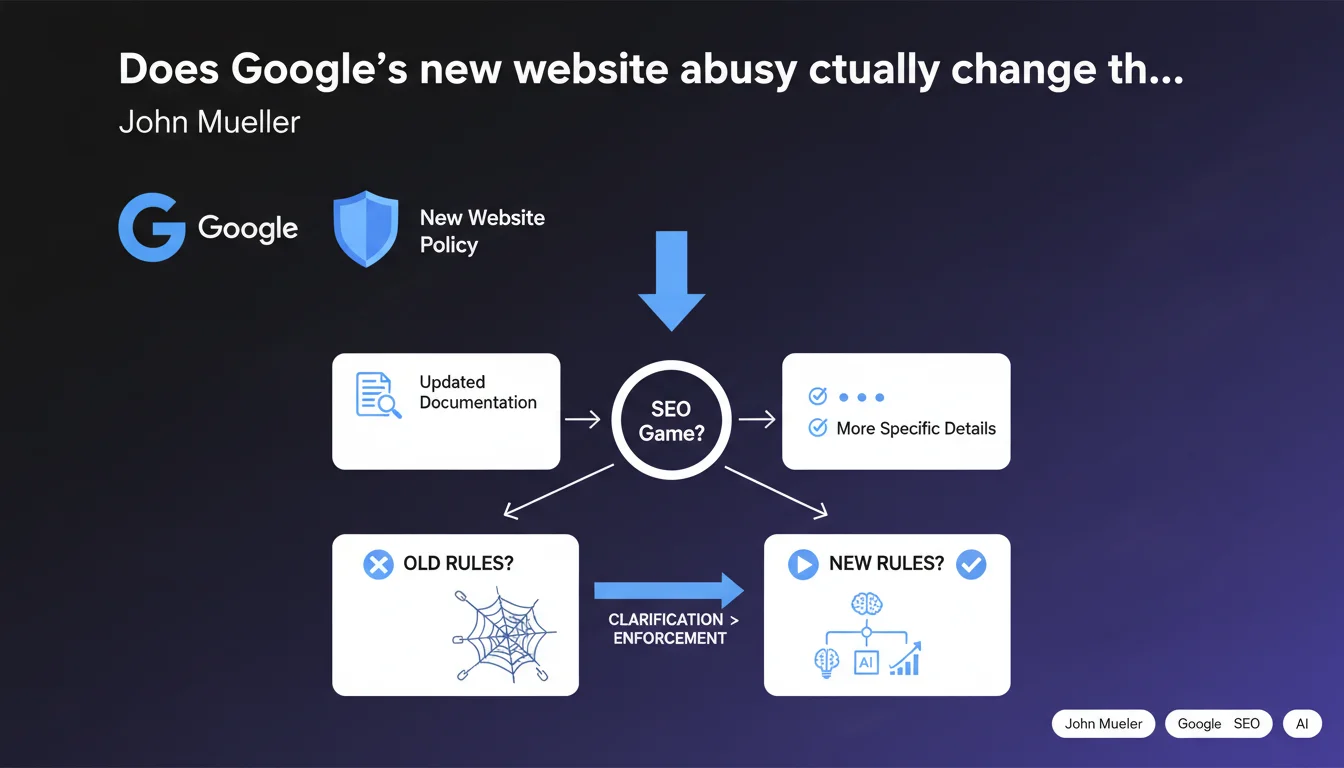
Google has overhauled its website abuse policy by adding more precise criteria to its official documentation. The goal: to better define what constitutes ranking manipulation through abusive exploitation of a domain's reputation. For SEO practitioners, this means heightened vigilance over certain practices that previously operated in gray areas.
What you need to understand
Google has decided to clarify its stance on what it considers website abuse. Until now, the boundaries remained murky — some tactics flew under the radar, while others got penalized without anyone really understanding why.
This update brings additional specifications to the official documentation. The idea? To reduce ambiguity and give webmasters clearer benchmarks to avoid crossing the line.
What does Google consider website abuse?
Google targets multiple behaviors aimed at manipulating rankings by exploiting the trust associated with an established domain name. This includes sites that rent out subdomains or entire sections to third parties without genuine editorial oversight, creating content poorly relevant to the site's main audience.
The targeted practices also include keyword stuffing, cloaking, deceptive redirects, and networks of sites designed solely to manipulate links. In short, anything that diverts a domain's original purpose to gain artificial SEO advantage.
Why is Google taking a harder line now?
The proliferation of AI-generated content has amplified certain abuses. Formerly respectable domains are transforming into low-quality content farms hosted on subdomains, leveraging the authority of the main domain to rank quickly.
Google wants to protect the quality of its search results. By clarifying the rules, the company is sending a clear message: what could slide two years ago won't pass anymore.
What's new in this documentation?
Google has added concrete examples of problematic practices — notably hosting content without editorial control, or renting site sections to third parties. These clarifications help better pinpoint where the red line sits.
The documentation also explicitly mentions third-party hosted sites and partnerships where the main site exercises no real oversight of published content. This is a notable evolution from earlier versions, which remained more general.
- Clarification on hosting third-party content without editorial oversight
- Specific examples of domain reputation manipulation
- Explicit mention of rented subdomains or delegated sections
- Reminder of possible penalties: partial or total deindexing
SEO Expert opinion
Does this update really change the game on the ground?
Honestly? Not radically. The targeted practices have been in Google's crosshairs for years. What changes is the formalization — Google is putting in writing what previously came down to interpretation.
For pros who apply white hat methods, nothing new under the sun. On the other hand, those playing in gray areas — renting subdomains, opaque partnerships — will need to rethink their approach. Or accept the risk.
Is Google consistent with its past actions?
Broadly speaking, yes. We've seen massive deindexations of sites that exploited their domain authority to host unrelated content. Documented cases (unnamed here) show that Google already acts against these practices.
But — and here's where it gets tricky — enforcement remains uneven. Some major players continue renting out entire sections without apparent issue. The question isn't so much whether the rule exists, but whether it's applied equally to everyone. [To verify]
What nuances need to be added?
First nuance: not all partnerships are problematic. If a general media outlet hosts a specialized section with a genuine editorial line and quality control, Google doesn't consider that abuse.
Second nuance: the notion of "editorial oversight" remains fuzzy. Google doesn't give precise thresholds — how many reviews? What level of involvement? This gray area persists. [To verify]
Practical impact and recommendations
What should you prioritize checking on your site?
First step: audit all subdomains and hosted sections. If you're renting space to third parties, ask yourself: is there thematic coherence? Quality control? Real editorial oversight?
Second step: examine content partnerships. If you publish sponsored content or partner articles, ensure they meet your editorial standards. No keyword stuffing, no artificial links, no completely off-topic themes.
What mistakes must you avoid at all costs?
Never rent a subdomain or entire section without strict editorial control. That's the surest way to get hit with a manual penalty — and lose all the authority you've built on the main domain.
Also avoid deceptive redirects. If a user clicks a link expecting content X and lands on completely different content Y, Google considers that manipulation.
How should you adapt your SEO strategy to this update?
Prioritize quality and thematic consistency. If you're developing a new vertical on your site, ensure it has a logical connection to your main activity. Document your editorial process — it could help if disputes arise.
For sites monetizing through content partnerships, put clear guidelines in place for your external contributors. Review, validate, and don't hesitate to reject content that doesn't meet your standards.
- Audit all subdomains and hosted sections
- Verify thematic consistency of third-party content
- Document the editorial oversight process
- Remove or correct off-brand content
- Review content partnerships and their terms
- Establish strict guidelines for external contributors
This update imposes heightened rigor in managing hosted content and partnerships. Sites playing in gray areas must now clarify their strategy.
For complex structures — multi-topic sites, multiple subdomains, extended partnerships — applying these new rules can prove tricky. A thorough audit and targeted restructuring require specialized expertise. If you manage a site ecosystem or extensive content partnerships, working with a specialized SEO agency can help you identify risks and implement necessary adjustments without compromising visibility.
❓ Frequently Asked Questions
Un sous-domaine hébergé pour un partenaire légitime peut-il être pénalisé ?
Comment savoir si mon site enfreint cette politique ?
Google prévient-il avant de sanctionner pour abus de site ?
Les sites d'affiliation sont-ils concernés par cette mise à jour ?
Peut-on récupérer d'une pénalité liée à l'abus de site ?
🎥 From the same video 9
Other SEO insights extracted from this same Google Search Central video · published on 14/01/2025
🎥 Watch the full video on YouTube →
💬 Comments (0)
Be the first to comment.