
Official statement
Other statements from this video 9 ▾
- □ Pourquoi Google ouvre-t-il l'accès à des données horaires dans Search Console ?
- □ Faut-il vraiment surveiller les nouvelles recommandations Search Console pour éviter les pénalités d'indexation ?
- □ Pourquoi Google fixe-t-il le seuil d'alerte d'exploration à 5% dans Search Console ?
- □ Google abandonne-t-il vraiment le terme 'webmaster' dans Search Console ?
- □ Que change vraiment la mise à jour de la politique Google sur l'abus de site ?
- □ Qu'est-ce qu'une spam update de Google et comment s'en protéger efficacement ?
- □ Faut-il supprimer les données structurées Sitelink Search Box maintenant que Google les ignore ?
- □ Pourquoi 84% des sites web possèdent-ils un fichier robots.txt ?
- □ Comment Googlebot explore-t-il réellement vos pages et quel impact sur votre crawl budget ?
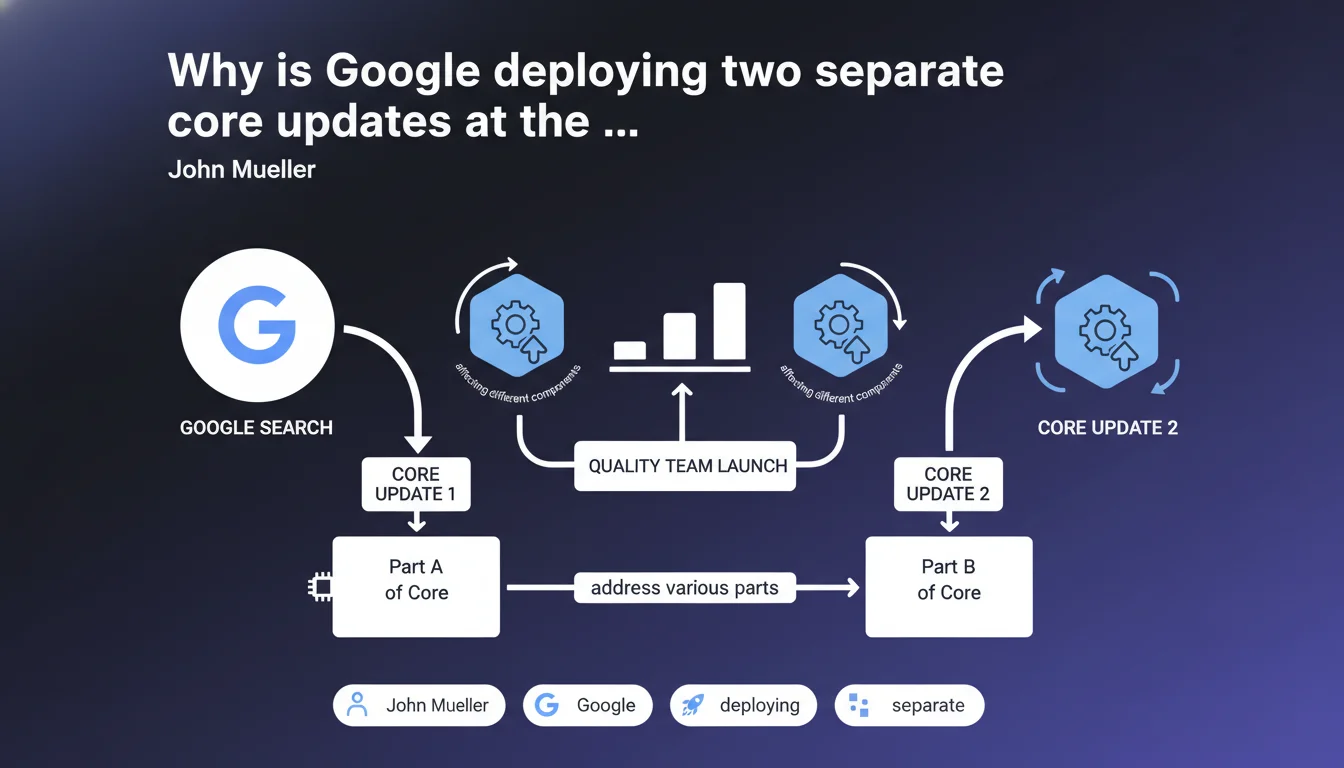
Google confirms the simultaneous rollout of two distinct core updates targeting different components of its search engine. This parallel approach — unusual by Google standards — suggests that Google's algorithm is now sufficiently modular to be optimized through independent building blocks, without waiting for a single global deployment.
What you need to understand
What does it mean to have 'two core updates' launched simultaneously?
Traditionally, Google announced a single core update per period, globally modifying how the engine evaluates content quality. Here, Mueller explicitly mentions two distinct updates, each targeting specific 'core' components.
This confirms what many suspected: Google's algorithm is no longer a monolithic block. It is now composed of independent modules — semantic relevance, user experience signals, backlink processing, freshness, etc. — that Google can adjust separately.
How does this modular approach change the game?
Because it makes ranking fluctuations more unpredictable. A site can be impacted by one of the two updates, by both, or by neither — depending on the components involved and the weaknesses of that specific site.
Concretely, if one update affects E-E-A-T signal handling and another handles internal linking, two sites with different profiles will react in completely asymmetrical ways. No more saying "it's a core update, everyone is in the same boat."
Which components are considered 'core'?
Google never officially specifies the list. But by cross-referencing, we know that the core includes at minimum: semantic understanding (NLP), quality scoring (E-E-A-T), user signal management (Core Web Vitals, behavior), backlink analysis, and freshness.
Any signal that directly influences overall organic ranking — not just an isolated feature like featured snippets — can be considered part of the core.
- Increasing modularity: Google can now adjust each component independently
- Asymmetric impacts: two competing sites can experience opposite effects based on their respective strengths/weaknesses
- Less transparency: Google never discloses which specific components are affected by each update
- Increased complexity: diagnosing a traffic drop after a core update becomes more delicate
SEO Expert opinion
Is this statement consistent with observed practices?
Absolutely. For several months, we've observed core update rollouts that overlap, with extended volatility periods. This didn't align well with the idea of a single global update.
Some sites saw their traffic recover mid-rollout, then drop again — likely indicating multiple successive or parallel adjustments were underway. Mueller's statement finally legitimizes these on-the-ground observations: yes, multiple core updates can coexist.
Why does Google remain so vague about the components involved?
Let's be honest: if Google revealed exactly which modules were being adjusted, SEOs could reverse-engineer the criteria and optimize surgically. Google prefers to maintain strategic opacity to prevent manipulation.
The problem is that it makes post-update diagnosis extremely complex. A site losing 30% of its traffic doesn't know whether to rework its content, internal linking, backlinks, or UX. [To be verified]: Mueller mentions "different components," but no concrete specifics are provided. We remain in the fog.
Should we expect more volatility going forward?
It's very likely. If Google can now iterate component by component, nothing prevents it from deploying three, four, or even five core adjustments simultaneously or in quick succession.
Result: periods of stability between core updates will likely shorten. And SEO tracking tools risk displaying charts of near-permanent volatility — which will further complicate distinguishing between normal fluctuation and actual algorithm impact.
Practical impact and recommendations
What should you do concretely after this announcement?
First, abandon the idea of a one-size-fits-all strategy when facing a core update. If two components are affected, you need to audit multiple axes in parallel: content quality, E-E-A-T signals, link profile, user experience, site architecture.
Next, cross-reference your data. Check whether the traffic drop affects certain specific page types (product pages vs blog articles), certain keyword segments (commercial vs informational queries), or certain devices (mobile vs desktop). This can reveal which component is penalizing you.
What mistakes should you avoid after a multi-component core update?
Classic mistake: panic and change everything at once. If you overhaul your site, rewrite your content, clean your backlinks, and modify your internal linking simultaneously, you'll never know what actually worked — or if you made things worse.
Another mistake: waiting for "automatic recovery." Google has already stated that core updates don't penalize; they re-evaluate. But if your content remains poor, you won't magically climb back at the next update. You need to take targeted action.
How do you diagnose which component impacted you?
Start by segmenting your analysis. If you lose traffic on YMYL queries (health, finance), it's probably an E-E-A-T adjustment. If it's on technically slow or mobile-unfriendly pages, it could be related to Core Web Vitals or UX signals.
Next, compare your site to those that gained traffic on the same keywords. What do they have that you don't? Better content? More authoritative backlinks? Better user experience? This competitive analysis is often more revealing than any monitoring tool.
- Audit multiple axes simultaneously: content, backlinks, UX, architecture, E-E-A-T
- Segment analysis by page type and query to identify patterns
- Don't change everything at once — test targeted modifications and measure effects
- Compare your site to update winners to identify critical gaps
- Monitor volatility over several weeks: a core update can take 2-3 weeks to stabilize
- Document each corrective action to know what actually worked
❓ Frequently Asked Questions
Google va-t-il annoncer systématiquement quand plusieurs core updates sont lancées en parallèle ?
Si mon site est impacté par une seule des deux updates, l'autre peut-elle compenser les pertes ?
Les core updates multi-composants rendent-elles les outils de tracking SEO moins fiables ?
Peut-on anticiper quels composants Google va ajuster dans les prochaines core updates ?
Si je n'ai subi aucun impact, dois-je quand même auditer mon site après une core update ?
🎥 From the same video 9
Other SEO insights extracted from this same Google Search Central video · published on 14/01/2025
🎥 Watch the full video on YouTube →
💬 Comments (0)
Be the first to comment.