
Official statement
Other statements from this video 9 ▾
- □ Pourquoi Google ouvre-t-il l'accès à des données horaires dans Search Console ?
- □ Faut-il vraiment surveiller les nouvelles recommandations Search Console pour éviter les pénalités d'indexation ?
- □ Pourquoi Google fixe-t-il le seuil d'alerte d'exploration à 5% dans Search Console ?
- □ Google abandonne-t-il vraiment le terme 'webmaster' dans Search Console ?
- □ Pourquoi Google lance-t-il deux core updates distinctes en même temps ?
- □ Que change vraiment la mise à jour de la politique Google sur l'abus de site ?
- □ Qu'est-ce qu'une spam update de Google et comment s'en protéger efficacement ?
- □ Pourquoi 84% des sites web possèdent-ils un fichier robots.txt ?
- □ Comment Googlebot explore-t-il réellement vos pages et quel impact sur votre crawl budget ?
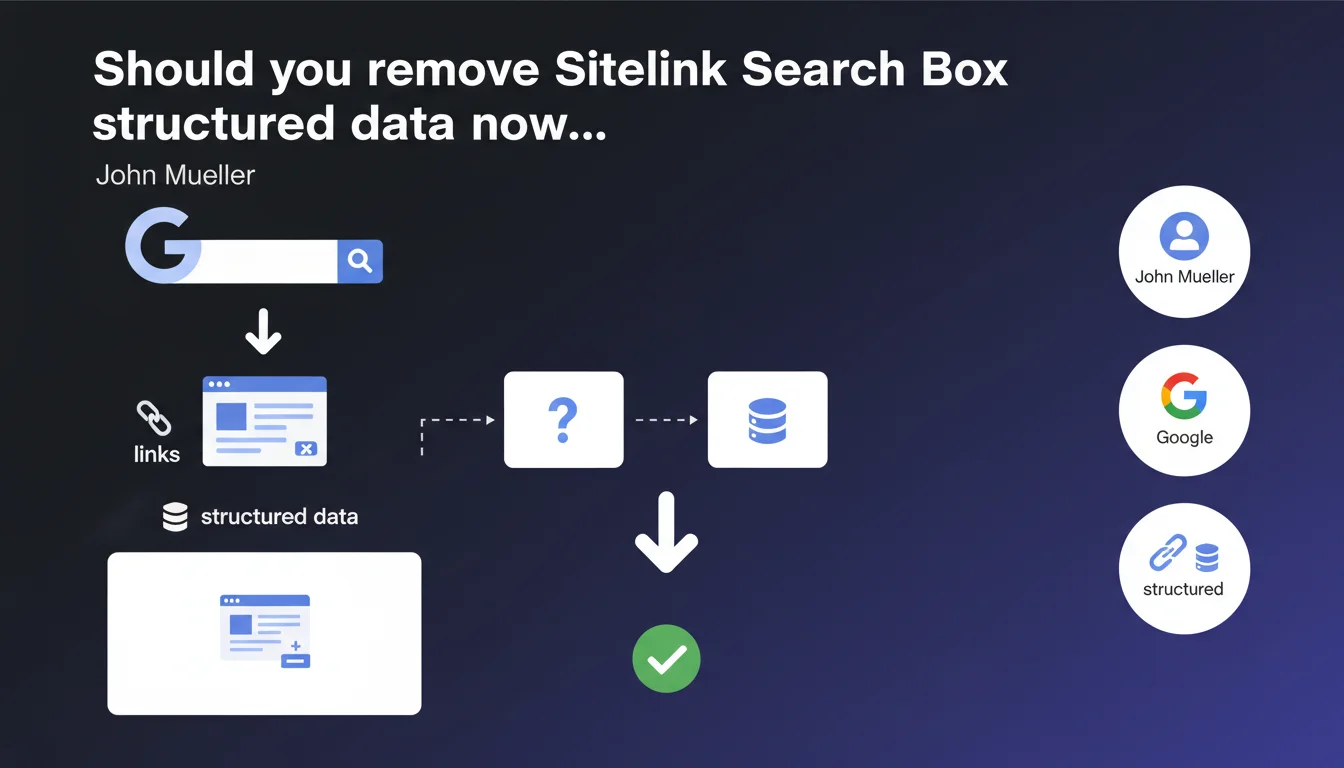
Google has removed the search box feature for sitelinks and no longer processes the associated structured data. Good news: no technical action is required on your end. Your SearchAction tags can remain in place without any negative impact.
What you need to understand
What is the search box for sitelinks and why is Google abandoning it?
The search box for sitelinks allowed users to launch a search directly from Google results, through an input field displayed below certain organic results. This feature relied on Schema.org SearchAction markup, a structured data that webmasters implemented to signal to Google the URL of their internal search engine.
Google doesn't publicly justify this removal. The most likely hypothesis? The usage rate was too low to justify the technical maintenance and screen space taken up in the SERPs. Classic sitelinks remain in place — only the search module disappears.
Does this removal impact the search rankings of affected sites?
No. This change is purely cosmetic on the SERP side and affects neither crawling, indexing, nor rankings. Sites that displayed this search box lose no SEO advantage — because there wasn't really one to begin with.
The real value of SearchAction markup was the user experience: making it easy for users to quickly access internal search from Google. Now that this gateway no longer exists, the Schema loses its functional purpose without becoming penalizing in any way.
What happens to the structured data already in place?
Google no longer exploits it, but tolerates its presence. John Mueller explicitly clarifies that it is not necessary to remove it. It triggers no errors in Search Console, doesn't significantly increase HTML processing time, and remains invisible to the end user.
In practice, this means: no technical urgency. If your dev team has other priorities, this cleanup can wait — or even be ignored indefinitely if the code doesn't bother you.
- The search box for sitelinks has been removed from the SERPs without warning or detailed explanation
- The SearchAction markup is no longer interpreted by Google but remains technically valid
- No negative SEO impact if you keep these structured data
- Classic sitelinks continue to function normally
- No urgent technical migration to plan
SEO Expert opinion
Is this decision consistent with Google's product strategy?
Absolutely. Google regularly removes SERP features with low adoption — remember Google Posts or enriched Q&A. The search box for sitelinks was poorly visible (reserved for strong brand queries) and rarely used (users prefer to click on a direct sitelink rather than reformulate a query).
What's more surprising is the complete lack of prior communication. No warning in Search Console, no gradual deprecation — just a silent removal. This confirms a trend: Google no longer treats structured data as stable contracts, but as optional signals that it activates or deactivates based on its own product priorities.
Should you still clean up these obsolete structured data?
Let's be pragmatic. If your site manages thousands of templates and SearchAction markup is injected dynamically everywhere, the ROI of cleanup is virtually zero. No SEO gain, no measurable performance improvement, just slightly less technical debt.
However, if you're redesigning your templating system or auditing your structured data for strategic reasons (SGE preparation, active rich snippet optimization), then yes — take the opportunity to remove this dead code. But it's never a priority 1 task.
What lessons can we draw for future structured data implementation?
First lesson: never invest heavily in an undocumented SERP feature marketed as a "ranking factor". Structured data primarily serves to improve display in search results — and that display remains entirely at Google's discretion.
Second lesson: prioritize Schema.org markup that serves multiple search engines (Bing, Yandex) or other uses (AI crawlers, voice assistants). SearchAction was only exploited by Google — hence its fragility. Organization, Product, Review, or FAQPage tags have broader reach and therefore more predictable lifespans.
Practical impact and recommendations
What should you concretely do with existing SearchAction markup?
Nothing urgent. If your structured data is already in place and generates no errors in Search Console, leave it alone. It doesn't interfere with any other Google processing and doesn't significantly bloat your pages.
If you want to clean up for technical hygiene reasons — because your team maintains a strict registry of active Schema — then schedule this work as a low priority task, after optimizations that actually impact traffic or conversions.
How can I verify if my site used this feature?
Two simple methods. First option: inspect the source code of your homepage and search for "@type": "SearchAction" or "potentialAction" in your JSON-LD blocks. If you find these mentions, the markup is present.
Second option: use Google Search Console's Rich Results Test tool. Paste your homepage URL — if it detects SearchAction markup, it will display it in the list of recognized types (even though Google no longer exploits it).
What errors should you avoid when cleaning up?
If you decide to remove the markup, never touch other properties of your Organization or WebSite Schema. SearchAction is often nested within a WebSite object — remove only the potentialAction key, not the rest.
Always test after modification. Malformed JSON-LD (missing bracket, extra comma) can invalidate all your structured data and cause other functional rich snippets to disappear. Validate with the Schema Markup Validator tool before pushing to production.
- Verify SearchAction presence in your HTML templates via grep or manual inspection
- Assess the technical cost of removal: number of affected templates, regression risk
- Prioritize this cleanup after projects with direct SEO impact (Core Web Vitals, internal linking, content)
- If removing: delete only the
potentialActionkey, keep the rest of the WebSite Schema - Validate modified JSON-LD with Schema.org Validator + Google Rich Results Test
- Monitor Search Console for 2 weeks post-deployment to catch any unexpected errors
❓ Frequently Asked Questions
Le retrait de la search box pour sitelinks pénalise-t-il mon référencement ?
Dois-je supprimer immédiatement le balisage SearchAction de mon site ?
La search box pour sitelinks reviendra-t-elle un jour ?
Bing ou d'autres moteurs exploitent-ils encore le balisage SearchAction ?
Quelles données structurées restent prioritaires pour les sitelinks en 2025 ?
🎥 From the same video 9
Other SEO insights extracted from this same Google Search Central video · published on 14/01/2025
🎥 Watch the full video on YouTube →
💬 Comments (0)
Be the first to comment.