
Official statement
What you need to understand
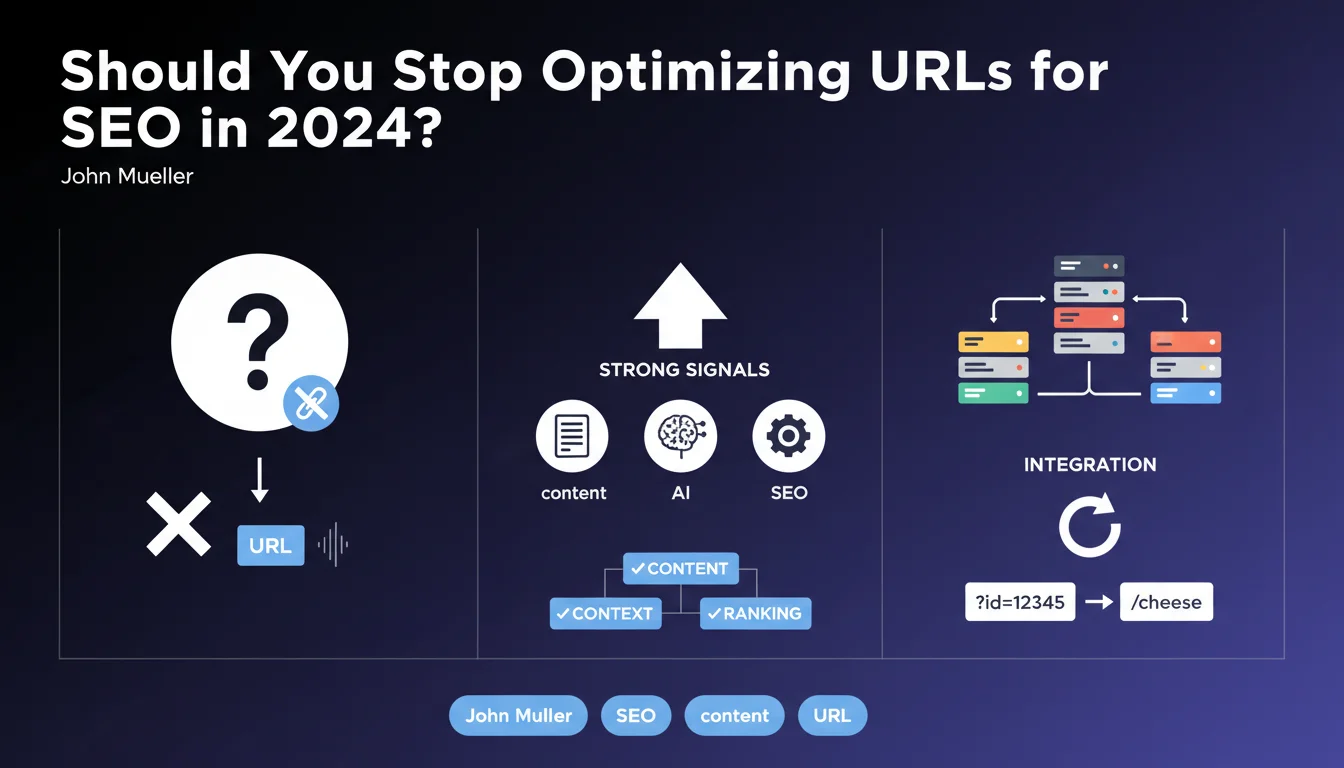
Google officially confirms that the URL itself generates a minimal ranking signal in its ranking algorithm. This statement clarifies a question that has divided the SEO community for years.
Concretely, this means that transforming a technical URL like "?id=12345" into a "clean" URL like "/cheese" will not bring any notable improvement in rankings. The weight of this factor in the overall algorithm has become negligible.
However, Google immediately nuances this by specifying that URL structure retains its importance for other strategic reasons. It is therefore not a matter of completely neglecting this technical aspect.
- Content and strong signals (links, relevance, user experience) far outweigh the URL
- Excessive URL optimization will not generate significant SEO gains
- URL structure remains useful for site organization and analytics
- User experience remains a valid criterion for crafting your URLs
SEO Expert opinion
This statement is perfectly consistent with field observations from recent years. A/B tests on URL changes have consistently shown negligible impacts on rankings, unlike the 2010s when URL optimization was considered an important lever.
Nevertheless, an important nuance must be made regarding keywords in the URL. While their direct impact on ranking is minimal, they play a role in click-through rate (CTR) from the SERPs. A clear and descriptive URL is more reassuring for users than a string of obscure characters.
Finally, in multilingual or multi-segment contexts, URL structure remains crucial for Google to correctly identify site sections (hreflang, geographic targeting). It's not the URL itself that matters, but its organizational function.
Practical impact and recommendations
- Don't launch URL migrations solely to "optimize" their SEO formulation
- Prioritize URL stability rather than cosmetic changes
- Maintain a logical structure by directories to facilitate administration and tracking
- Use descriptive URLs to improve CTR and user experience, not for ranking
- Avoid parameterized URLs only if they cause duplicate content or crawl problems
- Invest the time saved on high-impact optimizations: content quality, internal linking, link building, Core Web Vitals
- Maintain URL consistency for new content without keyword obsession
These strategic trade-offs between high and low impact optimizations require a comprehensive view of your SEO ecosystem. Identifying true growth levers and prioritizing projects according to their potential ROI are specialized skills.
For sites with high technical complexity or limited resources, surrounding yourself with experienced SEO experts helps avoid scattering efforts on marginal optimizations and concentrate investments where they actually generate measurable results.
💬 Comments (0)
Be the first to comment.