
Official statement
Other statements from this video 9 ▾
- □ Why is Google finally giving you hourly performance data in Search Console?
- □ Should you really monitor new Search Console recommendations to avoid indexation penalties?
- □ Why does Google set the crawl alert threshold at 5% in Search Console?
- □ Is Google really phasing out the term 'webmaster' from Search Console?
- □ Why is Google deploying two separate core updates at the same time?
- □ Does Google's new website abuse policy actually change the rules of the SEO game?
- □ Should you remove Sitelink Search Box structured data now that Google ignores it?
- □ Why do 84% of websites actually have a robots.txt file?
- □ Is your crawl budget being wasted? Here's what Google just revealed about how Googlebot really explores your pages
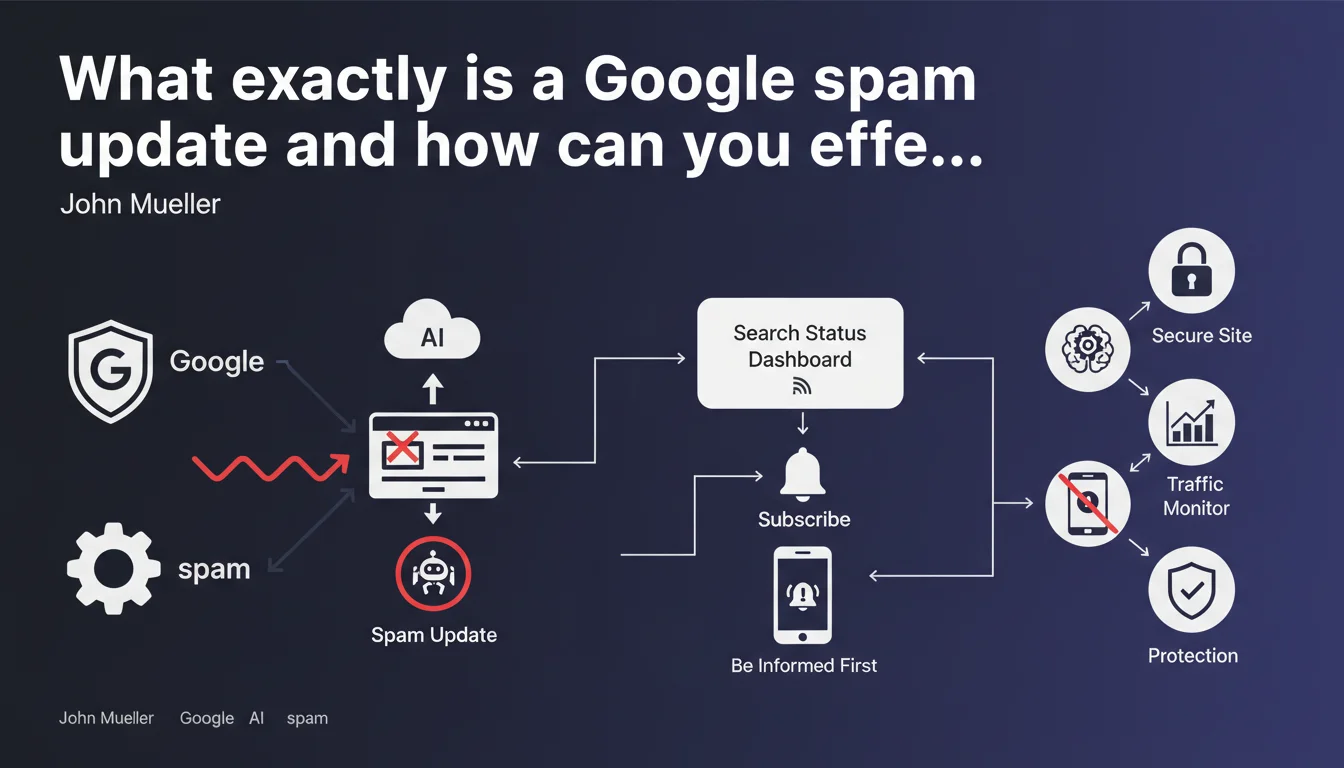
Google regularly launches spam updates to target manipulative techniques. These updates are announced via the Search Status dashboard with the option to subscribe via RSS feed. Objective: stay informed in real-time of deployments to anticipate potential impacts on your rankings.
What you need to understand
Why does Google communicate about spam updates?
Google publicly announces certain anti-spam updates to avoid false alarms in the SEO community. Without official communication, every fluctuation in rankings could be interpreted as a manual penalty or algorithmic bug.
The Search Status Dashboard centralizes these announcements. It distinguishes spam updates from core updates and feature releases. This relative transparency allows professionals to correlate traffic variations with algorithmic deployments.
What's the difference from other types of updates?
Spam updates specifically target practices that violate guidelines: auto-generated content, artificial link schemes, cloaking, deceptive redirects. They differ from core updates which reassess overall relevance without explicitly targeting spam.
In practice, a spam update can hit a site hard that used borderline techniques, while a core update progressively redistributes rankings based on perceived quality.
How are these updates deployed?
The rollout typically takes several days to two weeks. Google announces the launch then confirms the end of rollout. During this period, ranking fluctuations are normal and don't require panic reactions.
RSS feeds allow you to automatically receive each new announcement. Useful for monitoring without having to manually check the dashboard every day.
- Centralization: all announcements on a single dashboard
- RSS feeds available to automate monitoring
- Selective transparency: Google doesn't reveal the exact criteria targeted
- Variable timing: deployment between a few days and two weeks
- Clear distinction from core updates and feature updates
SEO Expert opinion
Is this transparency really useful for practitioners?
Yes and no. Knowing that a spam update is underway allows you to defer certain corrective actions and avoid modifying a site during an unstable indexing period. That's already a practical gain.
But let's be honest — Google never reveals the exact criteria being targeted. The announcement remains generic: "we're combating spam". Concretely? There's no way to know if your PBN network, satellite pages, or over-optimized anchor text are in the crosshairs without analyzing post-rollout variations. [To verify]
Are RSS feeds enough for effective monitoring?
The Search Status Dashboard RSS feed covers official announcements, not undocumented updates. Yet Google regularly deploys algorithmic adjustments without public communication. Third-party monitoring tools (Semrush Sensor, Mozcast, Algoroo) capture these variations where the RSS feed remains silent.
Combining both approaches is essential. The RSS feed for official confirmations, sensors for detecting unannounced movements. Relying solely on Google is like driving with a rear-view mirror only.
What strategy should you adopt during a spam update?
First rule: don't panic and massively modify a site during rollout. Temporary fluctuations are normal. Wait for the official end of deployment before drawing definitive conclusions.
If your rankings drop sharply, systematically audit risky practices — suspicious backlinks, thin auto-generated content, manipulative linking schemes. But don't disavow 500 referring domains in two hours because traffic dropped 15% on a Wednesday. The algorithm needs time to stabilize.
Practical impact and recommendations
What should you do concretely when Google announces a spam update?
First step: document your KPI status before rollout. Note key rankings, organic traffic, indexed pages, link profile. This allows you to measure real impact once deployment is complete.
Then, monitor daily without acting impulsively. If your rankings drop sharply right at the start of rollout, that's a warning signal. If they remain stable then vary slightly, it's probably algorithmic noise.
What mistakes should you avoid during a spam update?
Don't massively modify your backlink profile during deployment. Google reassesses signals in real-time — removing links can worsen the situation if the algorithm had already neutralized them without penalizing.
Also avoid suddenly publishing 50 articles to "prove" your site's quality. The algorithm detects these sharp behavioral variations. Continue your regular editorial rhythm.
How can you verify that your site isn't affected?
Compare your Search Console data before/after complete rollout. Look specifically at long-tail queries — that's often where spam updates strike first, on lower-quality content.
Also check pages with sharp impression drops. If they correspond to auto-generated content, satellite pages, or aggressive linking schemes, the algorithm has likely demoted them.
- Subscribe to the Search Status Dashboard RSS feed to receive announcements in real-time
- Document KPIs (rankings, traffic, indexed pages) before each announced rollout
- Don't massively modify the site during update deployment
- Wait for official confirmation of rollout completion before drawing conclusions
- Audit risky practices if sharp drop confirmed post-deployment
- Combine official RSS feed with third-party monitoring tools (Semrush Sensor, Mozcast)
- Compare Search Console before/after to identify affected pages and queries
- Prioritize fixes on thin content, suspicious backlinks, manipulative schemes
❓ Frequently Asked Questions
Quelle est la différence entre une spam update et une core update ?
Combien de temps dure le déploiement d'une spam update ?
Dois-je désavouer mes backlinks pendant une spam update ?
Le flux RSS couvre-t-il toutes les mises à jour algorithmiques ?
Comment savoir si mon site est touché par une spam update ?
🎥 From the same video 9
Other SEO insights extracted from this same Google Search Central video · published on 14/01/2025
🎥 Watch the full video on YouTube →
💬 Comments (0)
Be the first to comment.