
Official statement
Other statements from this video 16 ▾
- □ Faut-il vraiment supprimer les balises meta keywords de votre site ?
- □ Faut-il modifier la date lastmod du sitemap à chaque mise à jour mineure ?
- □ Faut-il vraiment séparer les sitemaps news et généraux pour éviter les doublons d'URLs ?
- □ Pourquoi Google ignore-t-il votre meta description alors que vous l'avez soigneusement rédigée ?
- □ Faut-il vraiment nettoyer les backlinks spammés de votre profil de liens ?
- □ Faut-il encore optimiser la densité de mots-clés pour le SEO ?
- □ Le désaveu de liens suffit-il à récupérer vos positions perdues après une pénalité ?
- □ Pourquoi les redirections 301 restent-elles le nerf de la guerre lors d'un changement de domaine ?
- □ Un code 404 ciblé sur Googlebot peut-il bloquer l'indexation de vos pages ?
- □ Faut-il vraiment avoir le même contenu sur mobile et desktop pour l'indexation mobile-first ?
- □ Vérifier son site dans Search Console améliore-t-il vraiment son référencement ?
- □ Pourquoi Google refuse-t-il le contenu multilingue dynamique sur une même URL ?
- □ Que se passe-t-il quand vos liens hreflang ne se valident pas tous ?
- □ Les liens footer « Made by X » sont-ils vraiment sans danger pour votre SEO ?
- □ Comment configurer correctement les balises canonical et alternate pour un site m-dot ?
- □ Les données EXIF des images sont-elles inutiles pour le SEO ?
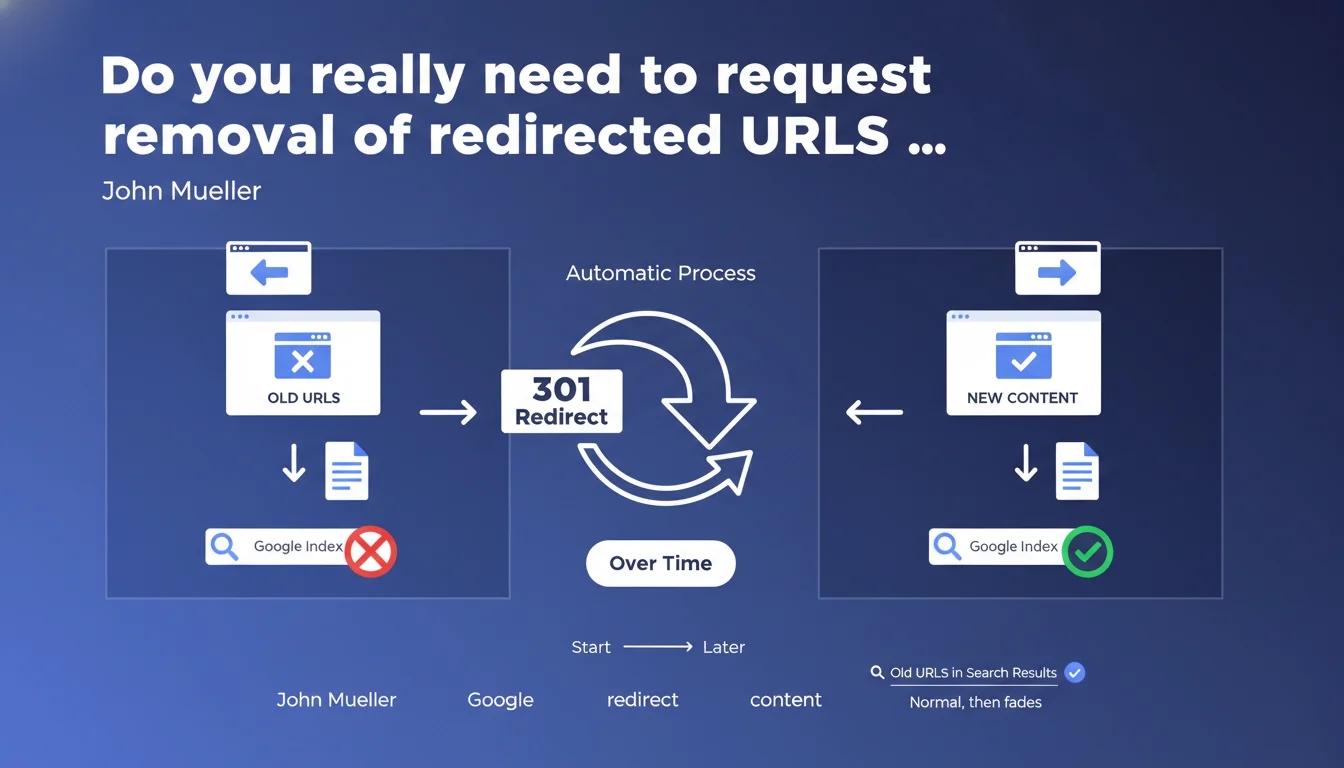
Google states that it's not necessary to request the removal of old URLs after a 301 redirect — the process happens automatically over time. If these URLs persist temporarily in the index, this is normal behavior that shouldn't be forced. Intervention via Search Console is therefore unnecessary in this specific case.
What you need to understand
Why does Google continue to index redirected URLs?
When a 301 redirect is implemented, Google doesn't immediately deindex the old URL. The search engine needs several crawl passes to confirm that the redirect is permanent and to transfer signals (PageRank, link anchors, authority) to the new destination.
This processing delay varies depending on the crawl frequency of your site, the quality of the technical implementation, and the number of URLs involved. This is expected behavior, not an anomaly.
What does this change for migration management?
Concretely, it means that after a migration or redesign, seeing old and new URLs temporarily coexist in the index is not an alarm signal. No need to panic or submit multiple removal requests via Search Console.
This statement aims to defuse counterproductive reflexes: bombarding Google with removal requests for URLs that will naturally disappear only complicates the search engine's work without accelerating the process.
When can you observe this phenomenon?
This situation primarily occurs during site migrations, structural redesigns, or content consolidations. You'll see old URLs resurface on ultra-specific queries (exact URL searches, site: operators, etc.).
If these URLs persist for weeks or even months, that's normal — as long as the redirects are properly configured and new pages are crawlable.
- 301 redirects transfer signals progressively, not instantly
- Deindexing of old URLs is automatic, but takes time
- Removal requests via Search Console are unnecessary in this context
- Seeing both versions of a URL coexist temporarily is expected behavior
- Google prioritizes index stability over raw update speed
SEO Expert opinion
Is this statement consistent with real-world observations?
Yes, broadly. On the majority of well-executed migrations, we observe progressive transition over several weeks. Old URLs disappear from the index without manual intervention once Google has sufficiently recrawled the site.
But be careful: this rule only applies if redirects are clean, stable, and new pages have sufficient crawl budget. On a large site with limited crawl budget, deindexing can drag on for months. [Check] case by case depending on volume and domain authority.
In what cases does this recommendation not apply?
Let's be honest: if you permanently delete content (no redirect, just a 404 or 410), then yes, requesting manual removal via Search Console can speed up index cleanup. Same applies to sensitive, obsolete, or legally problematic content.
Mueller's statement targets permanent redirects. It says nothing about dead content, massive 404 errors after cleanup, or emergency situations where the old URL creates an immediate business problem.
What's the nuance you shouldn't miss?
Mueller says removal "happens automatically over time". But he doesn't specify what timeframe or how to react if it drags on abnormally. That leaves a lot of room for interpretation.
In practice, if you notice persistence beyond 8-12 weeks on an active site, it's legitimate to investigate: check logs, crawl speed, potential mixed signals. Patience is required, but blind inaction is not.
Practical impact and recommendations
What should you do concretely after a migration with 301 redirects?
First rule: don't force anything. Avoid submitting removal requests in Search Console for each redirected old page. Let Google handle the process naturally.
Instead, focus on technical verification: ensure redirects are properly configured (301 HTTP code, no redirect chains, no loops), new URLs are crawlable and indexable, and XML sitemap reflects only new URLs.
How do you verify that everything is going smoothly?
Monitor coverage reports in Search Console: old URLs should progressively shift to "Redirected" status then disappear from the index. If they remain "Indexed, but with issues" or new URLs aren't climbing, dig deeper.
Also check server logs to confirm Googlebot is crawling new URLs at regular frequency. Stagnant crawl is often a sign of crawl budget issues or contradictory signals.
What mistakes should you absolutely avoid?
Don't multiply removal requests for redirected URLs — it speeds nothing up and can create index confusion. Don't remove redirects too early either: keep them in place for at least 12 months, ideally indefinitely.
And above all, don't mix signals: if you redirect URL A to B, make sure all technical elements (canonical, sitemap, internal linking) point to B, not A.
- Verify that all redirects are 301 permanent, not 302 temporary
- Ensure there are no redirect chains (A → B → C) or loops
- Update XML sitemap to reference only new URLs
- Fix internal linking to point directly to new URLs
- Monitor Search Console coverage reports for a minimum of 2-3 months
- Analyze server logs to check crawl frequency of new pages
- Don't remove redirects before at least 12 months
- Avoid removal requests for redirected URLs except in exceptional cases
❓ Frequently Asked Questions
Combien de temps faut-il attendre avant que Google désindexe les anciennes URLs redirigées ?
Puis-je quand même demander la suppression d'une URL redirigée si elle pose problème ?
Les redirections 301 transfèrent-elles 100% du jus SEO immédiatement ?
Faut-il garder les redirections 301 indéfiniment ou peut-on les retirer après un an ?
Si les anciennes URLs apparaissent encore dans les SERP après 3 mois, c'est grave ?
🎥 From the same video 16
Other SEO insights extracted from this same Google Search Central video · published on 31/01/2023
🎥 Watch the full video on YouTube →
💬 Comments (0)
Be the first to comment.