
Official statement
Other statements from this video 16 ▾
- □ Faut-il modifier la date lastmod du sitemap à chaque mise à jour mineure ?
- □ Faut-il vraiment séparer les sitemaps news et généraux pour éviter les doublons d'URLs ?
- □ Pourquoi Google ignore-t-il votre meta description alors que vous l'avez soigneusement rédigée ?
- □ Faut-il vraiment nettoyer les backlinks spammés de votre profil de liens ?
- □ Faut-il encore optimiser la densité de mots-clés pour le SEO ?
- □ Le désaveu de liens suffit-il à récupérer vos positions perdues après une pénalité ?
- □ Pourquoi les redirections 301 restent-elles le nerf de la guerre lors d'un changement de domaine ?
- □ Un code 404 ciblé sur Googlebot peut-il bloquer l'indexation de vos pages ?
- □ Faut-il vraiment avoir le même contenu sur mobile et desktop pour l'indexation mobile-first ?
- □ Faut-il vraiment demander la suppression des URLs redirigées de l'index Google ?
- □ Vérifier son site dans Search Console améliore-t-il vraiment son référencement ?
- □ Pourquoi Google refuse-t-il le contenu multilingue dynamique sur une même URL ?
- □ Que se passe-t-il quand vos liens hreflang ne se valident pas tous ?
- □ Les liens footer « Made by X » sont-ils vraiment sans danger pour votre SEO ?
- □ Comment configurer correctement les balises canonical et alternate pour un site m-dot ?
- □ Les données EXIF des images sont-elles inutiles pour le SEO ?
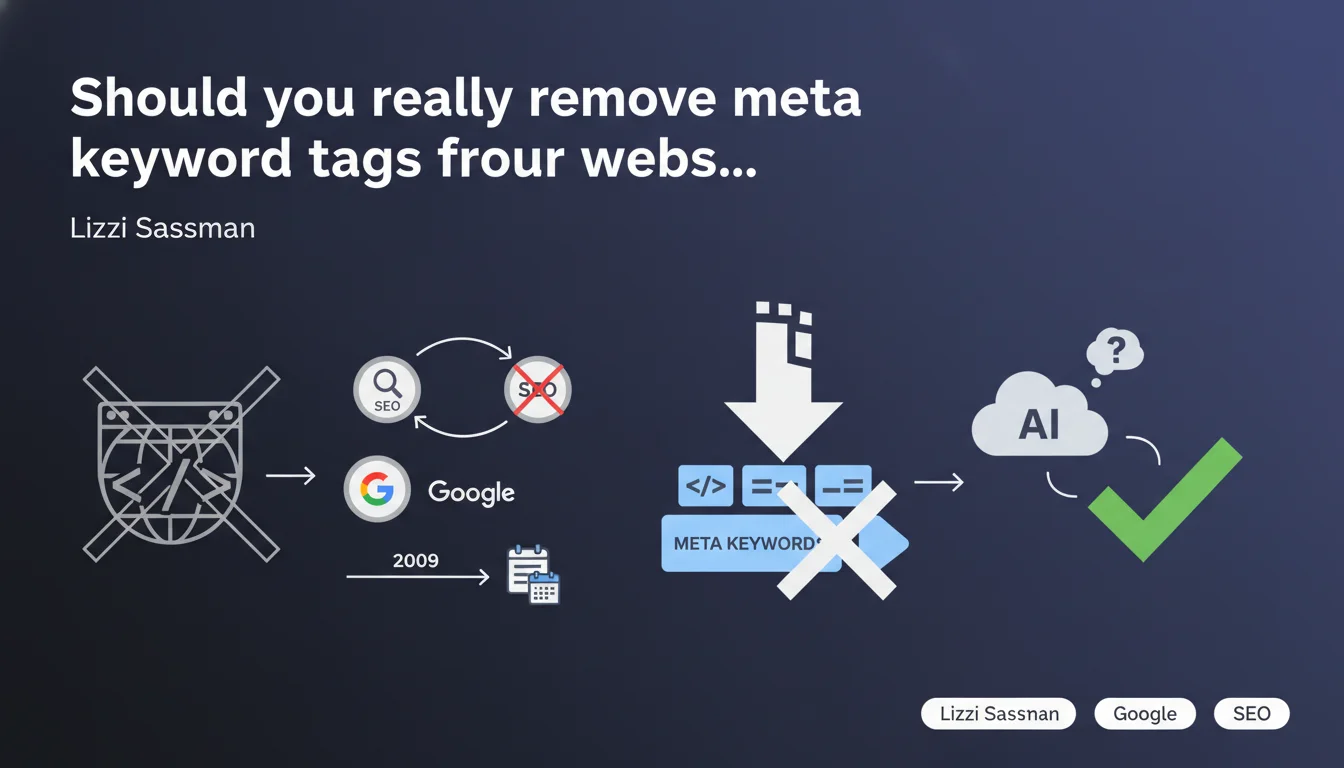
Google has not taken meta keyword tags into account since 2009 — and never truly used them for ranking in the first place. These tags provide no SEO benefit and can even signal your keyword strategy to competitors. You might as well remove them or simply ignore them.
What you need to understand
This official statement reinforces a truth known for over a decade: meta keyword tags have zero impact on Google rankings. The search engine abandoned them in the face of massive abuse — keyword stuffing, spam, ranking manipulation.
Lizzi Sassman references the historic blog post by Matt Cutts that definitively sealed the fate of this tag. The message is clear: stop wasting time on it.
Why did Google abandon this tag?
Meta keywords were designed to help primitive search engines understand page content. But as early as the 2000s, webmasters abused them by injecting hundreds of irrelevant terms.
Google quickly realized that this tag had become too easy to manipulate. Rather than assigning it negative or positive weight, the engine simply ignored it — and has never stopped since.
Can this tag harm my SEO?
No, not directly. Google purely and simply ignores its content. But it can create a competitive problem: by exposing your target keywords in the source code, you reveal your strategy to competitors.
Some alternative search engines or SEO analysis tools may still read them — but their weight remains negligible. In most cases, their presence only clutters the HTML without adding value.
- Meta keywords have had no impact on Google ranking for over 15 years
- Their abandonment stems from massive spamming abuse in the 2000s
- Their presence can expose your keyword strategy to competitors
- No major search engine uses them today for ranking purposes
SEO Expert opinion
Is this statement consistent with real-world observations?
Yes, without question. No serious empirical test has ever demonstrated a positive or negative impact of meta keywords on Google positions. SEOs who still fill them in are either out of habit or lack of knowledge.
It happens that some CMS or SEO plugins still offer this field — but that's more of a technical legacy than real utility. No informed professional wastes time on it today.
Should you actively remove them from your pages?
Let's be pragmatic: if they're already present on an older site, removing them will bring no measurable gain. Google ignores them — their presence or absence changes nothing.
On the other hand, if you're working on a new site or a redesign, you might as well not include them. This lightens the HTML code, avoids transmitting strategic information, and saves production time.
What mistake must you absolutely avoid?
Don't confuse meta keywords with meta description. The latter remains essential for CTR in SERP, even if it doesn't directly influence ranking. Some beginners mix the two and end up neglecting the description — a costly mistake.
Another pitfall: some outdated SEO tools continue to flag the absence of meta keywords as a "problem". Ignore these alerts — they reflect a lack of tool updates, not a real SEO issue.
Practical impact and recommendations
What should you concretely do with meta keyword tags?
If you're launching a new site or redesign: don't add them. Focus on truly useful tags: title, meta description, Open Graph, Schema.org.
If your existing site already contains them: you can safely leave them in place. Removing them won't bring you any measurable benefit — but it won't harm either. It's a matter of priority and available time.
What should you focus on instead?
Rather than wasting time on dead tags, invest in what really matters: visible text content quality, heading structure, structured data, mobile optimization, page speed.
Meta descriptions, on the other hand, deserve your full attention. While they don't directly influence ranking, compelling text significantly improves click-through rate in SERP — which, indirectly, can strengthen your positions.
- Stop including meta keyword tags in new projects
- Don't invest time in removing existing ones
- Verify that your templates and SEO plugins don't automatically generate this tag
- Focus your efforts on meta descriptions, titles, and visible content
- Train your editorial teams to ignore this field if it appears in the CMS
Meta keyword tags belong to the past. They have no impact on your Google visibility and deserve no attention. Redirect your resources toward levers that truly matter: user experience, structured data, quality content.
For complex sites or ambitious projects, orchestrating these optimizations requires pointed expertise and strategic vision. If you lack time or in-house technical skills, support from a specialized SEO agency can accelerate your results and avoid costly mistakes. A thorough audit often identifies real priorities — far beyond obsolete tags.
❓ Frequently Asked Questions
Les balises meta keywords nuisent-elles au référencement si on les remplit ?
Dois-je retirer les meta keywords déjà présentes sur mon site ?
Certains moteurs de recherche utilisent-ils encore cette balise ?
Pourquoi certains outils SEO recommandent-ils encore de les remplir ?
Quelle différence entre meta keywords et meta description ?
🎥 From the same video 16
Other SEO insights extracted from this same Google Search Central video · published on 31/01/2023
🎥 Watch the full video on YouTube →
💬 Comments (0)
Be the first to comment.