
Official statement
Other statements from this video 16 ▾
- □ Should you really remove meta keyword tags from your website?
- □ Should you update your sitemap's lastmod date every time you make a minor change?
- □ Should you really separate news sitemaps and general sitemaps to avoid duplicate URLs?
- □ Is Google really ignoring your carefully crafted meta description in favor of something else?
- □ Should you really waste time cleaning up spammy backlinks from your link profile?
- □ Should you still optimize keyword density for SEO in 2025?
- □ Does disavowing toxic backlinks really help you recover your lost rankings after a penalty?
- □ Why do 301 redirects remain absolutely critical when migrating to a new domain?
- □ Can a 404 code targeting Googlebot block the indexing of your pages?
- □ Does Google really require identical content on mobile and desktop for mobile-first indexing to work?
- □ Do you really need to request removal of redirected URLs from Google's index?
- □ Why does Google refuse to index dynamic multilingual content on a single URL?
- □ What happens when your hreflang links fail to validate completely?
- □ Are 'Made by X' footer links really safe for your SEO?
- □ How should you properly set up canonical and alternate tags for an m-dot architecture?
- □ Are image EXIF data really useless for SEO?
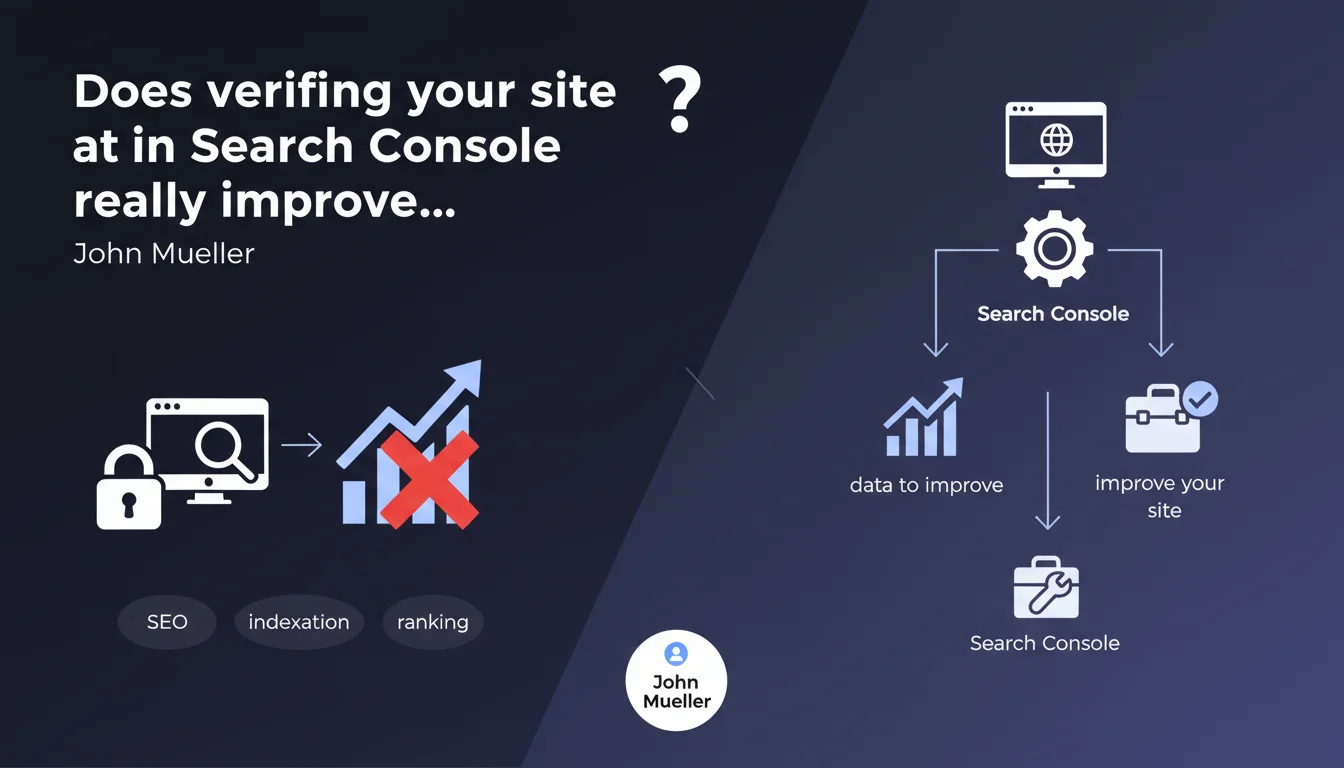
Verification in Search Console has absolutely no impact on the indexation or ranking of your site. Changing the verification method (HTML tag, DNS, file) changes nothing either. Search Console is solely a diagnostic and optimization tool, not a ranking signal.
What you need to understand
Why does Google clarify that Search Console verification doesn't affect SEO?
This clarification aims to dispel a persistent belief in the SEO community: the idea that a site verified in Search Console would receive preferential treatment from Google. Some professionals wrongly thought that having an active account signaled to Google that the site was being managed seriously.
In reality, verification is merely an authentication mechanism allowing Google to know that you are indeed the owner of the domain. Nothing more. The Googlebot crawler crawls, indexes, and ranks your site exactly the same way, whether or not you have configured Search Console.
What does this mean concretely for indexation?
Indexation depends on technical and qualitative factors: page accessibility, content quality, site architecture, relevance signals. The presence of a Search Console verification tag in your <head> or a specific DNS record is not part of these criteria.
Changing your verification method — switching from an HTML file to a meta tag or Google Analytics — triggers no re-evaluation of your site by the algorithm. It is purely administrative on the owner interface side.
What is the real value of Search Console then?
Search Console provides essential data for optimization: search performance, indexation errors, mobile usability issues, Core Web Vitals signals, sitemap coverage. This information allows you to identify and correct problems that actually impact SEO.
In other words, Search Console does not improve your rankings by its mere existence — but the corrective actions you take based on the data it provides can make all the difference.
- Search Console verification is an authentication mechanism, not a ranking signal
- Changing your verification method has no effect on indexation or ranking
- Search Console is a diagnostic tool whose value lies in the data it provides, not in its activation
- Indexation depends on technical and qualitative criteria, independent of your presence in Search Console
SEO Expert opinion
Is this statement consistent with field observations?
Yes, completely. I have verified this hypothesis on dozens of client sites: none has ever experienced a ranking variation following initial verification or a change in verification method. Traffic curves remain strictly identical before and after.
Some junior SEO professionals still worry about "losing their rankings" by removing an old verification tag. This is a baseless concern — the only consequence is that you lose access to Search Console data, nothing else.
Why does this confusion persist despite everything?
Two main reasons. First, many site owners create their Search Console account when they launch their SEO strategy — and then observe an improvement in their visibility. They wrongly associate the two events, when it is actually the content strategy and technical optimization that produces the results.
Second, some third-party tools display a higher "SEO score" when Search Console is configured. These tools actually measure the maturity of your SEO approach, not a real algorithmic advantage. Understandable confusion, but important to clarify.
In what cases might this rule seem not to apply?
If you actively submit URLs via the inspection tool or request reindexation, you may observe an indirect effect: certain pages are crawled faster than they would have been naturally. But it is not the verification that matters here — it is the manual action of requesting a crawl.
Similarly, correcting errors flagged by Search Console (misconfigured canonicals, mobile-friendliness issues) obviously improves your SEO. But again, it is the technical correction that counts, not the fact of having a verified account.
Practical impact and recommendations
Should you still verify your site in Search Console?
Absolutely. Even though it does not directly improve your rankings, Search Console remains the most accurate diagnostic tool for identifying what is blocking your visibility. Ignoring this tool means flying blind.
Verification takes a few minutes — there is no valid reason to skip it. Choose the method that works best for you: HTML tag, text file, DNS, Google Analytics, or Tag Manager. None is "better" from an SEO perspective.
What mistakes should you avoid regarding Search Console?
Do not believe that multiplying accounts or verification methods will give any boost. I have seen clients stack 3 different verification tags "just in case" — this is pointless and clutters the source code.
Another common mistake: neglecting Search Console after initial setup. The data is useless if you never consult it. Set up email alerts to be notified of critical indexation or security issues.
How to leverage Search Console to truly improve your SEO?
Focus on reports that reveal concrete opportunities: queries ranking 8-15 (optimization potential), pages excluded from the index without valid reason, mobile usability issues, degraded Core Web Vitals.
Use the URL inspection tool to understand how Googlebot actually sees your pages. Verify the JavaScript rendering, declared canonicals, detected structured data. This precise diagnosis allows you to identify invisible blockers otherwise.
- Verify your site in Search Console to access diagnostic data, not to "improve" indexation
- Choose a practical verification method and maintain it — changing has no SEO benefit
- Set up email alerts so you never miss any critical issue reported by Google
- Regularly consult coverage, performance, and Core Web Vitals reports
- Use the URL inspection tool to diagnose specific indexation issues
- Do not unnecessarily multiply verification tags — one is more than enough
❓ Frequently Asked Questions
Dois-je absolument vérifier mon site dans Search Console pour être indexé par Google ?
Quelle méthode de vérification Search Console est la meilleure pour le SEO ?
Si je supprime ma balise de vérification Search Console, vais-je perdre mon référencement ?
Vérifier mon site dans Search Console accélère-t-il l'indexation de nouvelles pages ?
Mes concurrents ont tous vérifié leur site dans Search Console, suis-je désavantagé si je ne le fais pas ?
🎥 From the same video 16
Other SEO insights extracted from this same Google Search Central video · published on 31/01/2023
🎥 Watch the full video on YouTube →
💬 Comments (0)
Be the first to comment.