
Official statement
Other statements from this video 16 ▾
- □ Should you really remove meta keyword tags from your website?
- □ Should you update your sitemap's lastmod date every time you make a minor change?
- □ Should you really separate news sitemaps and general sitemaps to avoid duplicate URLs?
- □ Is Google really ignoring your carefully crafted meta description in favor of something else?
- □ Should you really waste time cleaning up spammy backlinks from your link profile?
- □ Should you still optimize keyword density for SEO in 2025?
- □ Does disavowing toxic backlinks really help you recover your lost rankings after a penalty?
- □ Why do 301 redirects remain absolutely critical when migrating to a new domain?
- □ Can a 404 code targeting Googlebot block the indexing of your pages?
- □ Does Google really require identical content on mobile and desktop for mobile-first indexing to work?
- □ Do you really need to request removal of redirected URLs from Google's index?
- □ Does verifying your site in Search Console really improve your SEO rankings?
- □ Why does Google refuse to index dynamic multilingual content on a single URL?
- □ What happens when your hreflang links fail to validate completely?
- □ Are 'Made by X' footer links really safe for your SEO?
- □ How should you properly set up canonical and alternate tags for an m-dot architecture?
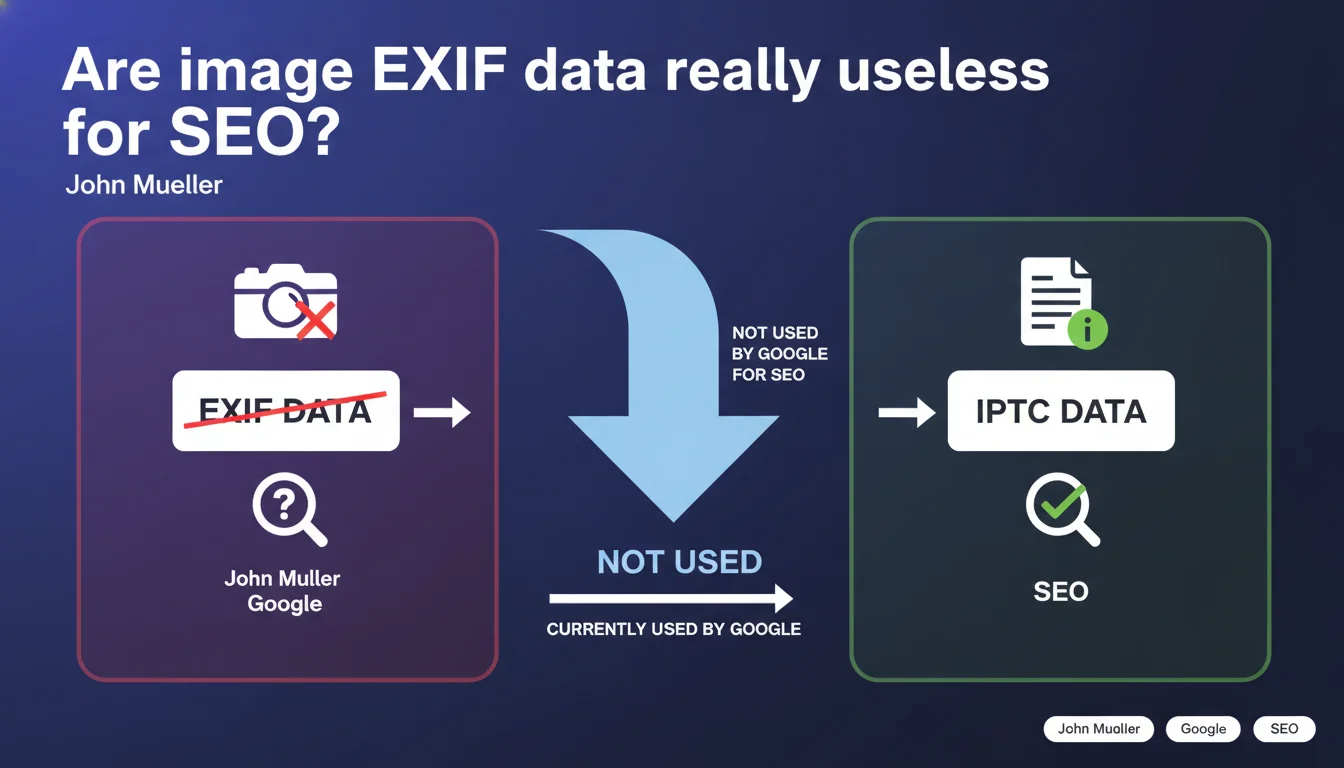
Google completely ignores image EXIF metadata for search engine optimization. Only IPTC data are taken into account by the search engine. Optimizing EXIF for SEO is therefore a complete waste of time.
What you need to understand
What's the difference between EXIF and IPTC?
The EXIF metadata (Exchangeable Image File Format) stores technical information captured by the camera: model, shooting date, exposure settings, GPS geolocation, and so on. They are automatically generated and rarely modified.
The IPTC metadata (International Press Telecommunications Council), on the other hand, are designed for publishing and distribution: title, description, keywords, author, copyright. They are added manually after shooting, often by journalists or photo agencies.
Why does Google ignore EXIF data?
The reason is simple: EXIF metadata provides no editorial or contextual value. Knowing that a photo was taken with a Canon EOS 5D at f/2.8 doesn't help understand what the image represents or how it relates to the page content.
IPTC, on the other hand, contains semantic and descriptive information: an explicit title, relevant keywords, a subject description. That's exactly what Google needs to index and understand an image.
Which IPTC metadata does Google actually use?
Mueller doesn't specify which specific IPTC fields are leveraged. We can reasonably assume that the title (Object Name), description (Caption), and keywords (Keywords) are priorities, as they correspond to information Google already extracts from HTML context.
- EXIF metadata (technical, automatic) are ignored by Google
- IPTC metadata (editorial, manual) are the only ones taken into account
- Image SEO optimization should focus on relevant IPTC fields
- EXIF geolocation information does not serve local search image optimization
SEO Expert opinion
Is this statement consistent with real-world observations?
Yes, completely. I've always found that HTML context takes precedence over any embedded metadata: alt tag, filename, adjacent text, page title. EXIF optimization tests have never produced measurable impact on positions in Google Images.
What's surprising is that Mueller doesn't specify which IPTC fields are actually leveraged. He says 'IPTC metadata are used', but which ones? To what extent? With what weight compared to HTML context? [To be verified]
Should we completely ignore EXIF then?
Let's be honest: for Google SEO, yes. But be careful — EXIF can have other legitimate uses: copyright management, image traceability, organization in a DAM (Digital Asset Management), authenticity verification for media.
The problem is that some SEO tools continue to recommend EXIF optimization as if it were a ranking factor. That's either a lack of knowledge or marketing bullshit to sell useless features.
Are IPTC data really exploited to their full potential?
There, it gets complicated. Very few websites properly fill in IPTC metadata. Most CMS don't even manage them natively. WordPress, for example, doesn't display them in the media library without a third-party plugin.
And even when they're present, there's no guarantee that Google prioritizes them over HTML context. My hypothesis: IPTC mainly serves as a validation signal or complement when HTML context is insufficient or ambiguous. But that's a guess — Google doesn't provide any details. [To be verified]
Practical impact and recommendations
Should we still invest time in image metadata?
Yes, but only on IPTC, and only if you've already optimized the fundamentals: descriptive alt tags, explicit filenames, rich HTML context around images, modern formats (WebP, AVIF), appropriate compression.
Concretely, filling in IPTC can make sense for:
- News or media sites that distribute their images to third parties
- Image banks or professional portfolios
- E-commerce sites with complex product catalogs where HTML context is limited
- Sites with large image volumes managed in a DAM
How to check and optimize IPTC metadata?
Most photo editing software (Photoshop, Lightroom, Bridge) allow you to modify IPTC. Online tools like ExifTool or ImageMagick automate bulk processing via scripts.
To verify what Google actually sees, extract metadata from an indexed image and compare it with how it renders in Google Images. If your IPTC data are ignored in favor of HTML context, you have your answer.
- Stop immediately optimizing EXIF metadata for SEO
- Focus on IPTC fields: title, description, keywords
- Verify that your compression tools preserve IPTC
- Always prioritize HTML context (alt, filename, adjacent text)
- Test the actual impact on your site before rolling out an IPTC workflow
What if you have thousands of images to rework?
It quickly becomes time-consuming. Auditing metadata, defining consistent IPTC standards, scripting automatic injection, verifying preservation after compression — all of this requires pointed technical expertise and time.
❓ Frequently Asked Questions
Les données de géolocalisation GPS dans les EXIF aident-elles au référencement local ?
Si je supprime toutes les métadonnées pour alléger mes images, est-ce que je perds du SEO ?
WordPress gère-t-il nativement les métadonnées IPTC ?
Quels champs IPTC Google exploite-t-il exactement ?
Les métadonnées IPTC peuvent-elles remplacer la balise alt ?
🎥 From the same video 16
Other SEO insights extracted from this same Google Search Central video · published on 31/01/2023
🎥 Watch the full video on YouTube →
💬 Comments (0)
Be the first to comment.