
Official statement
Other statements from this video 16 ▾
- □ Faut-il vraiment supprimer les balises meta keywords de votre site ?
- □ Faut-il modifier la date lastmod du sitemap à chaque mise à jour mineure ?
- □ Faut-il vraiment séparer les sitemaps news et généraux pour éviter les doublons d'URLs ?
- □ Pourquoi Google ignore-t-il votre meta description alors que vous l'avez soigneusement rédigée ?
- □ Faut-il vraiment nettoyer les backlinks spammés de votre profil de liens ?
- □ Faut-il encore optimiser la densité de mots-clés pour le SEO ?
- □ Le désaveu de liens suffit-il à récupérer vos positions perdues après une pénalité ?
- □ Pourquoi les redirections 301 restent-elles le nerf de la guerre lors d'un changement de domaine ?
- □ Un code 404 ciblé sur Googlebot peut-il bloquer l'indexation de vos pages ?
- □ Faut-il vraiment demander la suppression des URLs redirigées de l'index Google ?
- □ Vérifier son site dans Search Console améliore-t-il vraiment son référencement ?
- □ Pourquoi Google refuse-t-il le contenu multilingue dynamique sur une même URL ?
- □ Que se passe-t-il quand vos liens hreflang ne se valident pas tous ?
- □ Les liens footer « Made by X » sont-ils vraiment sans danger pour votre SEO ?
- □ Comment configurer correctement les balises canonical et alternate pour un site m-dot ?
- □ Les données EXIF des images sont-elles inutiles pour le SEO ?
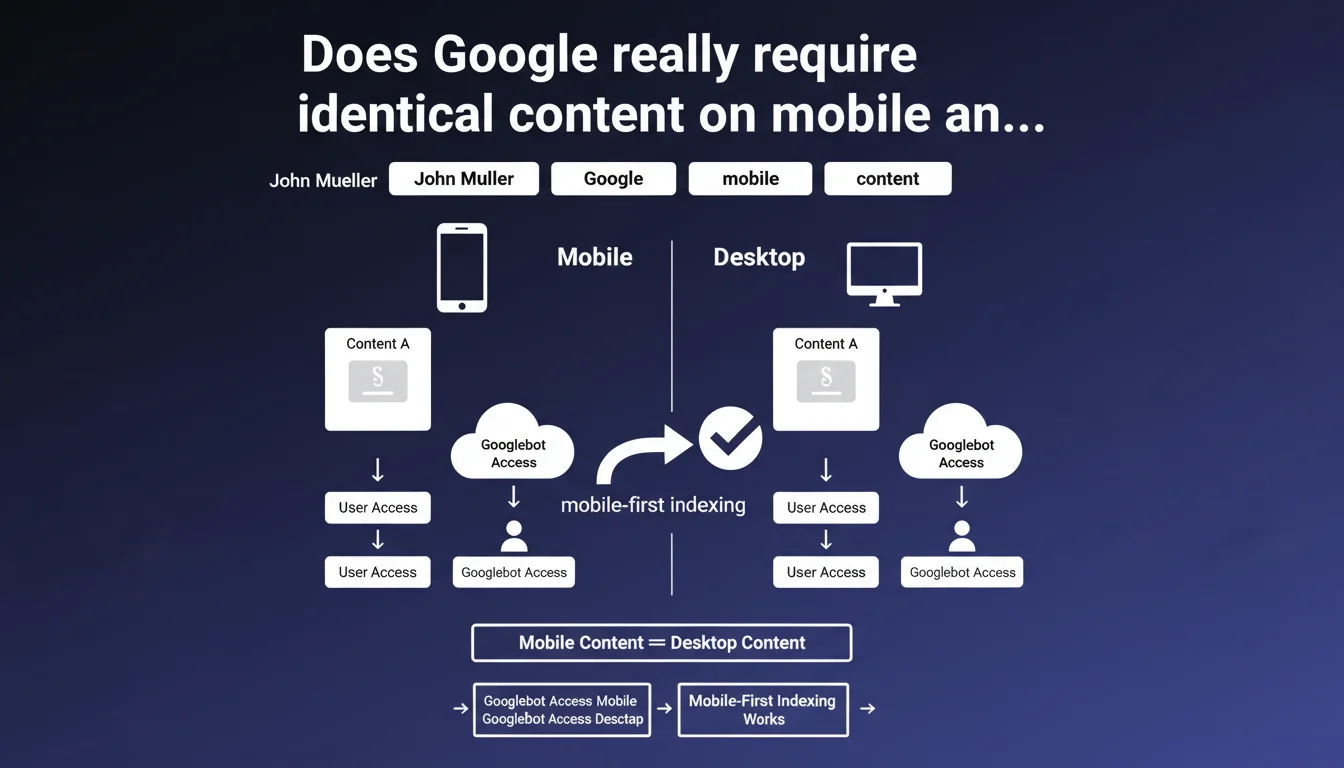
Google requires strict content parity between mobile and desktop versions for mobile-first indexing. Both versions must be accessible to both users and Googlebot. Any content discrepancy can compromise your organic visibility.
What you need to understand
Why does Google insist on mobile-desktop parity?
Since the shift to mobile-first indexing, Google crawls and prioritizes indexing the mobile version of your pages. If this version displays less content than the desktop version — a common practice a few years ago — Google simply won't see what's missing.
Concretely? Your desktop page might contain 2000 words, detailed tables, and solid argument sections. If your mobile version only shows 800 words and hides the rest behind accordions that aren't expanded by default, Google will only index those 800 words. The rest doesn't exist for the algorithm.
What exactly does Google mean by "same content"?
Mueller is talking about content parity, not display parity. You can present content differently (hamburger navigation, adaptive images, responsive layout), but text, images, videos, and links must be identical.
Critical points:
- Visible text: everything that appears on desktop must be accessible on mobile, even if it's in an accordion or tab
- Images and media: same images with identical alt attributes, same embedded videos
- Internal links: the linking structure must be consistent between the two versions
- Structured data: identical on mobile and desktop
- Metadata: title tags, meta descriptions, canonical tags — everything must match
How does Google access both versions to verify?
Google doesn't just crawl a single version. Even with mobile-first indexing, Googlebot occasionally visits the desktop version to check for consistency. If you block access to one of the versions (through misconfigured robots.txt, aggressive redirects, accidental cloaking), you create a negative signal.
Mueller specifies that both users AND Google must be able to access both versions. No user-agent sniffing that serves different content depending on whether it's a bot or a human. No forced mobile→desktop or desktop→mobile redirects that prevent access to the alternative version.
SEO Expert opinion
Is this directive really followed by major websites?
Let's be honest: many major e-commerce and media sites don't strictly follow this rule. You regularly find product pages where detailed specifications are hidden on mobile, or news articles where contextual information only appears on desktop.
Yet these sites rank well. Why? Because they compensate with other factors: massive domain authority, content freshness, volume of backlinks, positive user signals. But that's not a reason to ignore the directive — you probably don't have their margin for error.
What gray areas does Google fail to clarify?
Mueller remains vague on certain critical points. Accordions and tabs for example: are they considered accessible content if the user has to click to expand? Google has stated several times that yes, content within accordions is crawled and indexed.
But — and here's where it gets tricky — does hidden-by-default content carry the same weight as immediately visible content? [To verify] Field observations suggest a slightly lower weighting, but Google has never officially confirmed a devaluation coefficient.
In which cases can differences be tolerated?
Certain differences are acceptable, even recommended. Navigation can be restructured (hamburger menu vs horizontal menu). Ads can be adapted or reduced on mobile without negative SEO impact — it's even encouraged for user experience.
Images can use srcset to serve different resolutions, as long as the main image remains the same. Complex tables can be made horizontally scrollable on mobile — this is a presentation adaptation, not content removal.
Practical impact and recommendations
How do you audit content parity between mobile and desktop?
First step: crawl your site with two different user-agents (desktop and mobile) using Screaming Frog or Oncrawl. Compare text content length page by page. A gap exceeding 15-20% warrants investigation.
Then use the URL inspection tool in the Search Console. Explicitly select the smartphone user-agent and check the HTML rendering. Compare with desktop rendering. Differences will be obvious.
Watch out for:
- Verify that critical images (products, infographics) are present on mobile with the same alt attributes
- Ensure that internal linking doesn't lose important links on mobile
- Check that structured data (Schema.org) is identical on both versions
- Test accordions and tabs: content must be in the HTML, not loaded via AJAX after user interaction
What mistakes should you absolutely avoid?
The classic mistake: hiding content on mobile via display:none to "lighten" the page. Google crawls this content, but the signal is ambiguous — why hide something you deem important enough to include on desktop?
Another pitfall: poorly configured m-dot sites (m.example.com) that serve a stripped-down version of content. If you're still on an m-dot architecture in 2025, migration to responsive design becomes urgent. M-dot complicates maintenance and multiplies the risks of inconsistency.
Never block the CSS or JavaScript resources necessary for mobile rendering in robots.txt. Google needs these resources to properly interpret your content.
What strategy should you adopt to stay compliant while optimizing mobile UX?
Well-implemented responsive design remains the safest solution: same HTML, differentiated CSS based on screen size. You guarantee content parity by default, and you only adapt the presentation.
If you absolutely must hide secondary content on mobile, use accordions with content in the initial DOM. The user controls what they want to see, Google accesses everything. This is the cleanest compromise.
Mobile-desktop parity is non-negotiable if you're aiming for solid organic visibility. The exceptions you observe among web giants are not reproducible without their authority capital. Auditing, correcting, and maintaining this consistency requires pointed technical expertise — navigating JavaScript architectures, managing server-side rendering, optimizing Core Web Vitals while preserving content. If your technical stack is complex or you lack internal resources, working with a specialized SEO agency can significantly accelerate compliance and prevent costly mistakes.
❓ Frequently Asked Questions
Le contenu dans des accordéons sur mobile est-il bien indexé par Google ?
Peut-on avoir moins d'images sur mobile que sur desktop sans pénalité SEO ?
Les sites m-dot (m.example.com) sont-ils encore viables pour l'indexation mobile-first ?
Comment vérifier que Googlebot accède bien aux deux versions de mon site ?
Faut-il dupliquer les données structurées Schema.org entre mobile et desktop ?
🎥 From the same video 16
Other SEO insights extracted from this same Google Search Central video · published on 31/01/2023
🎥 Watch the full video on YouTube →
💬 Comments (0)
Be the first to comment.