
Official statement
Other statements from this video 16 ▾
- □ Should you really remove meta keyword tags from your website?
- □ Should you update your sitemap's lastmod date every time you make a minor change?
- □ Should you really separate news sitemaps and general sitemaps to avoid duplicate URLs?
- □ Should you really waste time cleaning up spammy backlinks from your link profile?
- □ Should you still optimize keyword density for SEO in 2025?
- □ Does disavowing toxic backlinks really help you recover your lost rankings after a penalty?
- □ Why do 301 redirects remain absolutely critical when migrating to a new domain?
- □ Can a 404 code targeting Googlebot block the indexing of your pages?
- □ Does Google really require identical content on mobile and desktop for mobile-first indexing to work?
- □ Do you really need to request removal of redirected URLs from Google's index?
- □ Does verifying your site in Search Console really improve your SEO rankings?
- □ Why does Google refuse to index dynamic multilingual content on a single URL?
- □ What happens when your hreflang links fail to validate completely?
- □ Are 'Made by X' footer links really safe for your SEO?
- □ How should you properly set up canonical and alternate tags for an m-dot architecture?
- □ Are image EXIF data really useless for SEO?
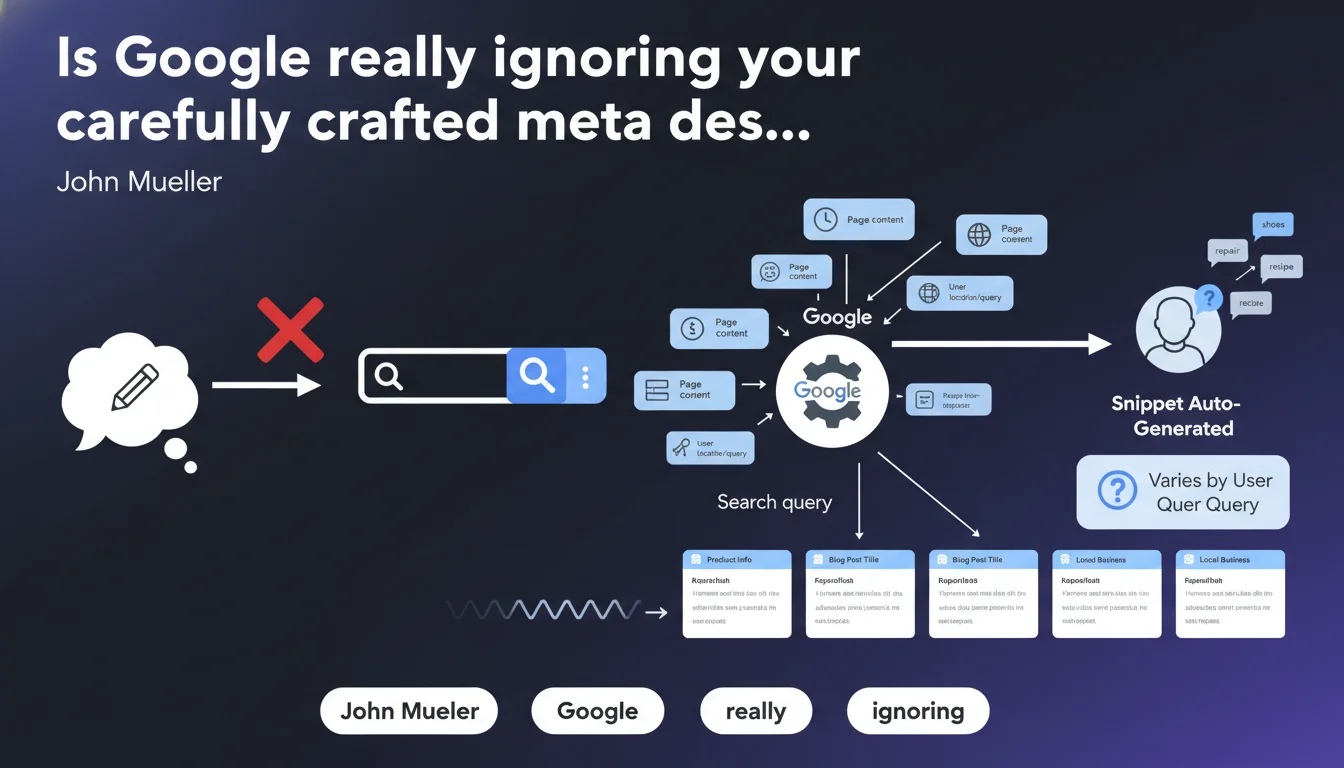
Google guarantees no use of the meta description you write. Snippets are generated dynamically based on the user's search query, pulling from different parts of your page according to contextual relevance. Your meta tag can be completely ignored if Google determines that another portion of content better answers the search intent.
What you need to understand
Does Google really generate snippets autonomously?
Yes, and it always has. The meta description has never been a directive but a suggestion. Google reserves the right to pull from anywhere in your page content to compose the snippet displayed in search results.
The nuance Mueller brings here: this generation is contextual. For the same page, the snippet can vary depending on the query that triggered it. Google tries to display the fragment most relevant to the user's intent, not necessarily the one you wrote.
Why doesn't Google just display what I wrote?
Because your meta description is often too generic or too commercial. It doesn't always align with the diversity of long-tail queries that trigger your page.
Concrete example: you optimized your meta for "running shoes", but a user searches "waterproof running shoes gel sole". If your page contains a paragraph mentioning these specific details, Google will display it rather than your generic meta.
What does this change for click-through rate?
Potentially a lot. An auto-generated snippet can be more relevant than a hastily written meta — or completely botched if Google extracts a mangled sentence from the middle of your page.
The problem: you lose narrative control. It's impossible to guarantee a coherent message, a precise CTA, or a formulation optimized for conversion.
- The meta description remains a suggestion, never a guarantee of display
- The snippet varies by query — the same page can have multiple different snippets
- Google pulls from all page content, not just meta tags
- Contextual relevance takes priority over your editorial intent
- You don't control the final message displayed to users
SEO Expert opinion
Is this statement consistent with what we observe in the field?
Completely. Large-scale snippet analyses show that Google ignores meta descriptions in 60 to 70% of cases. This isn't a bug, it's assumed behavior.
What Mueller doesn't say: Google actively tests different snippets to maximize CTR. Your meta may be displayed for a few weeks, then replaced by an auto-generated excerpt with no apparent reason. [To verify]: it appears Google A/B tests snippets based on click performance, but there's no official confirmation.
Should you still write meta descriptions then?
Let's be honest: yes, but with realistic expectations. The meta description remains your first line of defense. If it's well done, Google can use it for targeted main queries.
But don't spend hours perfecting 160 characters. Instead, focus on the overall editorial quality of your introductory paragraphs — those are what Google extracts most often.
What are the real levers to influence snippets?
Content structure. Short lists, concise sentences at the beginning of sections, well-formatted question-and-answer content — anything that facilitates extraction by Google.
And that's where it gets tricky. Many sites have compact paragraphs, convoluted sentences, zero clear semantic hierarchy. Google then extracts truncated snippets of text that hurt CTR.
Practical impact and recommendations
What should you do concretely to maximize your chances of a good snippet?
Continue to write meta descriptions, but change your approach. Write them as a concise commercial pitch, with a clear CTA. For strategic pages, it's non-negotiable.
Next, structure your introductions like autonomous summaries. The first 2-3 paragraphs should be extractable without context and remain understandable. Hook statement, main benefit, differentiating angle.
How can you verify what Google actually displays as snippets?
Use Search Console. "Performance" section, filter by page, look at queries generating impressions. Test these queries in private browsing to see real snippets.
Identify inconsistencies: snippets cutting off mid-sentence, displaying technical mentions ("Lorem ipsum", visible HTML tags), or extracting footer content. Prioritize corrections.
What mistakes should you absolutely avoid?
Never leave a page without a meta description. Even if Google often ignores it, complete absence guarantees an auto-generated snippet — and you lose any chance to influence the message.
Avoid duplicate metas between similar pages. Google detects them and prefers to generate its own snippets rather than display duplicated content.
- Write unique meta descriptions for each strategic page (max 155 characters)
- Structure your introductions in short, autonomous paragraphs
- Use lists, question-and-answer formats, clear definitions at the start of content
- Regularly check snippets displayed via Search Console
- Correct content generating truncated or inconsistent snippets
- Test your pages on multiple queries to see snippet variability
- Never duplicate meta descriptions between similar pages
❓ Frequently Asked Questions
Google utilise-t-il toujours ma meta description pour les requêtes de marque ?
Puis-je forcer Google à utiliser ma meta description ?
Les snippets auto-générés nuisent-ils au CTR ?
Faut-il optimiser différemment pour les featured snippets et les snippets classiques ?
La longueur de la meta description a-t-elle un impact sur son utilisation par Google ?
🎥 From the same video 16
Other SEO insights extracted from this same Google Search Central video · published on 31/01/2023
🎥 Watch the full video on YouTube →
💬 Comments (0)
Be the first to comment.