
Official statement
Other statements from this video 16 ▾
- □ Should you really remove meta keyword tags from your website?
- □ Should you update your sitemap's lastmod date every time you make a minor change?
- □ Should you really separate news sitemaps and general sitemaps to avoid duplicate URLs?
- □ Is Google really ignoring your carefully crafted meta description in favor of something else?
- □ Should you still optimize keyword density for SEO in 2025?
- □ Does disavowing toxic backlinks really help you recover your lost rankings after a penalty?
- □ Why do 301 redirects remain absolutely critical when migrating to a new domain?
- □ Can a 404 code targeting Googlebot block the indexing of your pages?
- □ Does Google really require identical content on mobile and desktop for mobile-first indexing to work?
- □ Do you really need to request removal of redirected URLs from Google's index?
- □ Does verifying your site in Search Console really improve your SEO rankings?
- □ Why does Google refuse to index dynamic multilingual content on a single URL?
- □ What happens when your hreflang links fail to validate completely?
- □ Are 'Made by X' footer links really safe for your SEO?
- □ How should you properly set up canonical and alternate tags for an m-dot architecture?
- □ Are image EXIF data really useless for SEO?
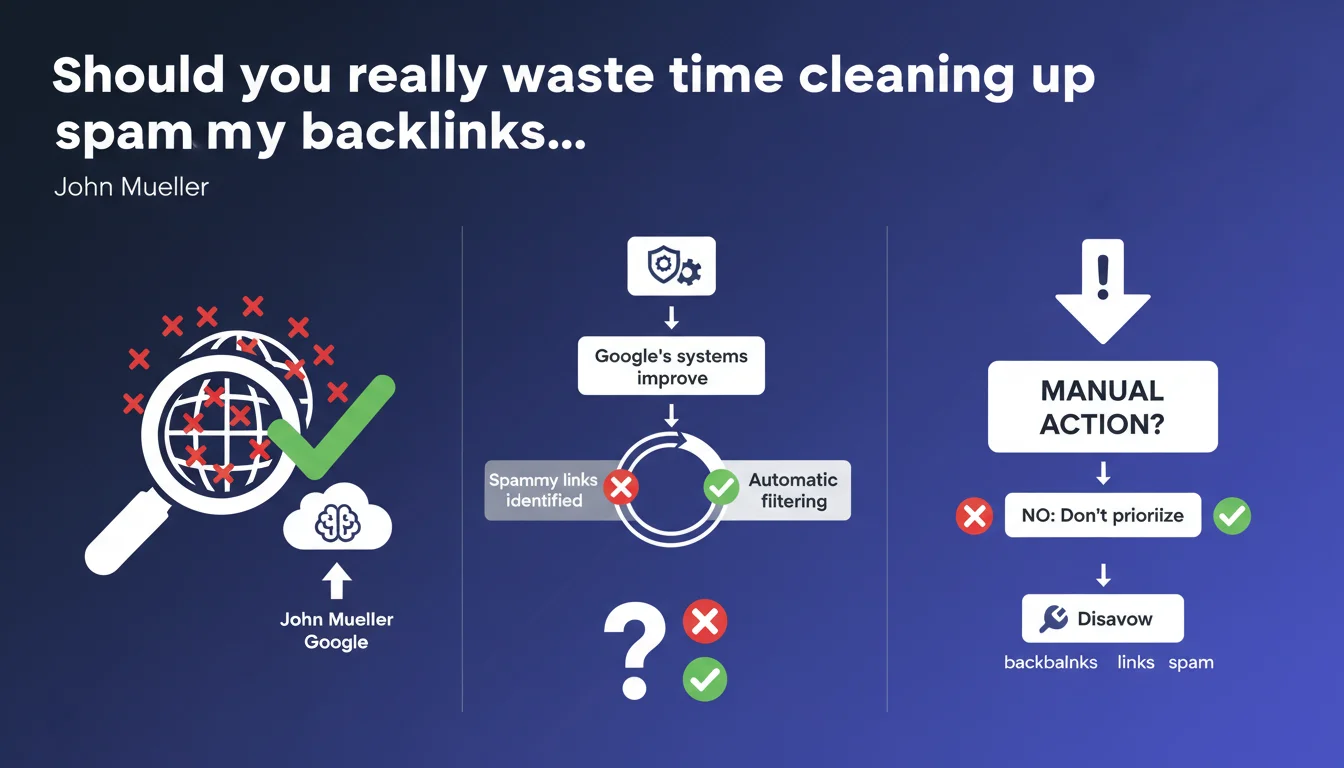
Google claims its systems now automatically detect spammed links and neutralize them with no negative impact on your rankings. Unless you receive a manual action, actively cleaning your link profile is no longer a priority according to Mueller. The disavow tool remains available but is only recommended in very specific cases.
What you need to understand
What does this shift in spammed link management really mean?
Google has significantly strengthened its link spam detection algorithms. Instead of penalizing sites receiving questionable backlinks, the systems simply ignore these links when calculating rankings. This change marks a departure from the historical approach where a poor link profile could actively harm your site.
In practical terms? Low-quality links — spammy directories, automated comments, poorly disguised PBN networks — are now neutralized rather than penalized. Your site is no longer held responsible for negative SEO attempts or dubious past practices from unscrupulous service providers.
When does link cleanup actually remain necessary?
Mueller clarifies there's only one situation that justifies action: receiving a manual action in Search Console. These manual penalties occur when a Google human reviewer detects a clear pattern of manipulation.
Manual actions for artificial links remain rare but do exist. They primarily affect sites that have massively purchased links or participated in organized link networks. In that specific case, the disavow tool becomes essential to lift the penalty.
Does the disavow tool still have practical value?
The tool remains available but its use becomes marginal. Google positions it as a last resort solution rather than a regular maintenance tool. Most SEO professionals can now ignore it entirely.
A few edge cases persist: sites purchased with documented toxic history, particularly aggressive negative SEO campaigns, or stubborn manual action removal. But for 95% of sites, the effort isn't worth it anymore.
- Spammed links are automatically neutralized by Google's algorithms with no negative impact
- Active cleanup is only required if you receive a confirmed manual action in Search Console
- The disavow tool becomes an exceptional resort rather than a common practice
- SEO resources can be reallocated toward levers with direct positive impact
SEO Expert opinion
Does this statement actually reflect what we observe in the field?
Yes — and it's consistent with what we've been seeing for several years. Sites with objectively catastrophic link profiles no longer collapse in the SERPs the way they did between 2012 and 2016. Penguin 4.0 marked a turning point by shifting from a penalty mode to a devaluation mode.
However. The nuance missing from Mueller's statement: ignoring a link isn't neutral. If 60% of your profile is devalued, your ranking potential is mechanically reduced. You don't lose positions, but you hit a ceiling faster than competitors with clean profiles.
In what contexts does this rule show its limitations?
First case: e-commerce sites in ultra-competitive niches. When three competitors battle for the top position with similar profiles, the ratio of valid links to ignored links sometimes makes the difference. No penalty, certainly — but a war of attrition over quality.
Second case: site acquisitions or mergers. A domain purchased with 80% of inherited toxic links from a previous unscrupulous owner won't be penalized, but its actual authority remains constrained. The disavow can then accelerate the cleanup Google perceives, even if Mueller downplays this aspect.
How much of this statement involves oversimplification?
Mueller speaks of "systems" in plural without detailing them. [To verify]: How does Google differentiate between intentionally acquired links and suffered spammed links? The boundary remains fuzzy. Sophisticated PBNs, triangular exchanges, disguised guest posts — are they really all automatically detected?
The absence of hard data raises questions. What percentage of links is actually neutralized? On what specific criteria? Google deliberately maintains this gray area to discourage gaming attempts. Pragmatically: if you need to wonder whether a link will pass detection, it's probably borderline.
Practical impact and recommendations
What should you concretely stop doing immediately?
Stop obsessive monthly backlink audits. Those Excel files with 10,000 lines where you color-code each link red/yellow/green? Reallocate that time elsewhere. Unless you see an alarm in Search Console, the exercise is just SEO theater.
Also abandon systematic disavow file submissions "just in case." This defensive practice adds nothing and can even, in rare cases, neutralize links Google considered valid. The risk outweighs the potential benefit.
What actions should you keep in your SEO routine?
Monitor manual action notifications in Search Console. Set up email alerts so you never miss this type of signal. This is the only trigger that justifies quick action on your link profile.
Continue building quality editorial links — that's the real lever. Mueller's statement doesn't change this equation: a contextual link from a reputable media outlet is still worth 100 times more than a niche directory. Neutralizing spam doesn't make good links optional.
- Check Search Console monthly for any manual actions
- Set up email alerts for critical Google messages
- Concentrate link budget on documented quality acquisitions
- Archive (don't delete) old disavow files for traceability
- Redirect toxic audit resources toward linked competitor analysis
- Document active link campaigns for justification in case of review
The bottom line: shift from defensive mode to offensive mode. The time saved on paranoid cleanup should fuel prospecting for real editorial placements. Only monitor Search Console alerts, ignore the background noise.
This strategic reorientation often requires a complete overhaul of SEO methodology. Complex link profiles, post-penalty repositioning, or acquisition strategies in competitive sectors demand specialized expertise. Partnering with a specialized SEO agency provides precise diagnosis of your situation and an adapted roadmap, particularly if you're coming out of years of time-consuming defensive practices.
❓ Frequently Asked Questions
Dois-je supprimer mon fichier de désaveu existant ?
Un concurrent peut-il me nuire avec des backlinks spammés ?
Les outils d'analyse de backlinks gardent-ils une utilité ?
Comment savoir si j'ai une action manuelle active ?
Faut-il encore auditer les backlinks lors d'un rachat de site ?
🎥 From the same video 16
Other SEO insights extracted from this same Google Search Central video · published on 31/01/2023
🎥 Watch the full video on YouTube →
💬 Comments (0)
Be the first to comment.