
Official statement
Other statements from this video 16 ▾
- □ Should you really remove meta keyword tags from your website?
- □ Should you update your sitemap's lastmod date every time you make a minor change?
- □ Should you really separate news sitemaps and general sitemaps to avoid duplicate URLs?
- □ Is Google really ignoring your carefully crafted meta description in favor of something else?
- □ Should you really waste time cleaning up spammy backlinks from your link profile?
- □ Should you still optimize keyword density for SEO in 2025?
- □ Does disavowing toxic backlinks really help you recover your lost rankings after a penalty?
- □ Why do 301 redirects remain absolutely critical when migrating to a new domain?
- □ Can a 404 code targeting Googlebot block the indexing of your pages?
- □ Does Google really require identical content on mobile and desktop for mobile-first indexing to work?
- □ Do you really need to request removal of redirected URLs from Google's index?
- □ Does verifying your site in Search Console really improve your SEO rankings?
- □ What happens when your hreflang links fail to validate completely?
- □ Are 'Made by X' footer links really safe for your SEO?
- □ How should you properly set up canonical and alternate tags for an m-dot architecture?
- □ Are image EXIF data really useless for SEO?
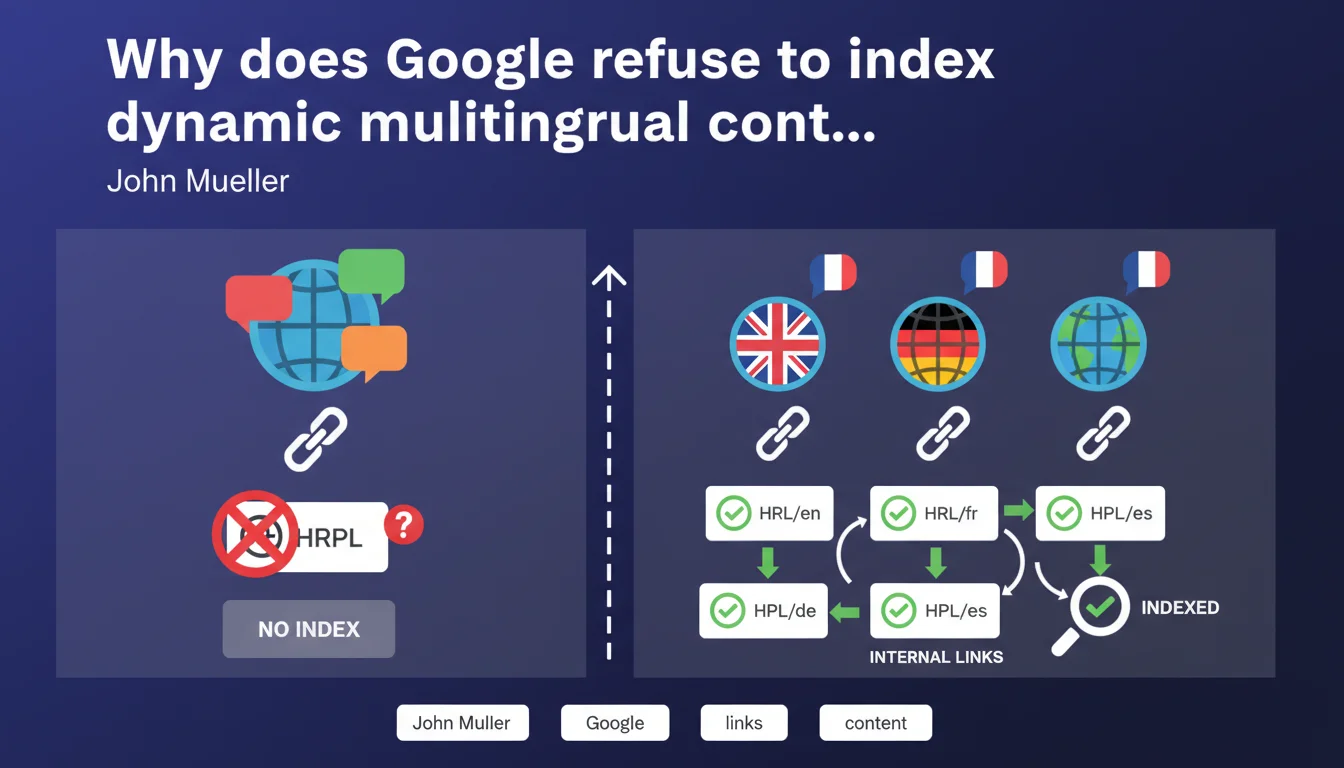
Google requires distinct URLs for each language on a multilingual site. Dynamically changing content on a single URL based on user language prevents search engines from indexing correctly. Internal linking between language versions becomes absolutely essential.
What you need to understand
What technically blocks the indexing of a single multilingual URL?
Google's crawlers cannot execute all language variants of the same URL. When a site detects the browser's language to display different content on example.com, Googlebot only sees one version — the one served by default or according to its user-agent settings.
Result: other languages remain invisible to the search engine. No indexation, no ranking. It's that simple.
Why does a separate URL architecture become mandatory?
Each language must have its own unique and crawlable URL: example.com/en/, example.co.uk, en.example.com, whatever structure you choose. The key is that each language version is accessible via a distinct address, without depending on cookies, client-side JavaScript, or IP detection.
This separation allows Google to index each language independently, apply hreflang correctly, and serve the right version based on geolocation and user language.
What role does internal linking play in this logic?
Creating distinct URLs isn't enough. If these pages aren't linked to each other through internal linking, Google may fail to discover all versions. A visible and accessible language selector is essential for exhaustive crawling.
- URLs must be distinct for each language
- Dynamic content on a single URL is not indexable
- Internal linking between language versions is mandatory
- Hreflang tags complement the setup but don't replace it
SEO Expert opinion
Does this directive really apply to all situations?
Google takes a very strict stance here, but real-world evidence shows nuances rarely discussed. For example, some sites use subdirectories with partially translated content and manage to index correctly by combining well-structured hreflang and multilingual sitemaps.
However, attempting to swap content via client-side JavaScript or cookies without distinct URLs is playing with fire. [To verify]: Google claims it cannot crawl these variants, but never details how its crawler handles hybrid sites that mix SSR and server-side language detection with URL rewriting.
Is internal linking truly decisive or just recommended?
Let's be honest: without internal links to language versions, you're relying solely on the XML sitemap to signal alternatives. It's doable, but risky. If your sitemap contains 10,000 URLs and Google decides to crawl 30% this month, some languages could remain orphaned for weeks.
Internal linking guarantees immediate discoverability. It's insurance — not an option.
What about global sites with 50+ languages?
That's where it gets tricky. Displaying a selector with 50 flags pollutes UX and dilutes link equity. Some sites implement geolocation-based selectors or dropdown menus grouping languages by region. Google gives no precise guidance on what it prefers — just that links must exist.
Practical impact and recommendations
What should you audit first on an existing multilingual site?
First step: verify that each language has a unique and stable URL. Use Google Search Console to confirm all language versions are indexed. If some languages are missing, it's likely a crawlability or internal linking issue.
Next, inspect the source code of pages to ensure the language selector generates standard HTML links — not JavaScript injecting URLs after load. Google may not follow these links if rendering is too complex.
What technical errors most often block multilingual indexation?
Automatic redirects based on IP or browser language are a classic mistake. The user lands on example.com, gets redirected to example.com/en/ based on their language — but US Googlebot never sees other versions. Result: only the English version gets indexed.
Another trap: canonical tags misconfigured to point to the English version across the board. This signals to Google that other languages are duplicates — they disappear from the index.
How should you structure internal linking between language versions?
- Integrate a visible language selector on each page, ideally in the header
- Use static HTML links to each version, not asynchronous JavaScript
- Implement hreflang tags to signal language equivalencies
- Verify that alternative URLs aren't blocked by robots.txt or noindex
- Submit a multilingual XML sitemap with all versions
- Test crawlability with Screaming Frog or similar tools
❓ Frequently Asked Questions
Peut-on utiliser des sous-domaines plutôt que des sous-répertoires pour les versions linguistiques ?
Les balises hreflang suffisent-elles sans maillage interne visible ?
Que se passe-t-il si on redirige automatiquement selon la langue du navigateur ?
Faut-il traduire absolument tout le contenu ou peut-on mixer langues sur une même page ?
Les sites e-commerce avec des milliers de produits doivent-ils vraiment dupliquer toutes les URLs ?
🎥 From the same video 16
Other SEO insights extracted from this same Google Search Central video · published on 31/01/2023
🎥 Watch the full video on YouTube →
💬 Comments (0)
Be the first to comment.