
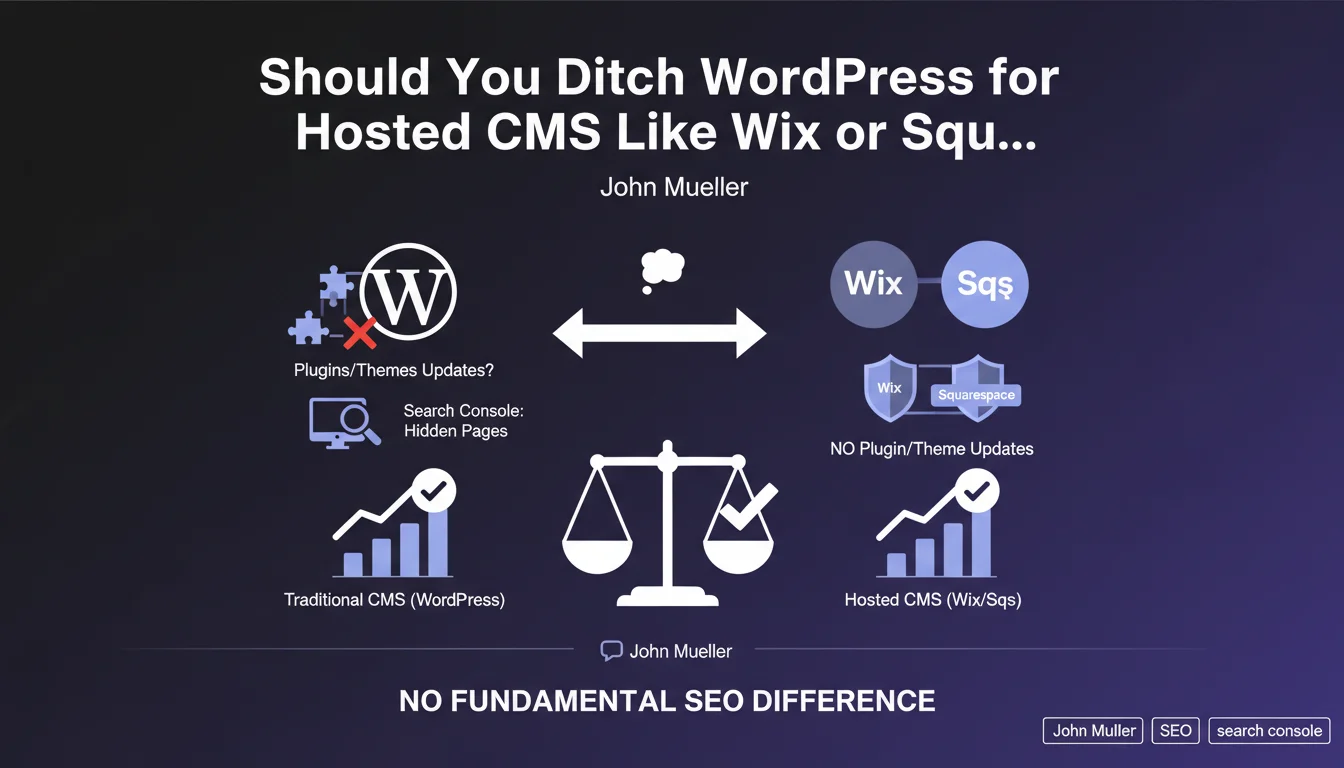
Official statement
What you need to understand
Google officially states that modern CMS platforms offer equivalent SEO performance. This statement challenges a widespread belief in the SEO community that WordPress holds a natural advantage for search engine optimization.
Google's position is clear: no CMS receives preferential treatment in the algorithm. Whether you use WordPress, Wix, Squarespace, Shopify or any other modern platform, the search engine only evaluates the technical quality of the final implementation.
This evolution is explained by the growing maturity of hosted solutions. Platforms like Wix or Squarespace have invested considerably in their SEO capabilities in recent years, correcting the historical shortcomings that penalized them.
- Technical equality: all modern CMS platforms enable achieving required SEO standards
- Simplified maintenance: hosted solutions eliminate risks related to plugin and theme updates
- End of the WordPress myth: using WordPress provides no intrinsic SEO bonus
- Focus on implementation: what matters is configuration quality, not CMS choice
SEO Expert opinion
This statement is technically correct but requires significant nuances in practice. Indeed, Google doesn't favor any CMS, but the operational reality is more complex.
The fundamental distinction lies in flexibility and technical control. WordPress with plugins like Yoast or Rank Math offers unmatched configuration granularity for advanced optimizations: custom schema markup, fine-grained crawl budget management, precise canonical URL control, loading time optimization via specific CDNs.
Hosted solutions excel for simple to moderately complex sites where simplified maintenance constitutes a real advantage. However, for ambitious e-commerce projects, complex multilingual sites or architectures requiring custom development, WordPress maintains a clear edge.
Practical impact and recommendations
- Don't migrate a well-performing WordPress site to Wix solely for supposed SEO reasons: it won't bring any gains
- Favor hosted solutions if you lack technical resources to maintain a secure and up-to-date WordPress
- Audit your current CMS via Search Console to identify real issues (orphan pages, indexing errors) rather than questioning the technology choice
- Test SEO fundamentals regardless of your CMS: loading speed, Core Web Vitals, structured data, XML sitemap, robots.txt file
- Document your future needs before any platform change: e-commerce features, multilingualism, third-party integrations, anticipated content volume
- Invest in configuration rather than platform: a perfectly optimized Wix outperforms a poorly configured WordPress
- Train yourself on the specifics of your chosen CMS to fully leverage its native SEO capabilities
SEO optimization of a website requires in-depth technical expertise and constant monitoring of best practice developments, regardless of the chosen platform. Optimal configuration of SEO parameters, information architecture and technical trade-offs demand mastery that few companies possess in-house. Engaging a specialized SEO agency provides expert perspective adapted to your specific CMS, helps avoid costly mistakes during potential migrations, and ensures your platform is configured to perform sustainably in search results.
💬 Comments (0)
Be the first to comment.