
Official statement
John Mueller commented on this humorously on Bluesky ("Maybe the real impressions were the friends we made along the way"), implying that many of these impressions were not real.
What you need to understand
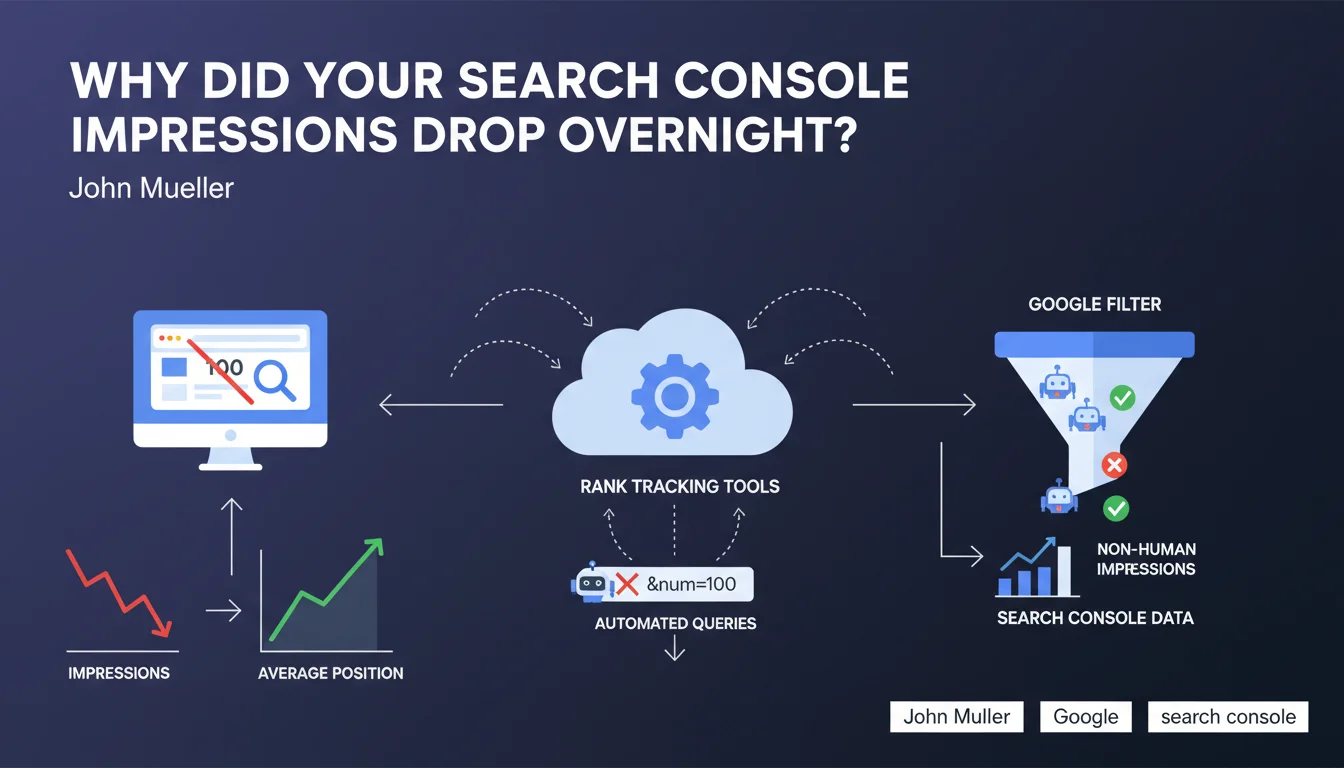
Google recently removed the &num=100 URL parameter that allowed displaying 100 search results per page instead of the usual 10. This technical modification has had a major impact on the data reported in Google Search Console.
The direct consequence: many sites have observed a sudden drop in their impressions, particularly on desktop, paradoxically accompanied by an improvement in their average position.
The explanation is simple but important to understand: automated rank tracking tools heavily used this parameter to check rankings. These robotic queries generated artificial impressions that inflated statistics without corresponding to real users.
- Removal of the &num=100 parameter by Google
- Filtering of non-human impressions generated by rank trackers
- Search Console data closer to user reality
- Drop in impressions but increase in average position (mathematical effect)
- Impact mainly visible on desktop where this parameter was more widely used
SEO Expert opinion
This explanation from Google is perfectly consistent with what we have been observing for years. SEO tracking tools do indeed generate enormous volumes of automated queries, and their impact on Search Console statistics was an open secret in the industry.
The humorous remark reflects an important reality: many SEO practitioners were focusing on artificially inflated metrics rather than actual traffic. This technical correction forces a return to essentials: real impressions generated by real users.
This update emphasizes the importance of cross-referencing multiple data sources: Analytics for actual traffic, Search Console for trends, and third-party tools with caution. The truly important KPIs remain qualified organic traffic and conversions.
Practical impact and recommendations
- Analyze your Search Console data before and after the change to quantify the impact on your site
- Compare with Google Analytics: if actual organic traffic hasn't dropped proportionally, everything is fine
- Adjust your benchmarks and objectives based on this new, more realistic data
- Inform your clients or management of this technical change to avoid false alerts
- Don't modify your SEO strategy in reaction to this mechanical drop in impressions
- Focus on business metrics: conversions, actual click-through rate, user engagement
- Reassess the reliability of your tracking tools and their data collection methodology
- Document this change in your reports to maintain historical consistency
These measurement and analysis adjustments can prove complex to interpret correctly, especially when explaining variations to non-technical stakeholders. Support from a specialized SEO agency provides proven expertise to distinguish cosmetic technical changes from real visibility issues, and maintain a coherent optimization strategy based on the right indicators.
💬 Comments (0)
Be the first to comment.