
Official statement
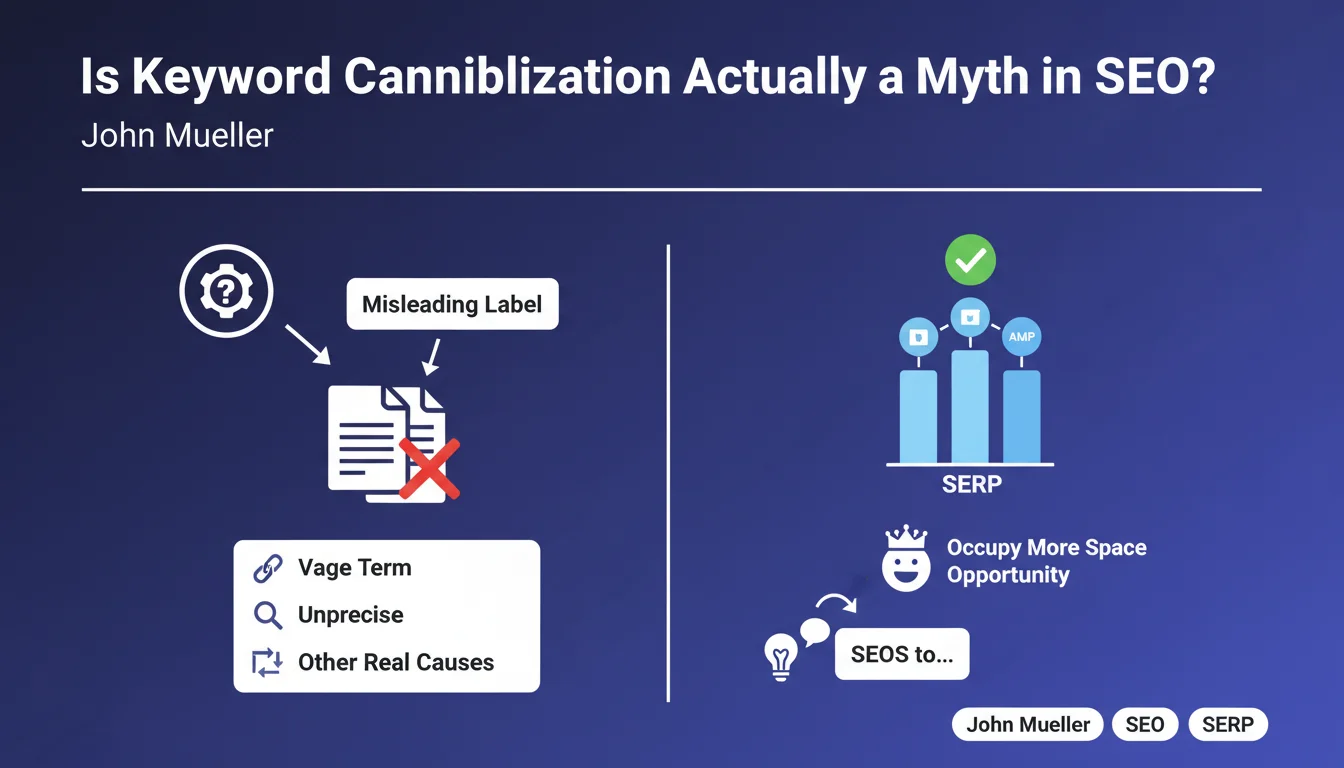
For example, if three pages appear in the same SERP, it's rather an opportunity to occupy more space. In short, John Mueller invites SEOs to abandon the concept of cannibalization to focus on more concrete and measurable problems: relevance, clarity, internal linking and real value for the user.
What you need to understand
Keyword cannibalization is a widely spread concept in the SEO community. It refers to the situation where multiple pages from the same site rank for an identical query, thus creating a form of "internal competition".
According to this statement, this concept would be poorly defined and often misused to explain SEO problems. In reality, having multiple pages appearing for the same search isn't necessarily harmful.
The example given is telling: if three pages from the same site appear in the results, this represents an exceptional opportunity to occupy more space in the SERP. It's potentially beneficial for the site's overall visibility.
- The term "cannibalization" is vague and doesn't correspond to a precise technical dysfunction
- Multiple pages for the same query can be a strategic advantage rather than a problem
- The real problems to investigate are: content relevance, clarity of intent, internal linking and value provided to the user
- It's recommended to change perspective and abandon this label to focus on concrete metrics
SEO Expert opinion
This position is consistent with field observations from numerous practical cases. Indeed, high-performing e-commerce sites regularly display multiple URLs (category pages, product pages, buying guides) for the same queries without this harming their overall performance.
Nevertheless, important nuances must be made. If Google randomly alternates between two weak pages without favoring either one, it's often a symptom of an editorial clarity problem. The search engine cannot determine which page is most relevant to answer the search intent.
The recommended approach consists of diagnosing the real underlying problem: duplicate content, misunderstood user intent, confusing information architecture, or absence of clear signals (linking, tags) indicating to Google which page to prioritize.
Practical impact and recommendations
- Stop obsessively tracking supposed cannibalization in your SEO tools without contextual analysis
- Analyze ranking patterns instead: does one page clearly dominate or is there chaotic alternation?
- Evaluate overall performance: if multiple pages rank and generate qualified traffic, it's positive
- Check search intent: do your pages answer slightly different intents (informational vs transactional)?
- Optimize your internal linking to clearly indicate to Google which page is priority for which query
- Clarify your editorial architecture: each page must have a distinct objective and semantic target
- Measure user value: conversion rate, engagement, time spent rather than just ranking
- Consolidate only when necessary: merge pages only if they're truly redundant and neither performs
- Test and measure: any consolidation decision must be followed by precise KPIs to validate impact
In summary: replace the superficial diagnosis of "cannibalization" with an in-depth analysis of real problems: relevance, intent, structure and signals sent to Google.
These strategic optimizations require sharp expertise in information architecture and a fine understanding of algorithmic signals. For complex sites with hundreds of pages, the analysis can quickly become laborious and time-consuming.
If you notice unstable ranking patterns or deep structural problems, support from a specialized SEO agency can prove valuable to establish a precise diagnosis and implement a tailored optimization strategy, adapted to your specific context.
💬 Comments (0)
Be the first to comment.