
Official statement
Other statements from this video 21 ▾
- □ Should you update the same page or create a new URL every day for frequently refreshed content?
- □ Should you stop using the manual submission tool in Google Search Console?
- □ Do H2 tags in your footer actually hurt your SEO rankings?
- □ Do HTML5 <header> and <footer> tags really boost your SEO rankings?
- □ Should you really rely on the schema.org validator to optimize your structured data?
- □ Does improving page speed really boost your rankings as fast as everyone claims?
- □ Does Google really crawl all your sitemaps at the same pace?
- □ Does Google really keep crawling a sitemap after you remove it from Search Console?
- □ Is Google really refusing to index your pages even though they're crawled regularly and have no technical issues?
- □ Can you safely use bidirectional canonicals between two site versions without any risk?
- □ Can structured data really replace traditional internal linking strategy?
- □ Why is one x-default enough for your entire multi-domain hreflang configuration?
- □ Do you really need to pick one primary language per page if you're targeting multiple markets?
- □ Why is Google completely ignoring your desktop version once mobile-first indexing kicks in?
- □ Can commodity content really survive in Google search results?
- □ Should you isolate your FAQs on separate pages to rank better?
- □ Is Google really cutting back on FAQ rich snippets in search results, and what does that mean for your SEO strategy?
- □ Is Google really ignoring 95% of your submitted URLs—and what does that say about your content?
- □ Can you host your XML sitemap on a different domain than your main website?
- □ Does the shift from 'Bad' to 'Medium' on Core Web Vitals really transform your Google rankings?
- □ Does server speed really impact the crawl budget of large websites?
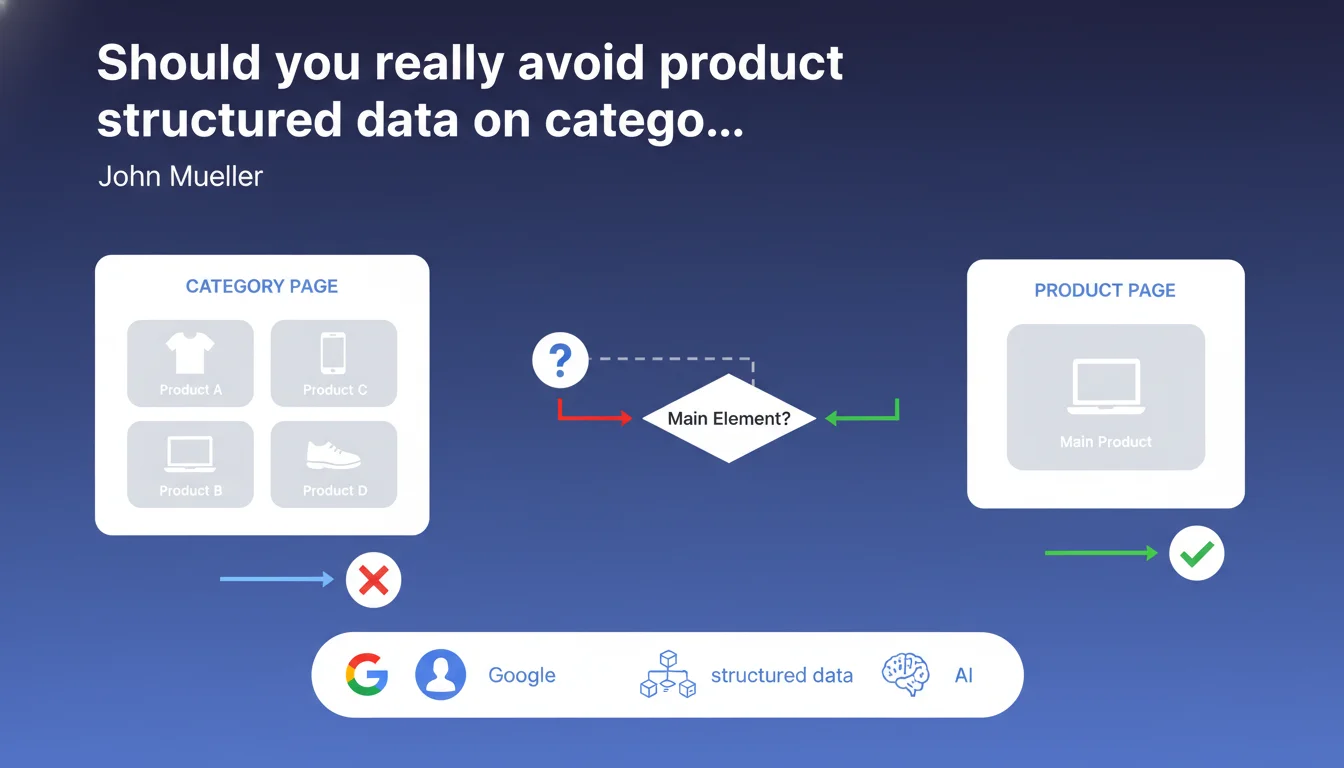
Google explicitly prohibits implementing multiple product schemas on a listing page. Product markup should only apply to the main element of the page — on a category page with multiple products, none is the main element by definition. The rule is clear: no multiple product markup on listing pages.
What you need to understand
This statement from John Mueller clarifies a gray area that generates a lot of confusion among SEO practitioners. Many e-commerce businesses have historically added Product structured data to each product visible on their category pages, thinking it would improve their visibility in rich results.
However, Google considers this practice to be non-compliant with its policies. The logic is straightforward: Product structured data signals to the search engine that a page is dedicated to a specific product.
Why does Google refuse multiple product markup on listings?
The notion of main element is at the heart of this policy. A category page does not have a single product as its central subject — it presents a collection of products. Each product has its own dedicated page where Product markup has its rightful place.
Marking up each product on a category page would be like telling Google that this page is simultaneously about 20, 50, or 100 main products. This is a semantic contradiction that the search engine rejects.
What is a main element according to Google?
The main element of a page is its unique and identifiable subject. On a product sheet: the product. On a blog post: the article. On a category page: the category itself as an organized collection.
This definition therefore mechanically excludes Product markup on listing pages, since no individual product plays the main role there.
What are the exceptions to this rule?
There really aren't any in Mueller's statement. The wording is clear: you should not implement multiple product schemas on a listing page.
It remains to define exactly what a "listing" is. Standard category pages are clearly included. Internal search pages too. But what about comparison pages or buying guides with a few selected products? The boundary can become blurry.
- Product structured data is reserved for individual product pages
- On a category page, no product is the main element
- Multiple markup on listings violates Google's policies
- The notion of main element is decisive for choosing the right schema
SEO Expert opinion
Is this rule really enforced by Google in the SERPs?
Let's be honest: you can still find sites that display multiple product structured data on their categories and don't seem to be penalized. Some even get rich snippets in the results. This doesn't mean the rule is wrong — rather that enforcement is not immediate or systematic.
Google has manual and algorithmic processes to detect structured data abuse. A site can operate with non-compliant implementation for months before manual action occurs, or before the algorithm decides to stop displaying rich data. [To be verified]: the direct impact on organic rankings remains difficult to measure — Google states that structured data is not a direct ranking factor.
What nuances should be added to this statement?
Mueller speaks of "product listing page" without specifying the exact boundary. A category page with 50 products is clearly a listing. But what about a comparison page that presents 3 selected products with detailed analyses? Technically, it's still a "listing," but the editorial intent is different.
Similarly, some sites build hybrid pages — half editorial content, half listing — where one product is actually highlighted as the main element, with other suggestions at the bottom of the page. In this case, marking only the main product could be defensible. But this is a gray area that calls for caution.
What structured data should you use on category pages then?
Google implicitly recommends other schema types for collection pages. The most relevant is CollectionPage or ItemList, which clearly indicate that this is a list of items without claiming that each one is the main subject.
ItemList notably allows you to list the products present on the page with their position, which can help Google understand the structure of the category. But be careful: ItemList does not generate product rich snippets in results — that's not its role.
Practical impact and recommendations
What should you do concretely on your category pages?
First reflex: audit your existing structured data. Use Google's rich results testing tool or a crawler like Screaming Frog to identify all pages that implement Product schema.
If you discover multiple Product markup on your categories, remove it. Keep it only on individual product pages where it belongs.
Next, implement structured data suited to collection pages: ItemList is the ideal candidate. It signals to Google that this is an organized list of items, without any possible confusion.
How can you verify that your site is compliant?
Search Console offers a dedicated report for rich results that lists detected errors and warnings. Consult it regularly — Google flags structured data issues there, including inappropriate uses.
Manually test a few representative URLs with the rich results testing tool. Verify that only your product pages display Product schema, and that your categories trigger no warnings.
What errors should you absolutely avoid?
Don't mark up each product visible in a category with complete Product structured data. Even if this seems logical from a technical standpoint, it is explicitly contrary to guidelines.
Also avoid creating an "empty" or generic Product markup for the category itself — it makes no semantic sense. A category is not a product.
Finally, don't count on ItemList to generate product rich snippets in the SERPs. Its role is purely descriptive to help Google understand the structure of your page.
- Audit all pages with Product structured data via crawler or Search Console
- Remove Product markup from category and listing pages
- Implement ItemList or CollectionPage on collection pages
- Keep Product schema only on individual product pages
- Regularly check the rich results report in Search Console
- Test critical URLs with Google's testing tool
- Document your structured data strategy to maintain consistency
❓ Frequently Asked Questions
Puis-je utiliser ItemList sur mes pages catégories pour remplacer le structured data Product ?
Est-ce que retirer le structured data produit de mes catégories va impacter mon trafic ?
Comment Google distingue-t-il une page produit d'une page catégorie ?
Que faire si mon CMS ajoute automatiquement du structured data Product partout ?
Le structured data ItemList améliore-t-il le classement de mes catégories ?
🎥 From the same video 21
Other SEO insights extracted from this same Google Search Central video · published on 05/03/2022
🎥 Watch the full video on YouTube →
💬 Comments (0)
Be the first to comment.