
Official statement
What you need to understand
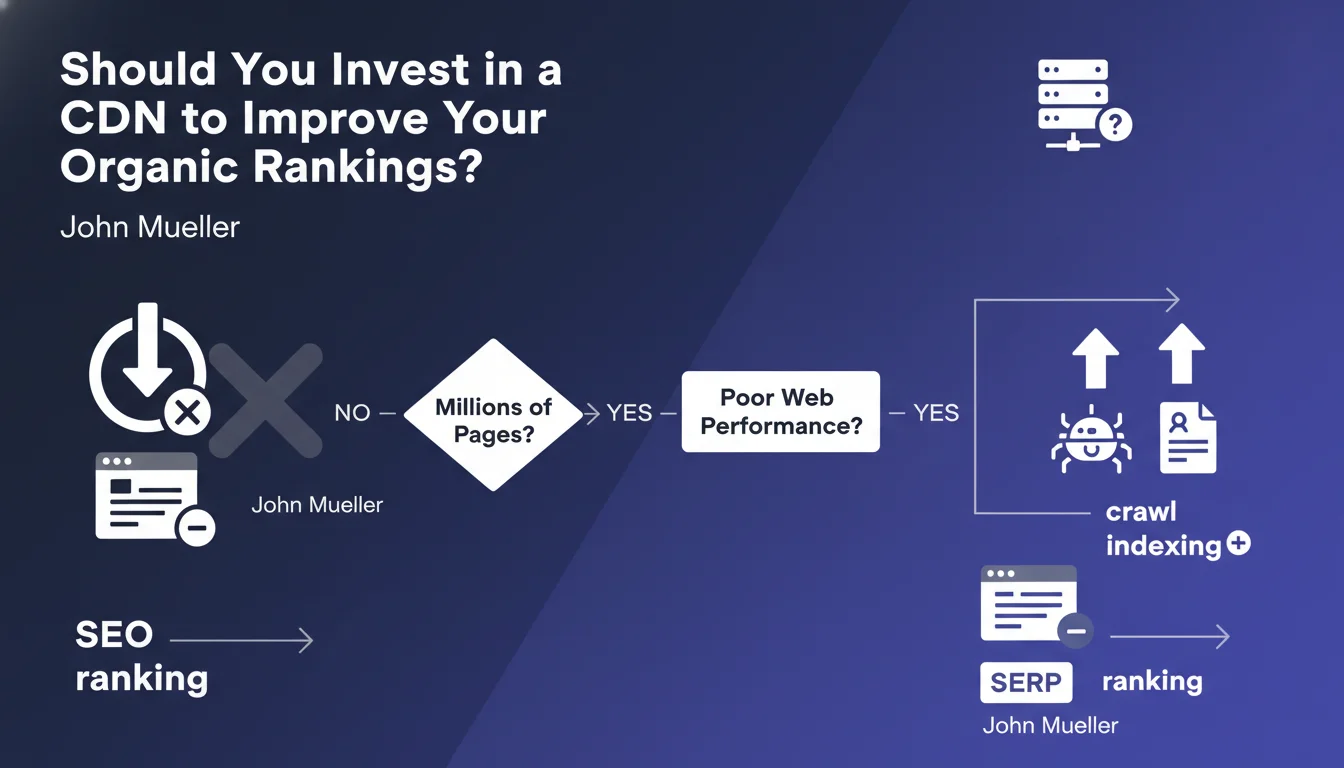
John Mueller clarifies a common misconception: a CDN does not provide a direct SEO bonus. Contrary to what many practitioners believe, implementing a Content Delivery Network does not automatically boost your positions in the SERPs.
This statement distinguishes two fundamental aspects: the impact on crawling versus the impact on ranking. For the vast majority of websites, using a CDN remains neutral from Google's algorithmic perspective.
However, there is one notable exception: sites with millions of pages and poor performance. In this specific case, the CDN can facilitate the work of Google's robots by accelerating content distribution.
- A CDN does not directly improve positioning in search results
- The impact is limited to crawling and indexing for very large, poorly optimized sites
- Improved user experience remains the only measurable benefit
- We must not confuse display speed with a direct ranking factor
SEO Expert opinion
This position from Google is perfectly consistent with what we observe in the field. A/B tests conducted on medium-sized sites indeed show a lack of measurable impact on rankings after implementing a CDN alone.
However, an important nuance must be made regarding Core Web Vitals. If the CDN significantly improves LCP (Largest Contentful Paint) or reduces CLS, it can indirectly influence SEO through these metrics. The effect remains marginal but exists in certain geographical contexts.
The true value of a CDN lies in improving user experience, which itself can generate better behavioral signals. It's an indirect domino effect rather than a direct ranking factor.
Practical impact and recommendations
- Don't justify a CDN investment solely with SEO arguments to your management
- Prioritize on-site optimizations: CSS/JS minification, image compression, lazy loading before considering a CDN
- Evaluate your real need: if your site has fewer than 100,000 pages and has acceptable loading time, a CDN is not an SEO priority
- For large sites (millions of pages): first audit your crawl budget and actual server performance
- Measure user impact rather than SEO impact: bounce rate, session duration, conversions
- If you implement a CDN, do it for the right reasons: global availability, resilience, user experience
- Test the impact on Core Web Vitals specifically if you're targeting geographically distant markets
- Instead invest in quality content, semantic optimization, and link building that will have a real and measurable SEO impact
Orchestrating an effective web performance strategy requires a global vision and sharp technical expertise. Between code optimization, server configuration, choosing caching solutions, and analyzing Core Web Vitals, the variables to master are numerous and interdependent. For large-scale projects where every tenth of a second counts, surrounding yourself with technical SEO specialists helps identify high-ROI optimizations and avoid superfluous investments.
💬 Comments (0)
Be the first to comment.