
Official statement
What you need to understand
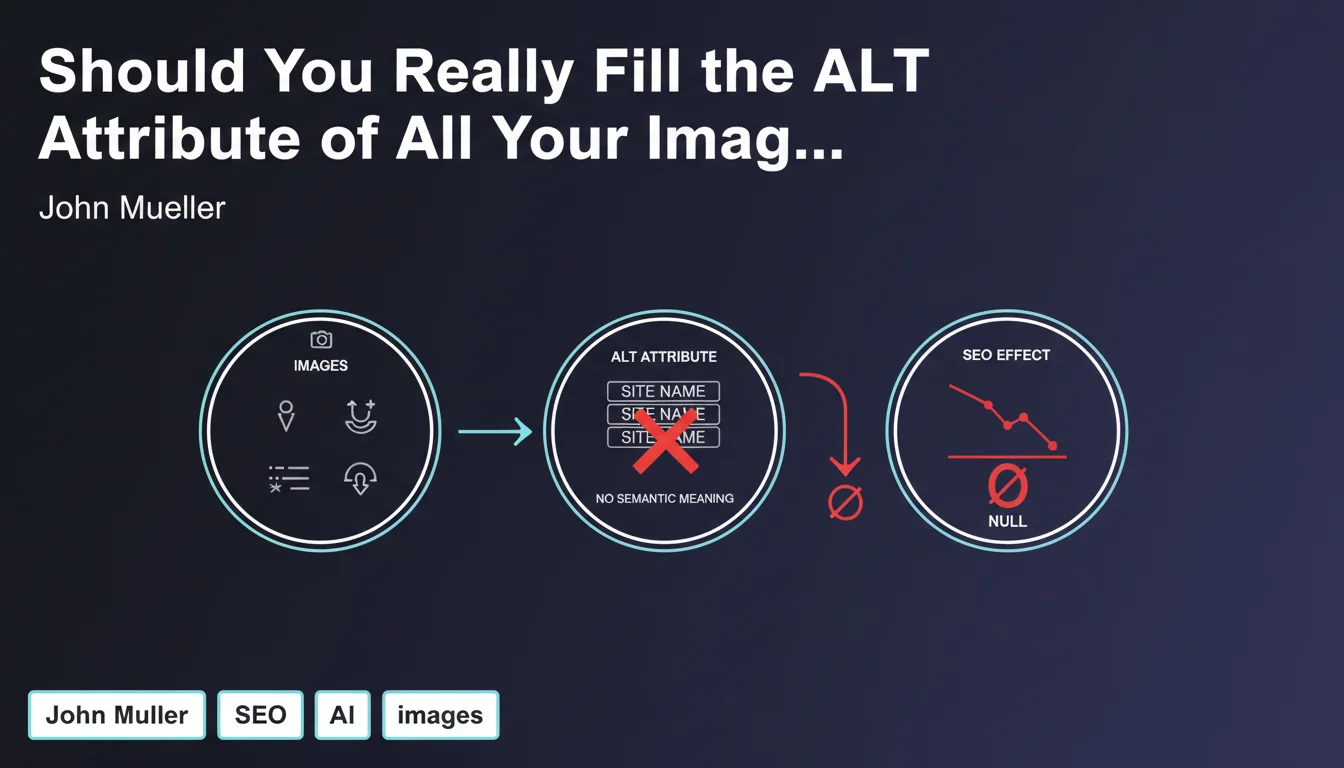
John Mueller clarified a problematic practice observed on many sites: systematically repeating the site name in the ALT attribute of decorative images or images without semantic value.
This technique is often used by webmasters who think they are reinforcing their branding or SEO relevance. In reality, this approach goes against accessibility best practices and provides no benefit for natural search rankings.
Mueller specifies that this strategy has a null SEO effect and can even harm user experience, particularly for people using screen readers.
- Decorative images (bullets, lines, dividers) must have an empty ALT attribute (alt="")
- Repeating the site name on non-semantic elements does not improve search rankings
- The ALT attribute should only describe the relevant visual content of the image
- W3C standards recommend an empty ALT for images without informational value
SEO Expert opinion
This statement is consistent with Google's recommendations on content quality and user experience. The algorithm is mature enough to detect keyword stuffing, even in ALT attributes.
In my practice, I regularly observe sites penalized for over-optimization that use exactly this technique. The principle is simple: if an image does not provide information, its ALT must be empty, not filled with generic keywords.
This approach aligns perfectly with WCAG accessibility criteria and improves the experience for visually impaired users, a quality signal that Google increasingly values.
Practical impact and recommendations
- Audit all your images to identify those that are purely decorative (bullets, lines, dividers, backgrounds)
- Empty the ALT attributes of decorative images: replace alt="Site Name" with alt=""
- Write relevant descriptions for informational images: products, infographics, illustrative photos
- Never mechanically repeat the same ALT text across multiple different images
- Avoid keyword stuffing: the ALT should describe the image, not serve as a keyword repository
- Keep a descriptive ALT only for the main logo in a strategic position (header)
- Test accessibility with a screen reader to verify the consistency of your descriptions
- Document your ALT attribution rules in your editorial guidelines to maintain consistency
Optimizing ALT attributes across an entire site can prove more complex than it appears, particularly on e-commerce platforms with thousands of images or dynamically generated sites. A thorough technical audit and a structured optimization strategy often require specialized expertise to balance accessibility, SEO, and technical constraints. For medium to large-scale sites, guidance from a specialized SEO agency enables you to deploy these optimizations consistently and avoid errors that could negatively impact your visibility.
💬 Comments (0)
Be the first to comment.