
Official statement
What you need to understand
What Does Google Recommend for Site Logo ALT Attributes?
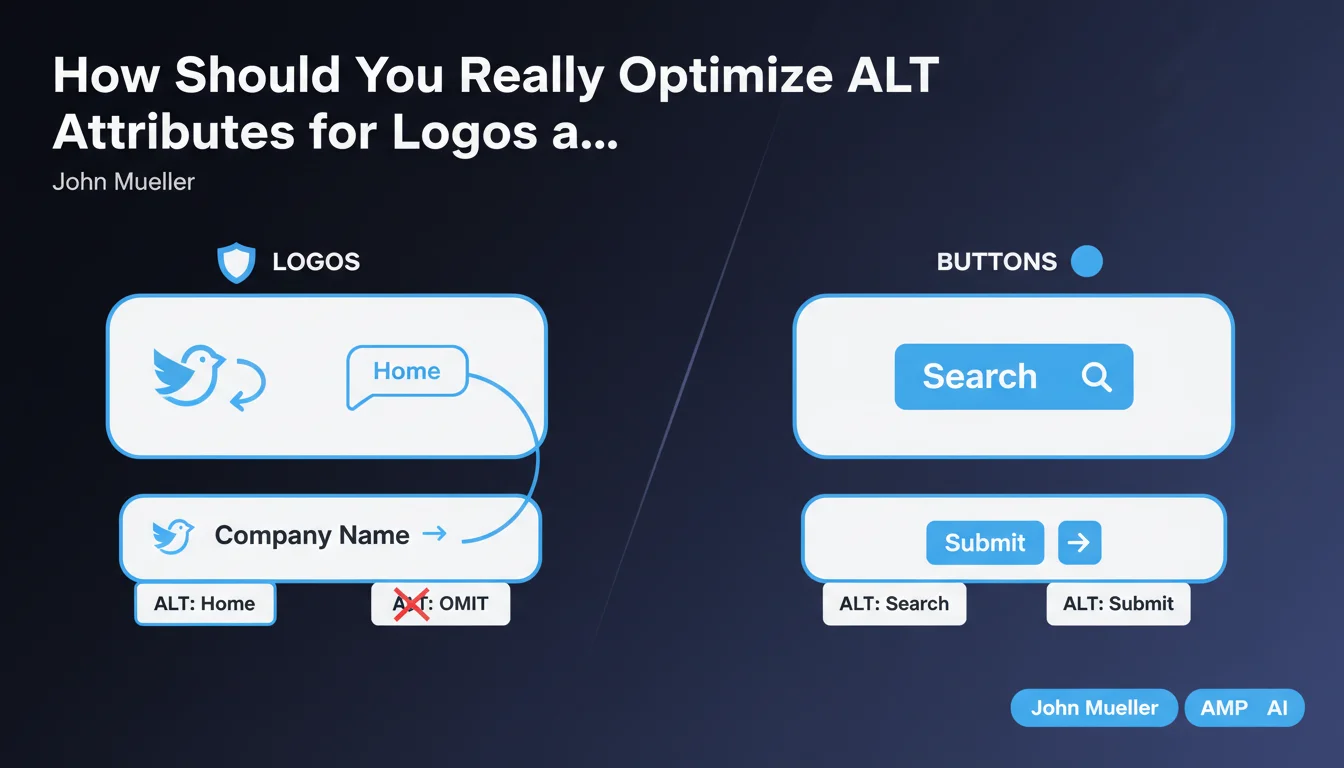
Google, through John Mueller, advocates for a pragmatic and user-centered approach to logo ALT attributes. The logo should contain alternative text indicating the site name and the click destination, typically "Home" or "[Site Name] - Home".
This recommendation aligns with W3C accessibility rules. If the logo is accompanied by clickable text within the same link, the ALT attribute can be omitted to avoid redundancy.
How Should You Handle ALT Attributes for Image-Format Buttons?
For buttons in image format, the rule is even simpler: the ALT attribute should exactly replicate the displayed text on the button. For example, a button displaying "Search" will have an ALT attribute of "Search".
This consistency between visual and alternative text ensures a homogeneous user experience, whether you're sighted or visually impaired.
Why Does Google Emphasize Compliance with W3C Standards?
Google aligns its recommendations with web accessibility standards for several reasons. First, these standards guarantee a better experience for users with disabilities. Second, they facilitate content understanding by bots.
- Logo ALT attributes should indicate the site name and destination ("Home")
- If clickable text accompanies the logo in the same link, ALT can be omitted
- Image buttons should have an ALT replicating the displayed text
- These rules follow W3C standards for web accessibility
- The objective is twofold: accessibility and search engine understanding
SEO Expert opinion
Is This Minimalist Approach Sufficient for High-Performance SEO Strategy?
Google's recommendation is correct but deliberately conservative. It aims to guarantee a solid accessibility baseline without risk of over-optimization. However, for a more ambitious SEO strategy, there's interesting room for maneuver.
It's entirely possible to enrich ALT attributes with relevant semantic field terms, provided it remains natural and useful for the user. For example, "Home [Brand Name] - Digital Marketing Agency Paris" can bring additional SEO value without harming accessibility.
What Risks Should You Avoid When Enriching ALT Attributes?
The main danger is keyword stuffing in ALTs. An ALT attribute like "Home digital marketing SEO agency Paris consultant expert" would be counterproductive. It would degrade the experience for screen reader users and could be perceived as spam by Google.
The balance to find lies between semantic relevance and readability. The decisive test: if you read this ALT aloud to someone who can't see the image, would it be natural and informative?
In Which Cases Can You Deviate from Google's Minimalist Rule?
Specific landing pages constitute a legitimate use case. If your logo appears on a thematic landing page, slightly adapting the ALT can make sense. Similarly, for multilingual or multi-regional sites, specifying the version in the ALT can improve relevance.
Decorative or illustrative images in content also deserve particular attention. Unlike logos and buttons, these images can benefit from more descriptive and semantically rich ALTs, as they provide context to the content.
Practical impact and recommendations
What Should You Audit as a Priority on Your Current Site?
Start with a comprehensive audit of your existing ALT attributes. Identify all logos, buttons, and clickable images on your site. Check their consistency and compliance with basic recommendations.
Pay particular attention to elements repeated across all pages (header, footer). These are the elements that have the most massive impact on your technical SEO and accessibility.
What Common Errors Must You Absolutely Correct?
The most frequent error is complete absence of ALT attribute on logos and buttons. This is a problem for both accessibility and SEO. Google cannot understand the function of these elements.
The second major error is using file names as ALT ("logo-final-v3.png"). These attributes provide no value for either the user or the search engine.
Finally, watch out for duplicate ALTs on different images. Each image with a different function should have a unique and descriptive ALT.
How Can You Implement These Optimizations Effectively?
For quick and effective implementation, start with the most visible elements: main logo, navigation menu, call-to-action buttons. These elements appear on the majority of your pages and offer the best return on investment.
Then create internal guidelines for your content team and developers. Define clear rules for each type of image according to its context and function.
- Audit all logos: verify that ALT indicates site name and destination
- Fix image buttons: ALT must replicate the displayed text
- Remove redundant ALTs: if adjacent clickable text in the same link
- Eliminate empty or generic ALTs: "image", "logo", file names
- Test accessibility: use a screen reader to validate consistency
- Document the rules: create a guide for contributors
- Enrich strategically: add semantic context when relevant
- Monitor regularly: integrate this check into your recurring SEO audits
💬 Comments (0)
Be the first to comment.