
Official statement
Other statements from this video 19 ▾
- □ Does Google really index all languages the same way?
- □ Are nofollow links and noindex tags actually hurting your SEO?
- □ Do 404 errors really hurt your site's search rankings?
- □ Should you really redirect all 404 pages to improve your SEO?
- □ Does your image CDN speed really penalize your ranking in Google Images?
- □ Can you really reset Search Console data when you take over a website?
- □ Are regional subdomains enough to target a specific geographic market?
- □ Why are your rich results displaying the wrong currency and what's the fix?
- □ Does Google really penalize you for publishing video transcriptions as text on your website?
- □ Why does Google reject aggregated reviews in product structured data?
- □ Does Google really crawl URL variations that have no internal links or backlinks pointing to them?
- □ Why does Googlebot keep crawling 404 pages long after they've been deleted?
- □ Is the text-to-code ratio really a Google ranking factor?
- □ Do you really need to reply to every blog comment to boost your SEO?
- □ Should you worry when robots.txt shows up as a soft 404 in Search Console?
- □ Do you really need to worry about missing X-Robots-Tag and meta robots tags?
- □ Are your automatic Geo IP redirects killing your international SEO performance?
- □ Can modifying your title tags and meta descriptions really shift your Google rankings?
- □ Can poor quality links or traffic harm your site's reputation?
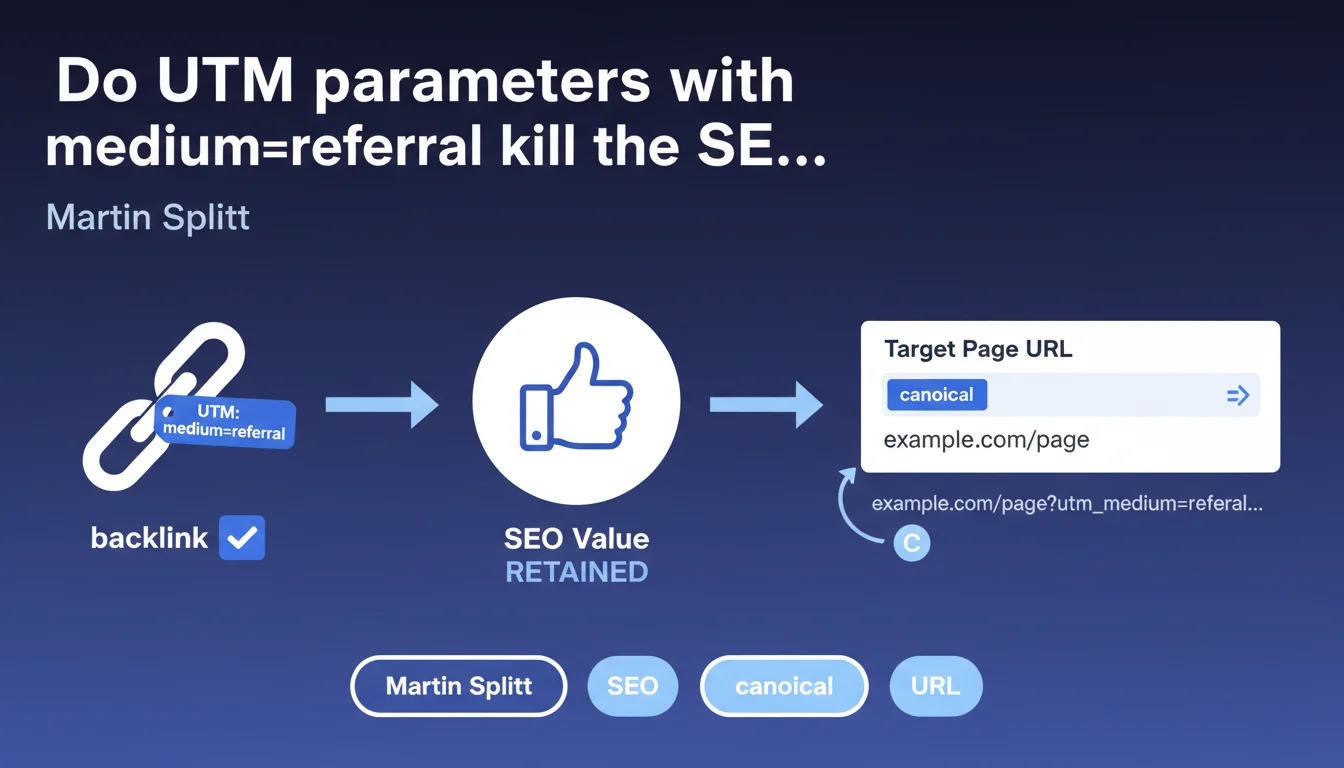
UTM parameters with medium=referral do not remove SEO value from a backlink. Google recommends canonicalizing the target page to the URL without UTM to simplify reporting. SEO juice flows normally, even with these tracking parameters.
What you need to understand
Why this clarification about UTM parameters and medium=referral?
A persistent confusion in the SEO community: many professionals believe that UTM parameters — especially with medium=referral — dilute or cancel the value of a backlink. This belief stems from a misunderstanding of how Google treats URLs with parameters.
Martin Splitt puts the debate to rest. UTM parameters are analytics markers, not signals that modify the transmission of PageRank. If Site A links to your-site.com?utm_source=partner&utm_medium=referral, the link counts exactly as if it pointed to your-site.com without parameters.
What is the technical nuance to understand here?
The nuance lies in canonicalization. Google recommends setting a canonical tag on the target page that points to the clean URL, without UTM. Why? To prevent your own reporting and analytics tools from fragmenting data across multiple identical URLs.
Concretely: Google already consolidates SEO signals on the canonical URL. If you receive 10 backlinks with 10 different UTM variants, the SEO juice aggregates on the canonical version — provided you have properly configured your tags.
What does this change for internal and external linking?
Nothing on the external linking side. Your partners can track their links with UTM parameters without fear of losing SEO value. On the internal linking side, avoid using UTM parameters: it complicates crawling and reporting for nothing.
Canonicals remain your safety net. If you receive backlinks with UTM parameters, make sure each page canonicalizes to its clean version. No self-referential canonical with UTM parameters in it.
- UTM parameters do not cancel the SEO value of a backlink, even with medium=referral
- Google automatically consolidates signals on the canonical URL
- Canonicalizing to the URL without UTM simplifies analytics reporting
- Never use UTM parameters in internal linking
SEO Expert opinion
Is this statement consistent with real-world observations?
Absolutely. A/B tests conducted on netlinking campaigns show that backlinks with UTM transmit the same PageRank as those without. No measurable difference in rankings or domain authority.
What sometimes gets stuck: third-party SEO tools (Ahrefs, Majestic, etc.) may count backlinks with UTM as distinct URLs in their reports. This distorts the reading if you don't manually consolidate. But on Google's side, consolidation happens automatically via canonicals.
What common mistake does this clarification help avoid?
Many sites refuse backlinks with UTM parameters, thinking they lose value. Result: they negotiate to get "clean" links, waste time, or even miss netlinking opportunities. It's absurd.
The other mistake: not canonicalizing correctly. If you leave your pages with UTM without canonical tags, Google will choose the canonical version itself — and it's not always the one you want. [Verify] regularly via Search Console to avoid surprises.
In what cases could this rule cause problems?
If you multiply UTM variants without logic, you fragment your own reporting. Google will consolidate the SEO, but your analytics will show 50 different URLs for the same page. This complicates performance analysis.
Another edge case: sites that use UTM parameters in their XML sitemap. Technically, Google ignores parameters via canonical, but it pollutes crawl budget. Never do this.
Practical impact and recommendations
What should you do concretely to leverage this clarification?
First action: audit your canonical tags. Verify that each page canonicalizes to its URL without UTM parameters. If you use a CMS, make sure the canonical logic automatically ignores UTM parameters.
Second action: train your marketing teams and partners. Affiliate campaigns, partnerships, and link exchanges can use UTM parameters without worry. It simplifies tracking without sacrificing SEO.
What mistakes should you avoid when managing UTM parameters?
Never use UTM parameters in internal linking. It serves no purpose and complicates crawling. UTM parameters are designed to track external sources, not to navigate within your own site.
Also avoid canonicalizing to URLs with UTM parameters. If your-site.com/page?utm_source=X canonicalizes to itself, you fragment the data. The canonical must always point to the cleanest version: your-site.com/page.
How can you verify that your site manages UTM parameters correctly?
Use Search Console to check indexed URLs. If you see variants with UTM parameters indexed, your canonicals aren't working correctly. Normally, only clean URLs should appear.
Also test with a crawl tool (Screaming Frog, OnCrawl) to detect canonicals pointing to URLs with parameters. Everything must converge to versions without UTM parameters.
- Audit all canonical tags to ensure they point to URLs without UTM
- Never use UTM parameters in internal linking
- Train marketing teams: UTM parameters on external backlinks are OK
- Regularly check Search Console for indexed URLs with UTM parameters
- Crawl the site to identify misconfigured canonicals
- Clean your XML sitemap of any URL with UTM parameters
❓ Frequently Asked Questions
Les backlinks avec UTM et medium=referral perdent-ils de la valeur SEO ?
Dois-je refuser des backlinks qui contiennent des UTM ?
Pourquoi Google recommande-t-il de canonicaliser vers l'URL sans UTM ?
Puis-je utiliser des UTM dans mon maillage interne ?
Comment vérifier que mes canonicals gèrent bien les UTM ?
🎥 From the same video 19
Other SEO insights extracted from this same Google Search Central video · published on 21/08/2024
🎥 Watch the full video on YouTube →
💬 Comments (0)
Be the first to comment.