
Official statement
Other statements from this video 19 ▾
- □ Does Google really index all languages the same way?
- □ Are nofollow links and noindex tags actually hurting your SEO?
- □ Do 404 errors really hurt your site's search rankings?
- □ Should you really redirect all 404 pages to improve your SEO?
- □ Does your image CDN speed really penalize your ranking in Google Images?
- □ Can you really reset Search Console data when you take over a website?
- □ Are regional subdomains enough to target a specific geographic market?
- □ Why are your rich results displaying the wrong currency and what's the fix?
- □ Does Google really penalize you for publishing video transcriptions as text on your website?
- □ Why does Google reject aggregated reviews in product structured data?
- □ Does Google really crawl URL variations that have no internal links or backlinks pointing to them?
- □ Why does Googlebot keep crawling 404 pages long after they've been deleted?
- □ Do UTM parameters with medium=referral really kill the SEO value of a backlink?
- □ Do you really need to reply to every blog comment to boost your SEO?
- □ Should you worry when robots.txt shows up as a soft 404 in Search Console?
- □ Do you really need to worry about missing X-Robots-Tag and meta robots tags?
- □ Are your automatic Geo IP redirects killing your international SEO performance?
- □ Can modifying your title tags and meta descriptions really shift your Google rankings?
- □ Can poor quality links or traffic harm your site's reputation?
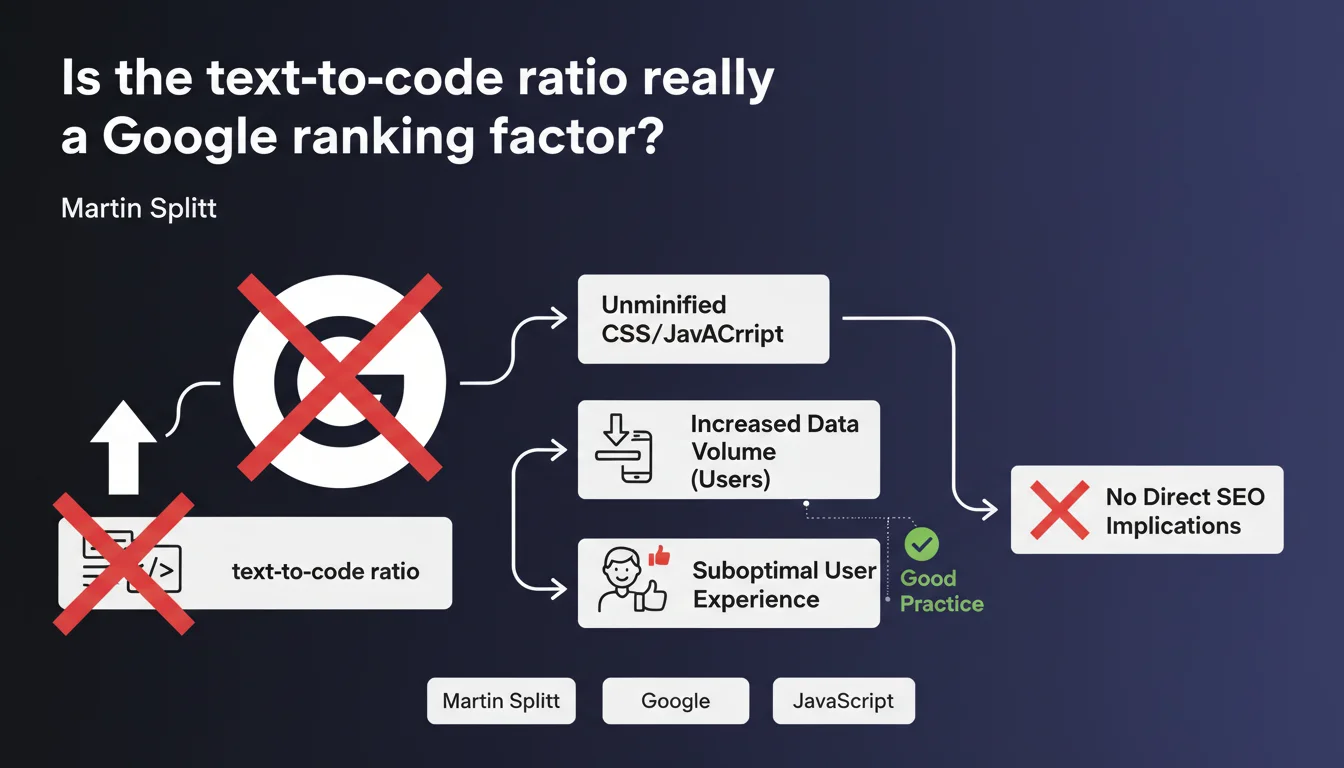
Google confirms that the text-to-code ratio has no impact on rankings. CSS and JavaScript minification improves performance for users but does not directly influence SEO, even though it remains recommended for overall experience.
What you need to understand
Why does this confusion about text-to-code ratio persist?
The myth of text-to-code ratio as a ranking factor dates back to the early days of SEO, when the idea that a site "light on code" would be better indexed was consensus in the community. This belief is based on seductive logic: more visible content, less technical "noise."
Google dismantles this misconception here. The search engine does not measure the ratio between your HTML and your visible text. It focuses on content relevance, semantic structure, and its ability to answer search intent. Code volume does not enter the ranking equation.
Does code minification have any SEO value?
Martin Splitt clarifies that minification remains a good practice — but for reasons related to user performance, not crawling or indexing. Unminified CSS or JavaScript increases page weight, slows down loading, and potentially degrades Core Web Vitals.
And there, indirectly, it can affect SEO. Because Core Web Vitals are a ranking signal. But it is not minification itself that matters — it is its effect on perceived speed and user experience.
What should you monitor if text-to-code ratio doesn't matter?
- The quality and relevance of text content, not its proportion relative to code
- Loading performance (LCP, FID, CLS) which can be impacted by heavy code
- Content accessibility for Googlebot: text must be indexable, whether buried in 10 KB or 100 KB of HTML
- Semantic structure (heading tags, Schema.org) which helps Google understand content, regardless of code volume
SEO Expert opinion
Is this statement consistent with real-world observations?
Yes, and it is a relief to see Google clarify this point. No reliable correlation has ever been observed between an "optimal" text-to-code ratio and better rankings. Sites with heavy JavaScript loads — think React or Vue SPAs — can rank very well if content is accessible and relevant.
However, confusion often arises from the fact that a site with bloated code may have other problems: catastrophic load times, content hidden in unrendered JavaScript, chaotic HTML structure. These are not ratio problems, but global technical quality issues.
Should you abandon all code-side SEO optimization?
Let's be clear: no. Splitt's statement does not say "code has no importance." It says that the ratio as such is not a factor. Crucial distinction.
Poorly structured code, render-blocking JavaScript, critical CSS not inlined — all of that can wreck your Core Web Vitals and, by extension, your SEO. What matters is the impact of code on user experience and Google's ability to access content. Not the percentage of bytes allocated to text vs. tags.
What are the limitations of this statement?
Splitt remains evasive on one point: at what point does excessively heavy code become problematic for crawling? Google has a limited crawl budget. If your pages weigh 5 MB each because of unoptimized JavaScript, the bot may slow down its exploration. [To verify]
Similarly, the boundary between "not a direct factor" and "indirect factor via Core Web Vitals" remains blurry. A savvy SEO expert will not settle for this statement to justify sloppy code under the guise that "Google doesn't care."
Practical impact and recommendations
What should you do concretely after this statement?
Stop measuring text-to-code ratio as an SEO KPI. If you have tools that calculate this ratio, ignore this metric. It adds nothing to your ranking strategy.
Instead, focus on these actionable levers: content quality, semantic structure, Googlebot accessibility (particularly through JavaScript rendering), and especially user performance measured by Core Web Vitals.
Does minification remain a priority?
Yes, but for the right reasons. Minify your CSS and JavaScript to reduce page weight, speed up loading, and improve speed scores. This is a performance optimization, not a direct SEO optimization.
However, be careful: minification can complicate debugging. Make sure to keep unminified versions in development and generate source maps to facilitate diagnosis in production.
How should you prioritize your technical optimizations?
- Abandon text-to-code ratio as an SEO tracking metric
- Audit your Core Web Vitals (LCP, FID, CLS) and fix pages below recommended thresholds
- Verify that essential text content is accessible to Googlebot (test with Search Console and HTML rendering)
- Minify CSS and JavaScript to improve performance, but do not justify this action by a direct SEO gain
- Optimize semantic structure (heading tags, Schema.org) rather than focusing on code volume
- Monitor total page weight: beyond 3-4 MB, you risk crawl budget issues
❓ Frequently Asked Questions
Le ratio texte/code a-t-il un impact indirect via les Core Web Vitals ?
Faut-il minifier le CSS et JavaScript pour le SEO ?
Google pénalise-t-il les sites avec beaucoup de code HTML ?
Un site JavaScript lourd peut-il bien se classer ?
Quelles métriques techniques surveiller si le ratio texte/code n'a pas d'importance ?
🎥 From the same video 19
Other SEO insights extracted from this same Google Search Central video · published on 21/08/2024
🎥 Watch the full video on YouTube →
💬 Comments (0)
Be the first to comment.