
Official statement
Other statements from this video 19 ▾
- □ Google indexe-t-il vraiment toutes les langues de la même manière ?
- □ Les liens nofollow et balises noindex nuisent-ils à votre référencement ?
- □ Les erreurs 404 pénalisent-elles vraiment le classement de votre site ?
- □ Faut-il vraiment rediriger toutes les pages 404 pour améliorer son SEO ?
- □ La vitesse de votre CDN d'images pénalise-t-elle vraiment votre référencement dans Google Images ?
- □ Peut-on réinitialiser les données Search Console d'un site repris ?
- □ Pourquoi vos rich results affichent-ils la mauvaise devise et comment y remédier ?
- □ La transcription vidéo est-elle considérée comme du contenu dupliqué par Google ?
- □ Pourquoi Google refuse-t-il les avis agrégés dans les données structurées produit ?
- □ Google crawle-t-il les variations d'URL sans liens internes ou backlinks ?
- □ Pourquoi Googlebot persiste-t-il à crawler des pages 404 après leur suppression ?
- □ Le ratio texte/code est-il vraiment un facteur de classement Google ?
- □ Les paramètres UTM avec medium=referral tuent-ils vraiment la valeur SEO d'un backlink ?
- □ Faut-il absolument répondre aux commentaires de blog pour le SEO ?
- □ Faut-il s'inquiéter quand robots.txt apparaît comme soft 404 dans Search Console ?
- □ Faut-il vraiment s'inquiéter de l'absence de balises X-Robots-Tag et meta robots ?
- □ Pourquoi les redirections Geo IP automatiques sabotent-elles votre SEO international ?
- □ Modifier ses balises title et meta description peut-il vraiment faire bouger son classement Google ?
- □ Les liens ou le trafic de mauvaise qualité peuvent-ils nuire à la réputation de votre site ?
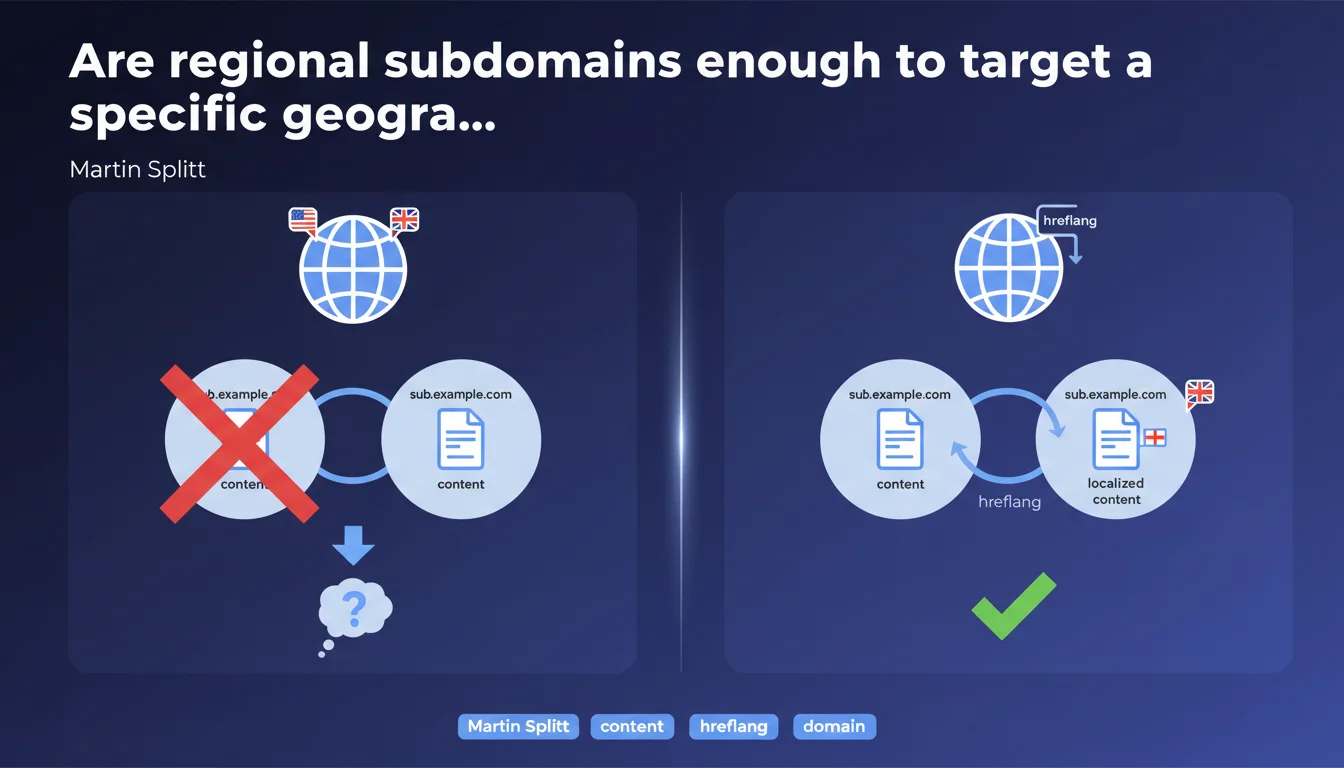
Deploying identical content across multiple regional subdomains (fr.example.com, de.example.com) guarantees no geographic targeting. Google treats this content as identical, regardless of URL structure. Only hreflang allows you to indicate variations by country/language.
What you need to understand
Why this clarification about regional subdomains?
Many international sites believe that by creating subdomains by market (uk.example.com, fr.example.com, es.example.com), Google will automatically understand geographic targeting. This is a common mistake.
Martin Splitt makes it clear without ambiguity: if the content remains identical across subdomains, Google will make no distinction. URL structure is not a sufficient targeting signal — it does not replace the mechanisms designed for this purpose.
What is the real role of URL structure in targeting?
The structure (subdomain, subdirectory, distinct domain) can serve as an organizational signal, but it has no declarative value to Google. A subdomain fr.example.com does not tell Google "this content is for France," it simply says "here is a section of the site."
The only mechanism Google officially recognizes for geographic and language targeting is hreflang. Without it, even a perfectly named subdomain guarantees nothing.
What happens if the content is truly identical?
Google will treat these pages as duplicate content. It will choose a canonical version — likely the one it judges most relevant based on other signals (popularity, backlinks, user behavior). Other versions risk being marginalized in search results.
Result: your regional subdomains cannibalize each other instead of covering each market. You lose visibility and fragment your SEO efforts.
- URL structure ≠ targeting signal: a regional subdomain is not enough
- Identical content = duplication: Google will choose a canonical version and ignore the others
- Hreflang is mandatory: it is the only mechanism recognized for declaring variations by country/language
- Without hreflang, no guarantee: ranking will be unpredictable and often disappointing
SEO Expert opinion
Is this statement consistent with field observations?
Completely. In the field, we regularly see international sites that deploy subdomains or subdirectories by market without implementing hreflang. Result: the UK version appears in France, the FR version ends up in Germany, and traffic is completely disordered.
Martin Splitt's message is clear: structure does not do the work for you. If you duplicate content without explicitly declaring variations, Google will not guess your intentions.
What nuances should be applied to this rule?
First point: this statement targets sites that strictly duplicate identical content across multiple subdomains. If each market has truly distinct content (different texts, local products, specific information), the problem is less significant — but hreflang is still recommended.
Second point: Google can use other signals to guess the target market — server IP address, geographic targeting in Search Console, ccTLD. But these are secondary indicators, never guarantees. Relying on them is playing roulette.
[To verify] Google does not explicitly specify how it weighs these secondary signals against the absence of hreflang. Field observations suggest that without hreflang, behavior becomes unpredictable — especially for languages shared between multiple countries (English, Spanish, French).
In which cases does this rule pose a real problem?
Typically: multi-market e-commerce sites with identical product catalogs but different prices/currencies. Many duplicate product sheets on fr.example.com, de.example.com, etc., changing only the currency and a few legal mentions.
Google sees this as duplicate content. Even with hreflang, if content is too similar, you risk cannibalization. The solution: truly adapt the content (local descriptions, customer reviews by market, market-specific shipping information).
Practical impact and recommendations
What should you do concretely for a multi-market site?
First step: implement hreflang correctly on all pages with regional or linguistic variants. Each page must declare all its alternatives, including itself. Syntax errors are frequent and can render implementation completely ineffective.
Second step: verify that each market has truly distinct content. If pages are 95% identical, Google will treat them as duplicates. Adapt at minimum the descriptions, add local elements (testimonials, cultural references, legal information).
Third step: use Search Console to verify that hreflang is properly understood. Google reports declaration errors, orphaned URLs, inconsistencies. Systematically correct these alerts.
What mistakes must you absolutely avoid?
Mistake #1: create regional subdomains and hope that is enough. Without hreflang, you will just create duplicate content and lose visibility.
Mistake #2: implement hreflang incompletely — for example, declare fr-FR and de-DE but forget en-GB. Each page must list all its variants, otherwise Google may ignore the declarations.
Mistake #3: use hreflang for non-equivalent content. Hreflang serves to link versions of the same page, not completely different pages. If content diverges too much, Google may reject the declarations.
How do you verify your configuration is correct?
Use specialized tools to validate hreflang syntax: Search Console, Screaming Frog, or online validators. Verify that each declaration is bidirectional (if page A points to page B, page B must point to page A).
Test behavior in SERPs: search your content from different countries (VPN or Google Search Console). Verify that the correct version appears for each market. If not, review your declarations.
Monitor traffic metrics by country in Analytics. A sudden drop on a market can indicate a targeting problem or cannibalization.
- Implement hreflang on all multi-market pages with correct syntax and bidirectional declarations
- Truly differentiate content by market — descriptions, testimonials, local information
- Check hreflang errors in Search Console and correct them systematically
- Test behavior in SERPs from different countries to validate targeting
- Monitor traffic by country and quickly detect any anomalies
- Avoid strictly duplicating the same content across multiple subdomains without adaptation
❓ Frequently Asked Questions
Hreflang est-il obligatoire pour un site multi-pays ?
Un ccTLD (.fr, .de) suffit-il à cibler un pays sans hreflang ?
Peut-on utiliser hreflang avec des sous-domaines ?
Que se passe-t-il si hreflang est mal configuré ?
Faut-il adapter le contenu même avec hreflang ?
🎥 From the same video 19
Other SEO insights extracted from this same Google Search Central video · published on 21/08/2024
🎥 Watch the full video on YouTube →
💬 Comments (0)
Be the first to comment.