
Official statement
Other statements from this video 19 ▾
- □ Google indexe-t-il vraiment toutes les langues de la même manière ?
- □ Les liens nofollow et balises noindex nuisent-ils à votre référencement ?
- □ Faut-il vraiment rediriger toutes les pages 404 pour améliorer son SEO ?
- □ La vitesse de votre CDN d'images pénalise-t-elle vraiment votre référencement dans Google Images ?
- □ Peut-on réinitialiser les données Search Console d'un site repris ?
- □ Les sous-domaines régionaux suffisent-ils à cibler un marché géographique ?
- □ Pourquoi vos rich results affichent-ils la mauvaise devise et comment y remédier ?
- □ La transcription vidéo est-elle considérée comme du contenu dupliqué par Google ?
- □ Pourquoi Google refuse-t-il les avis agrégés dans les données structurées produit ?
- □ Google crawle-t-il les variations d'URL sans liens internes ou backlinks ?
- □ Pourquoi Googlebot persiste-t-il à crawler des pages 404 après leur suppression ?
- □ Le ratio texte/code est-il vraiment un facteur de classement Google ?
- □ Les paramètres UTM avec medium=referral tuent-ils vraiment la valeur SEO d'un backlink ?
- □ Faut-il absolument répondre aux commentaires de blog pour le SEO ?
- □ Faut-il s'inquiéter quand robots.txt apparaît comme soft 404 dans Search Console ?
- □ Faut-il vraiment s'inquiéter de l'absence de balises X-Robots-Tag et meta robots ?
- □ Pourquoi les redirections Geo IP automatiques sabotent-elles votre SEO international ?
- □ Modifier ses balises title et meta description peut-il vraiment faire bouger son classement Google ?
- □ Les liens ou le trafic de mauvaise qualité peuvent-ils nuire à la réputation de votre site ?
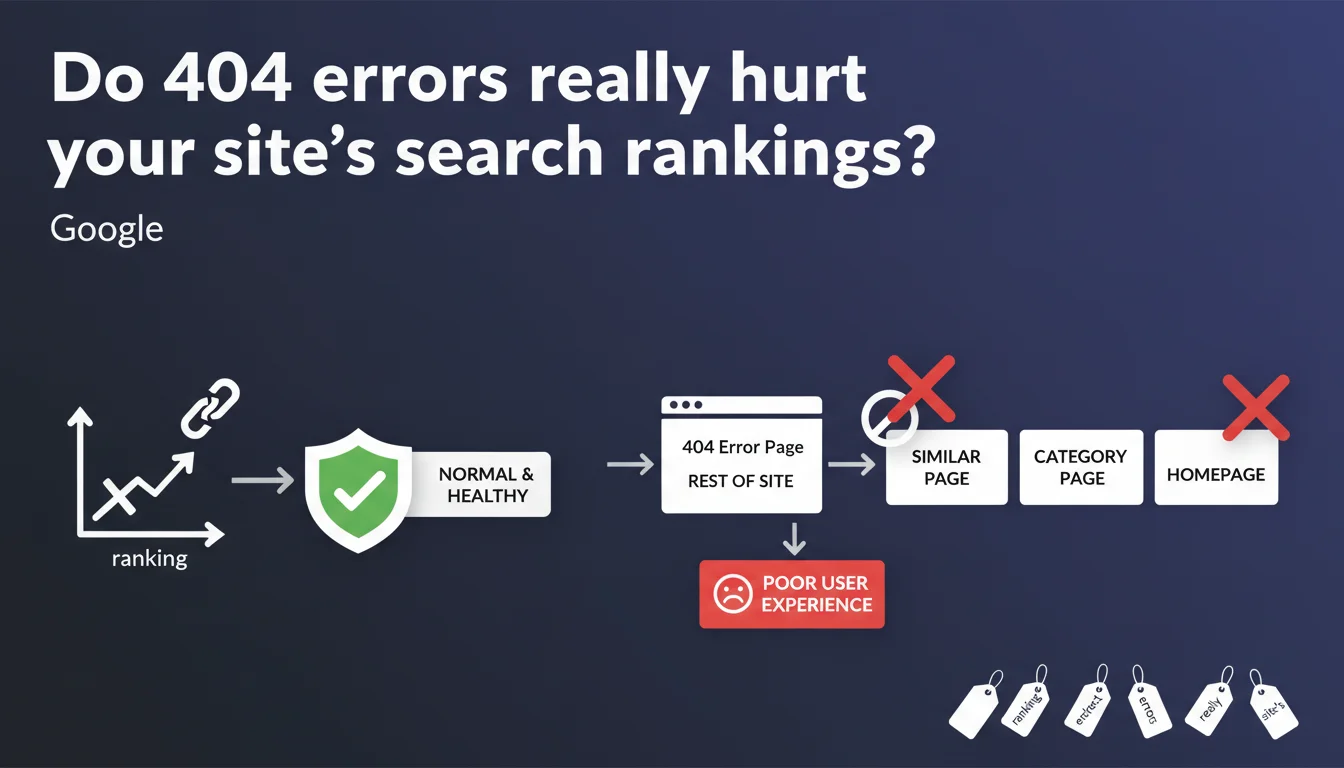
Google states that 404 errors don't impact a site's overall ranking and are part of normal website operations. Systematically redirecting these pages to the homepage or categories actually degrades user experience rather than protecting it. The real question: how far does this rule apply without nuance?
What you need to understand
Why does Google insist that 404 errors are normal?
Websites evolve — products are removed, outdated content is deleted, URLs are restructured. 404 errors are inevitable and Google knows this perfectly well. The search engine wants to prevent webmasters from panicking and creating absurd redirects that actually prevent natural cleanup of the index.
The official position is clear: a page that no longer exists should return a 404 code, not a 301 to an unrelated page. It's a matter of transparency toward users and crawlers.
What distinguishes a "healthy" 404 error from a structural problem?
A few isolated 404s on a site with thousands of pages? Normal. Hundreds of 404s generated by a poorly managed migration or broken internal linking? A structural problem that deserves attention.
Google distinguishes between natural residual 404s and a technically failing site where internal links massively point to dead pages. In the latter case, the indirect signal about overall site quality is real, even if the official statement remains vague on this point.
Is systematic redirection really a bad practice?
Redirecting all 404s to the homepage or a generic category creates soft 404s — pages that return a 200 but have no relevant content for the requested URL. Google detects this scenario and treats these pages as 404s anyway.
Even worse: the user who lands on an unrelated page immediately leaves your site. Bounce rate skyrockets, behavioral signals degrade. A well-designed actual 404 page offers relevant alternatives and keeps the user engaged.
- Isolated 404 errors are normal and don't affect your site's overall ranking
- Systematic redirects to the homepage or categories degrade user experience
- Google treats soft 404s (empty pages with 200 code) like real 404s
- A custom 404 page with relevant alternatives beats blind redirects
- The real problem: massive 404s linked to broken internal linking, not residual errors
SEO Expert opinion
Does this statement truly reflect what we observe in practice?
Yes and no. On established sites with solid history, a few dozen 404s genuinely slip by unnoticed. No measurable impact on rankings in most observed cases — this is confirmed by empirical testing.
But — and this is where the statement gets fuzzy — a sudden spike in 404s during a poorly managed migration can slow crawling and delay discovery of new pages. Crawl budget isn't directly a ranking factor, but it conditions indexing efficiency. Google deliberately avoids addressing this nuance.
What gray areas does this official position leave unaddressed?
The statement says nothing about 404s generated by internal links. If your internal linking points massively toward dead pages, that signals a poorly maintained site — and Google detects this indirectly through overall quality metrics. [To be verified]: the exact impact of this scenario remains debated, but observed correlations suggest a signal of disorganization.
Another point avoided: 404s on formerly strategic pages with solid backlinks. Letting a page with external link juice die without a relevant redirect is pure waste — Google doesn't address this specific case.
Should you really ignore all detected 404 errors?
No. The statement doesn't say "ignore everything," it says "don't panic and don't create absurd redirects." Important distinction. Each 404 deserves a quick audit: unimportant page? Leave it as 404. Page with backlinks or historical traffic? 301 redirect to the closest relevant content.
The problem is that Google oversimplifies its message to prevent misuse, but this simplification creates a gray area. A seasoned SEO expert knows that not all 404s are equal — the official statement doesn't make this distinction.
Practical impact and recommendations
How do you concretely handle 404 errors on a live site?
First step: audit the source of 404s. Are the errors detected by Google Search Console coming from internal links, external backlinks, or old URLs randomly crawled? The answer determines your action.
If 404s come from broken internal links, fix them immediately — that's a maintenance issue, not "normalcy." If they come from obsolete URLs with no traffic or backlinks, leave them as 404 without guilt.
What mistakes should you avoid when handling deleted pages?
Never reflexively redirect a dead page to your homepage. A redirect must make sense: if you remove a product, redirect to an equivalent product or specific category, not the homepage. Otherwise, leave it as 404 with a well-designed error page.
Also avoid redirect chains: if you redirect A to B, then B to C, Google may not follow the entire chain. Always simplify by redirecting directly from A to C.
How do you verify your 404 management follows best practices?
Use Google Search Console to identify 404s Google has detected. Filter those still receiving clicks or active backlinks — these pages deserve a redirect. For others, validate that your custom 404 page offers relevant alternatives.
Regularly crawl your site with Screaming Frog or Oncrawl to detect broken internal links. A clean linking structure is a quality signal — even though Google downplays 404 impact, a well-maintained site remains an asset.
- Audit the source of each 404: internal link, external backlink, or obsolete URL with no impact
- Fix broken internal links immediately — this isn't acceptable "normalcy"
- Redirect only to pages that are semantically close or equivalent, never to the homepage by default
- Customize your 404 page with contextual suggestions and internal search functionality
- Monitor 404s with active backlinks in Search Console and redirect them if relevant
- Crawl your site regularly to maintain clean and functional internal linking
- Avoid soft 404s: an empty page with 200 code is worse than a real 404
❓ Frequently Asked Questions
Combien de 404 un site peut-il avoir sans impact SEO ?
Faut-il vraiment laisser des pages en 404 même avec des backlinks ?
Une page 404 personnalisée aide-t-elle au SEO ?
Les soft 404 sont-elles mieux que les vraies 404 ?
Comment traiter les 404 lors d'une migration de site ?
🎥 From the same video 19
Other SEO insights extracted from this same Google Search Central video · published on 21/08/2024
🎥 Watch the full video on YouTube →
💬 Comments (0)
Be the first to comment.