
Official statement
Other statements from this video 19 ▾
- □ Google indexe-t-il vraiment toutes les langues de la même manière ?
- □ Les liens nofollow et balises noindex nuisent-ils à votre référencement ?
- □ Les erreurs 404 pénalisent-elles vraiment le classement de votre site ?
- □ Faut-il vraiment rediriger toutes les pages 404 pour améliorer son SEO ?
- □ La vitesse de votre CDN d'images pénalise-t-elle vraiment votre référencement dans Google Images ?
- □ Peut-on réinitialiser les données Search Console d'un site repris ?
- □ Les sous-domaines régionaux suffisent-ils à cibler un marché géographique ?
- □ Pourquoi vos rich results affichent-ils la mauvaise devise et comment y remédier ?
- □ Pourquoi Google refuse-t-il les avis agrégés dans les données structurées produit ?
- □ Google crawle-t-il les variations d'URL sans liens internes ou backlinks ?
- □ Pourquoi Googlebot persiste-t-il à crawler des pages 404 après leur suppression ?
- □ Le ratio texte/code est-il vraiment un facteur de classement Google ?
- □ Les paramètres UTM avec medium=referral tuent-ils vraiment la valeur SEO d'un backlink ?
- □ Faut-il absolument répondre aux commentaires de blog pour le SEO ?
- □ Faut-il s'inquiéter quand robots.txt apparaît comme soft 404 dans Search Console ?
- □ Faut-il vraiment s'inquiéter de l'absence de balises X-Robots-Tag et meta robots ?
- □ Pourquoi les redirections Geo IP automatiques sabotent-elles votre SEO international ?
- □ Modifier ses balises title et meta description peut-il vraiment faire bouger son classement Google ?
- □ Les liens ou le trafic de mauvaise qualité peuvent-ils nuire à la réputation de votre site ?
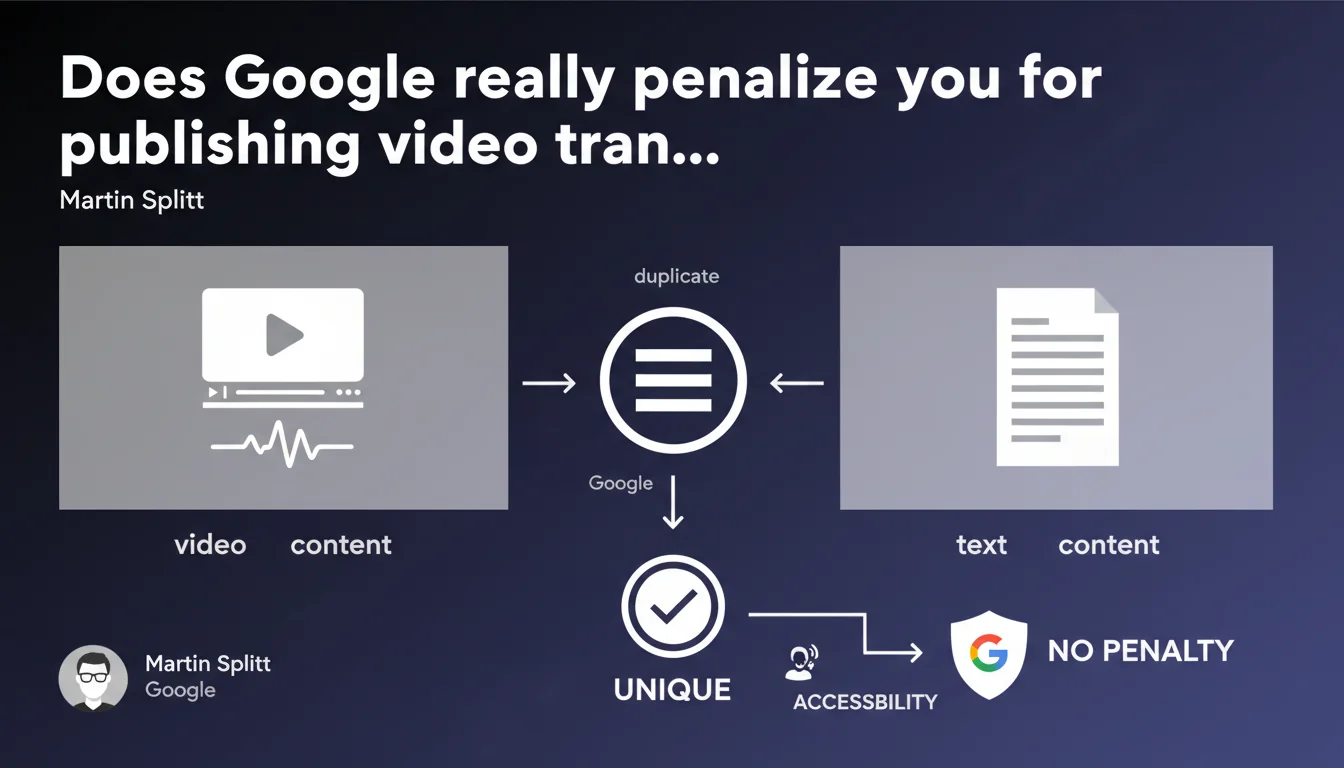
Publishing the text transcript of a YouTube video on your website triggers no duplicate content penalty. Google considers video format and text format as two distinct and unique contents. This practice is even encouraged to improve accessibility.
What you need to understand
Does Google really differentiate between content formats?
Martin Splitt's statement settles a recurring question: format matters just as much as substance. A YouTube video and its transcript published on a web page are not perceived as duplicate content.
Why? Because the algorithm distinguishes between media types. A video requires a player, streaming, a YouTube context. Text, on the other hand, displays directly on the page. Consumption signals are radically different.
What is the accessibility argument invoked by Google?
Google justifies its position through accessibility—a lever often underestimated in SEO. Transcripts allow deaf users, people in noisy environments or without sound to access the content. They also facilitate quick navigation and visual scanning of content.
On the crawl side, the transcript gives Googlebot direct access to text without requiring complex video processing. It's a clear signal of thematic relevance.
Does this rule apply to all video platforms?
Martin Splitt explicitly mentions YouTube, but the principle holds for Vimeo, Wistia, or any video hosted elsewhere. What matters is the format difference, not the platform.
Be careful however: duplicating a transcript already published elsewhere as plain text would indeed create duplicate content. The logic only applies to video → text conversion.
- Video format ≠ text format: Google treats them as two distinct entities
- No risk of duplicate content penalty in this specific case
- Transcription improves accessibility and facilitates crawling
- The rule applies to all video platforms, not just YouTube
- Duplicating a transcript already published as text remains problematic
SEO Expert opinion
Does this statement reflect what we observe in the field?
Let's be honest: Google's position does match actual observations. Sites that publish transcripts of their videos generally experience no loss in visibility. Some even see gains—the transcript allows ranking on long-tail queries absent from the video alone.
The problem? Google remains vague on one crucial point: which version to prioritize in the SERPs when video and text target the same query. The statement affirms there's no duplication, but doesn't specify whether both formats can coexist on the first page for the same search. [To verify] based on your sector and your analytics observations.
What nuances should be applied to this rule?
First nuance: a verbatim transcript isn't always optimal for SEO. A video contains hesitations, repetitions, oral turns of phrase poorly suited to reading. Lightly rewriting to improve fluidity often enhances the experience—and retention signals.
Second nuance: if your transcript reproduces 100% of the text from an existing article, then you create a video from it, you reverse the logic. The question becomes: does your video provide genuine added value or is it just lazy recycling? Google tolerates transcription, but values enrichment.
In what cases does this rule not protect against duplication?
If you publish the same transcript on three different pages of your site, you create classic internal duplication. The protection only concerns the video ↔ text relationship, not text ↔ text.
Likewise, taking a transcript of a competitor's video published elsewhere exposes you to a copied content flag. The rule only covers your own video content.
Practical impact and recommendations
What should you concretely do with this information?
First action: systematically transcribe your videos. Whether via automatic tools (YouTube Studio, Otter.ai, Descript) or manually, publish the text on the page where the video is embedded. This enriches the page, facilitates crawling and improves accessibility.
Second action: optimize the transcript. Don't settle for a raw copy-paste. Structure the text with intermediate headings, correct oral awkwardness, add relevant internal links. The transcript becomes real SEO content.
What mistakes should be avoided when implementing?
Mistake #1: hiding the transcript behind an accordion or tab invisible by default. Sure, it lightens the page visually, but Googlebot may interpret this as soft cloaking. Keep the text visible, or use an expand/collapse system without blocking JS.
Mistake #2: duplicating the transcript across multiple pages. If you republish the same video in three different articles, vary the transcripts or use a canonical to the main version.
Mistake #3: neglecting schema.org structure. A video with transcript deserves enriched VideoObject markup, explicitly mentioning the transcript in the "transcript" or "description" field.
How can you verify that the strategy is working?
Monitor organic traffic evolution on pages enriched with transcripts. Compare with video pages without text. Look at long-tail queries in Search Console: the transcript should surface expressions absent from the title and meta.
Also monitor engagement signals: time on page, bounce rate, scroll depth. A well-integrated transcript improves retention and reduces immediate exits.
- Systematically transcribe all strategic videos
- Lightly rewrite the transcript to improve fluidity
- Structure the text with headings and internal links
- Keep the transcript visible (not hidden by default)
- Never duplicate the same transcript across multiple pages
- Implement VideoObject schema with transcript mention
- Monitor traffic evolution on long-tail query terms
- Compare performance of pages with/without transcripts
❓ Frequently Asked Questions
Puis-je publier la transcription d'une vidéo YouTube concurrente sur mon site ?
Faut-il publier la transcription sur la même page que la vidéo ou sur une page séparée ?
La transcription automatique de YouTube suffit-elle ou faut-il la corriger ?
Google favorise-t-il la vidéo ou la transcription dans les résultats de recherche ?
Dois-je baliser la transcription avec un schema spécifique ?
🎥 From the same video 19
Other SEO insights extracted from this same Google Search Central video · published on 21/08/2024
🎥 Watch the full video on YouTube →
💬 Comments (0)
Be the first to comment.