
Official statement
Other statements from this video 19 ▾
- □ Does Google really index all languages the same way?
- □ Are nofollow links and noindex tags actually hurting your SEO?
- □ Do 404 errors really hurt your site's search rankings?
- □ Should you really redirect all 404 pages to improve your SEO?
- □ Does your image CDN speed really penalize your ranking in Google Images?
- □ Can you really reset Search Console data when you take over a website?
- □ Are regional subdomains enough to target a specific geographic market?
- □ Why are your rich results displaying the wrong currency and what's the fix?
- □ Does Google really penalize you for publishing video transcriptions as text on your website?
- □ Why does Google reject aggregated reviews in product structured data?
- □ Does Google really crawl URL variations that have no internal links or backlinks pointing to them?
- □ Why does Googlebot keep crawling 404 pages long after they've been deleted?
- □ Is the text-to-code ratio really a Google ranking factor?
- □ Do UTM parameters with medium=referral really kill the SEO value of a backlink?
- □ Do you really need to reply to every blog comment to boost your SEO?
- □ Should you worry when robots.txt shows up as a soft 404 in Search Console?
- □ Are your automatic Geo IP redirects killing your international SEO performance?
- □ Can modifying your title tags and meta descriptions really shift your Google rankings?
- □ Can poor quality links or traffic harm your site's reputation?
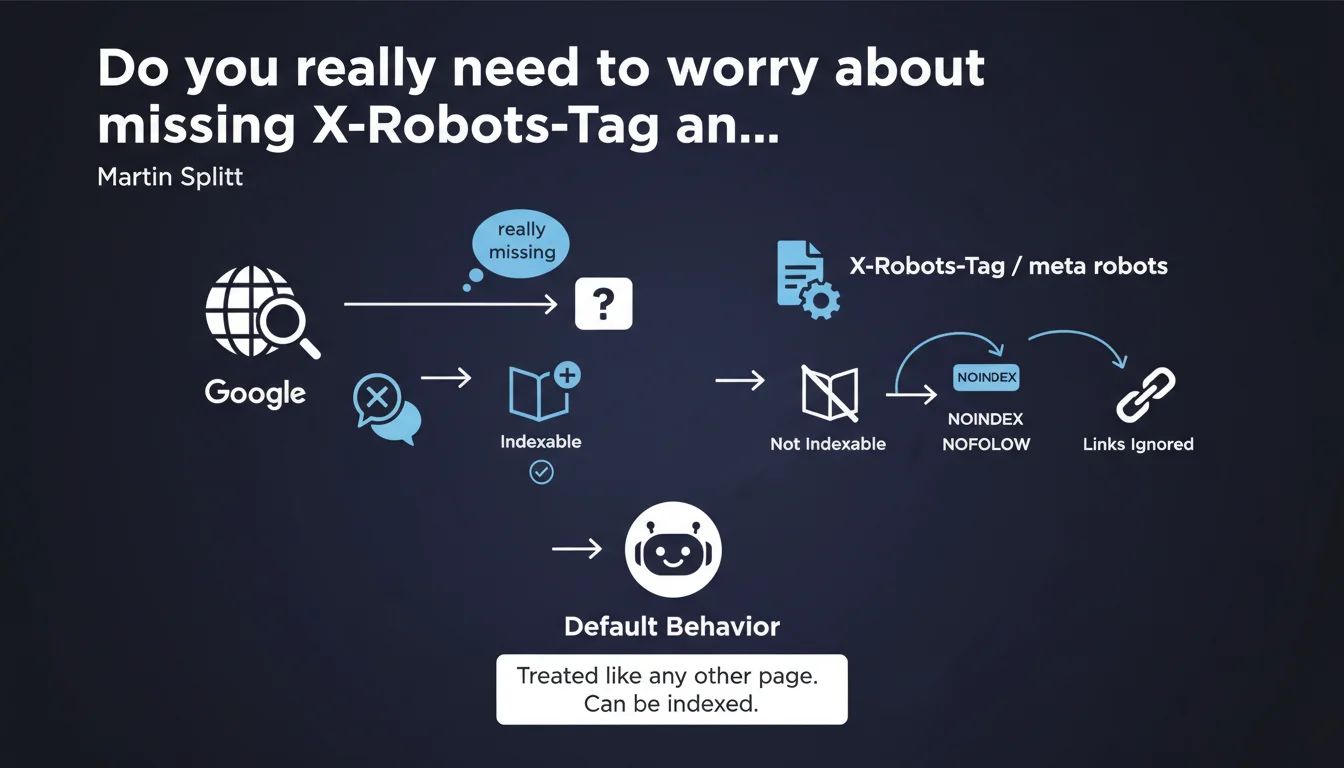
The absence of X-Robots-Tag or meta robots tags is not inherently a problem. These mechanisms only serve to give specific directives to search engines. Without them, the page is simply treated normally and can be indexed by default.
What you need to understand
Why does Google clarify robot tags in this way?
Martin Splitt reminds us of an obvious technical fact that seems to generate recurring questions among some SEO professionals. The X-Robots-Tag (HTTP header) and meta robots (HTML tag) are control tools, not prerequisites.
Their absence does not mean Google cannot crawl or index a page — quite the opposite. Without an explicit directive, the search engine applies its default behavior: crawl, analyze, and potentially index the content if it deems it relevant.
When do these tags become truly useful?
These mechanisms only make sense when you want to modify Google's standard behavior. Typically: block indexation (noindex), prevent link following (nofollow), forbid caching (noarchive), or limit snippet display (nosnippet).
Without any instructions to the contrary, Google assumes you accept standard treatment. This is a principle of implicit consent: silence equals acceptance.
- The absence of robot tags means the page can be indexed normally
- These tags are restriction tools, not indexation conditions
- The X-Robots-Tag (HTTP header) and meta robots (HTML) serve the same function; only the vector differs
- Explicit directives allow fine-grained control over indexation of certain sections: filter pages, PDFs, internal search results pages, etc.
How does Google handle the complete absence of directives?
In automatic mode. The crawler analyzes the content, evaluates its quality, detects duplication or low-quality signals, and independently decides whether indexation is worthwhile.
This autonomy can be problematic on complex websites where certain pages — deep pagination, multiple facets, printable versions — end up indexed when they shouldn't be. The absence of robot tags is not a bug, but a default choice that sometimes requires adjustments.
SEO Expert opinion
Is this statement consistent with real-world practices?
Yes, absolutely. Based on thousands of audits, we observe exactly this behavior: pages without explicit directives are crawled and indexed if they meet Google's quality criteria. No mystery here.
The problem emerges when sites leave useless pages indexed through negligence (login, cart, thank-you pages) that pollute the index and dilute crawl budget. The absence of robot tags then becomes an indirect problem — not technical, but strategic.
What nuances should be added to this statement?
Splitt talks about "treating a page differently," but this phrasing masks a more complex reality. Google can very well treat two pages without directives differently based on their content, structure, duplication, or depth in the site architecture.
The real issue is not the absence of a tag, but intentionality. If you let Google decide alone, you lose granular control. On an e-commerce site with 50,000 products and thousands of filter combinations, this loss of control can be catastrophic.
In which cases does this rule not really apply?
When robots.txt already blocks access. If a URL is disallowed in robots.txt, Google cannot crawl it and will never see any potential meta robots tag in the HTML. The X-Robots-Tag in HTTP header can still be read, but this is an edge case.
Another exception: sites requiring authentication. Without content access, Google cannot index anything, tags or not. The absence of a directive becomes irrelevant.
Practical impact and recommendations
What should you concretely do with robot tags?
First step: audit indexed pages via Search Console and identify those with no SEO value (admin pages, redundant filters, internal search results, tracking pages). Then, decide for each one: noindex or robots.txt blocking.
Second phase: define a clear indexation strategy. You don't need robot tags everywhere — only where you want to deviate from standard behavior. A 20-page brochure website can work fine without them altogether. A 100,000-URL e-commerce site must manage its directives rigorously.
- List all currently indexed pages via
site:yourdomain.comand Search Console - Identify pages with no SEO value: login, cart, checkout, thank-you, redundant filters, deep paginations
- Apply noindex to pages that should be crawled but not indexed (for internal linking)
- Block via robots.txt only pages that should neither be crawled nor indexed (crawl budget savings)
- Check logs to ensure Googlebot is not wasting resources on non-strategic sections
- Monitor indexation changes in Search Console after each modification
What mistakes should you avoid in managing robot tags?
Never combine noindex + robots.txt blocking on the same URL. If Google cannot crawl, it will never see the noindex and might keep the URL in the index with a truncated snippet. This is a classic mistake that generates Search Console alerts.
Also avoid global noindex by accident — a misconfigured X-Robots-Tag HTTP header at server level can destroy an entire site's indexation within days. Always test in development before pushing to production.
How can you verify that your robot directives management is optimal?
Three essential checks: inspect HTTP headers with tools like Screaming Frog or Chrome DevTools, analyze server logs to see which sections Googlebot visits most, and monitor the evolution of indexed pages in Search Console.
The goal is to maximize the ratio of strategic indexed pages / total pages crawled. If Google spends 40% of its time on useless pages, you have an architecture problem, not a tag problem.
❓ Frequently Asked Questions
Est-ce qu'ajouter des balises meta robots sur toutes mes pages améliore mon SEO ?
Quelle est la différence entre X-Robots-Tag et meta robots ?
Si je retire toutes mes balises noindex, Google va-t-il tout indexer d'un coup ?
Peut-on combiner plusieurs directives dans une même balise robots ?
Pourquoi Google indexe-t-il encore des pages bloquées par robots.txt ?
🎥 From the same video 19
Other SEO insights extracted from this same Google Search Central video · published on 21/08/2024
🎥 Watch the full video on YouTube →
💬 Comments (0)
Be the first to comment.