
Official statement
Other statements from this video 19 ▾
- □ Are nofollow links and noindex tags actually hurting your SEO?
- □ Do 404 errors really hurt your site's search rankings?
- □ Should you really redirect all 404 pages to improve your SEO?
- □ Does your image CDN speed really penalize your ranking in Google Images?
- □ Can you really reset Search Console data when you take over a website?
- □ Are regional subdomains enough to target a specific geographic market?
- □ Why are your rich results displaying the wrong currency and what's the fix?
- □ Does Google really penalize you for publishing video transcriptions as text on your website?
- □ Why does Google reject aggregated reviews in product structured data?
- □ Does Google really crawl URL variations that have no internal links or backlinks pointing to them?
- □ Why does Googlebot keep crawling 404 pages long after they've been deleted?
- □ Is the text-to-code ratio really a Google ranking factor?
- □ Do UTM parameters with medium=referral really kill the SEO value of a backlink?
- □ Do you really need to reply to every blog comment to boost your SEO?
- □ Should you worry when robots.txt shows up as a soft 404 in Search Console?
- □ Do you really need to worry about missing X-Robots-Tag and meta robots tags?
- □ Are your automatic Geo IP redirects killing your international SEO performance?
- □ Can modifying your title tags and meta descriptions really shift your Google rankings?
- □ Can poor quality links or traffic harm your site's reputation?
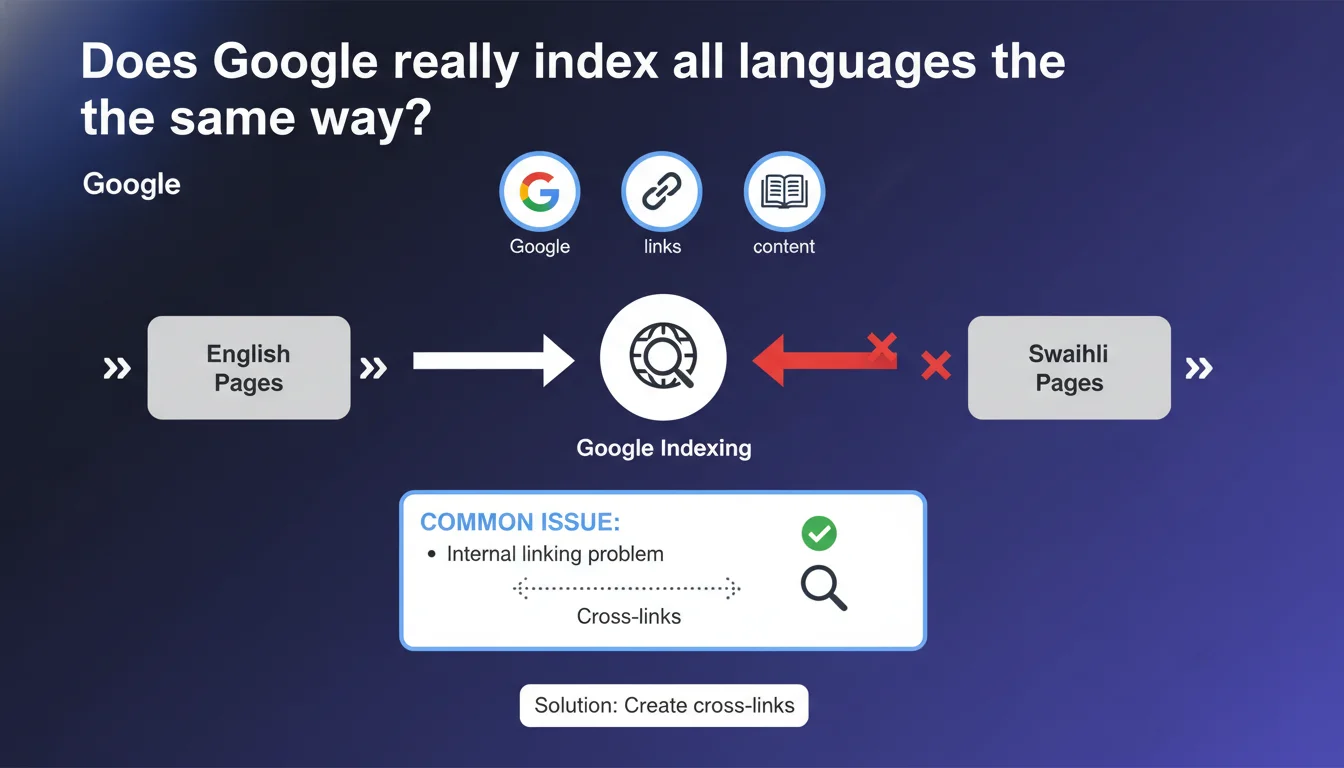
Google claims to treat all languages equally during indexing. If your pages in rare languages aren't indexed while your English pages are, the problem likely stems from your internal linking structure, not algorithmic linguistic bias. The solution: create cross-language links between your language versions.
What you need to understand
Does Google favor certain languages in its algorithm?
No, according to this statement. Google's algorithm processes content similarly regardless of the language used. No privilege for English, no penalty for Swahili or Basque.
This official position contradicts a widespread belief that Google would structurally favor English-language content. The search engine positions itself as linguistically neutral — indexing doesn't depend on language but on universal technical factors.
Why aren't my pages in rare languages indexed?
If your multilingual pages experience indexation disparities, Google points the finger at your internal link architecture. Pages in less common languages are often poorly connected to the rest of the site.
The crawler must be able to discover these pages via links from already-known pages. If your Swahili or Thai versions are dead ends with no incoming links from your English pages, they'll remain invisible — and that's not a language problem.
What does it mean to create cross-links between language versions?
Concretely: each language version must contain links to other versions of the same page. A visible and functional language selector sometimes isn't enough.
These cross-links serve two objectives: facilitate discovery by Googlebot and strengthen understanding of relationships between language versions. Combined with hreflang tags, they form the ideal technical architecture for multilingual sites.
- Linguistic neutrality: Google claims to treat all languages equally
- Multilingual indexation problem: often due to internal linking flaws, not algorithmic bias
- Recommended solution: create bidirectional links between all language versions of the same page
- Essential architecture: cross-links facilitate discovery and indexation by crawlers
SEO Expert opinion
Is this statement consistent with real-world observations?
Yes and no. In principle, the absence of programmatic linguistic bias seems consistent with what we observe: websites in rare languages can rank very well if their SEO is solid.
But — and this is where it gets tricky — Google oversimplifies reality. Content in dominant languages mechanically benefits from more signals: more external links, more user searches, more engagement data. This isn't direct algorithmic bias, but a network effect that structurally advantages certain languages.
Does internal linking explain all multilingual indexation problems?
It's a major factor, certainly. But reducing all indexation issues solely to internal linking is overlooking other frequent causes: insufficient crawl budget, improperly configured hreflang tags, duplicated content between versions, incorrect canonicals.
I've seen sites with perfect linking but indexation problems due to signal conflicts between hreflang and canonical. Google mentions none of this here. [To verify]: to what extent is internal linking truly sufficient when crawl budget is limited?
Should you systematically link all language versions to each other?
In theory yes, but watch out for edge cases. If you have 40 languages, creating a selector with 40 links on each page can dilute internal PageRank and bloat the DOM.
Some sites adopt a hybrid approach: direct links to main languages, dropdown menu for others. The key is that Googlebot finds a path — whether via HTML or XML sitemap. Prioritize practicality over orthodoxy.
Practical impact and recommendations
What should you do concretely to guarantee multilingual indexation?
Audit your internal linking between language versions. Verify that each version of a page contains HTML links to its equivalents in other languages — ideally at the top of the page, in a visible selector.
Complete this with properly implemented hreflang tags (in HTML or sitemap). Ensure that each URL declares all its language and regional variants, including itself.
Monitor your crawl budget: if Google doesn't regularly crawl your secondary language pages, increase their crawl frequency through internal linking from your main pages. Use the coverage reports in Search Console to identify pages discovered but not indexed.
What mistakes must you absolutely avoid?
Don't isolate your language versions in watertight silos without internal links. This is the classic mistake: creating /en/, /fr/, /de/ without any links between these directories.
Avoid signal conflicts: canonical pointing to another language, inconsistent hreflang with actual structure, automatic redirects based on IP that prevent Googlebot from accessing certain versions.
Don't rely solely on XML sitemap. While useful, it doesn't replace solid HTML linking — Google discovers and understands better through clickable links.
How can you verify your multilingual architecture is correct?
Test discoverability: start from your homepage and verify you can reach all language versions in a few clicks. Use a crawler (Screaming Frog, Oncrawl) to map links between versions.
Validate your hreflang tags with Google's tool (Search Console, International Targeting section) or third-party validators. Look for common errors: non-canonical URLs, incomplete chains, incorrect language codes.
Monitor indexation metrics by language in Search Console. If a language remains systematically under-indexed despite correct linking, dig deeper: duplicate content problem, insufficient perceived quality, weak user signals?
- Create a visible language selector on all pages with HTML links to each version
- Implement coherent and complete hreflang tags (each version must reference all others)
- Verify that each language is accessible from primary navigation or footer
- Audit internal linking between language versions with a crawler
- Submit a separate multilingual XML sitemap or integrated one with all URLs
- Monitor indexation by language in Search Console and identify discrepancies
- Test accessibility of each version without automatic IP-based redirects
- Avoid cross-language canonicals (each version should be self-canonical or point to its own language)
Multilingual indexation relies on solid link architecture and coherent technical signals. If Google claims not to discriminate by language, it's up to SEO professionals to ensure all versions are discoverable and properly flagged.
These multilingual optimizations can quickly become complex, especially on high-volume sites or with many languages. Between linking audits, hreflang validation, and indexation tracking per market, the technical expertise required often exceeds available internal resources. Working with an agency specialized in multilingual SEO allows you to structure the architecture correctly from the start and avoid costly visibility mistakes.
❓ Frequently Asked Questions
Google favorise-t-il vraiment l'anglais dans ses résultats de recherche ?
Les liens entre versions linguistiques remplacent-ils les balises hreflang ?
Faut-il créer un sitemap XML spécifique pour chaque langue ?
Pourquoi mes pages en langue minoritaire n'apparaissent-elles pas dans Search Console ?
Comment gérer le multilingue avec un budget crawl limité ?
🎥 From the same video 19
Other SEO insights extracted from this same Google Search Central video · published on 21/08/2024
🎥 Watch the full video on YouTube →
💬 Comments (0)
Be the first to comment.