
Official statement
Other statements from this video 19 ▾
- □ Does Google really index all languages the same way?
- □ Are nofollow links and noindex tags actually hurting your SEO?
- □ Do 404 errors really hurt your site's search rankings?
- □ Should you really redirect all 404 pages to improve your SEO?
- □ Does your image CDN speed really penalize your ranking in Google Images?
- □ Can you really reset Search Console data when you take over a website?
- □ Are regional subdomains enough to target a specific geographic market?
- □ Why are your rich results displaying the wrong currency and what's the fix?
- □ Does Google really penalize you for publishing video transcriptions as text on your website?
- □ Why does Google reject aggregated reviews in product structured data?
- □ Does Google really crawl URL variations that have no internal links or backlinks pointing to them?
- □ Why does Googlebot keep crawling 404 pages long after they've been deleted?
- □ Is the text-to-code ratio really a Google ranking factor?
- □ Do UTM parameters with medium=referral really kill the SEO value of a backlink?
- □ Do you really need to reply to every blog comment to boost your SEO?
- □ Should you worry when robots.txt shows up as a soft 404 in Search Console?
- □ Do you really need to worry about missing X-Robots-Tag and meta robots tags?
- □ Can modifying your title tags and meta descriptions really shift your Google rankings?
- □ Can poor quality links or traffic harm your site's reputation?
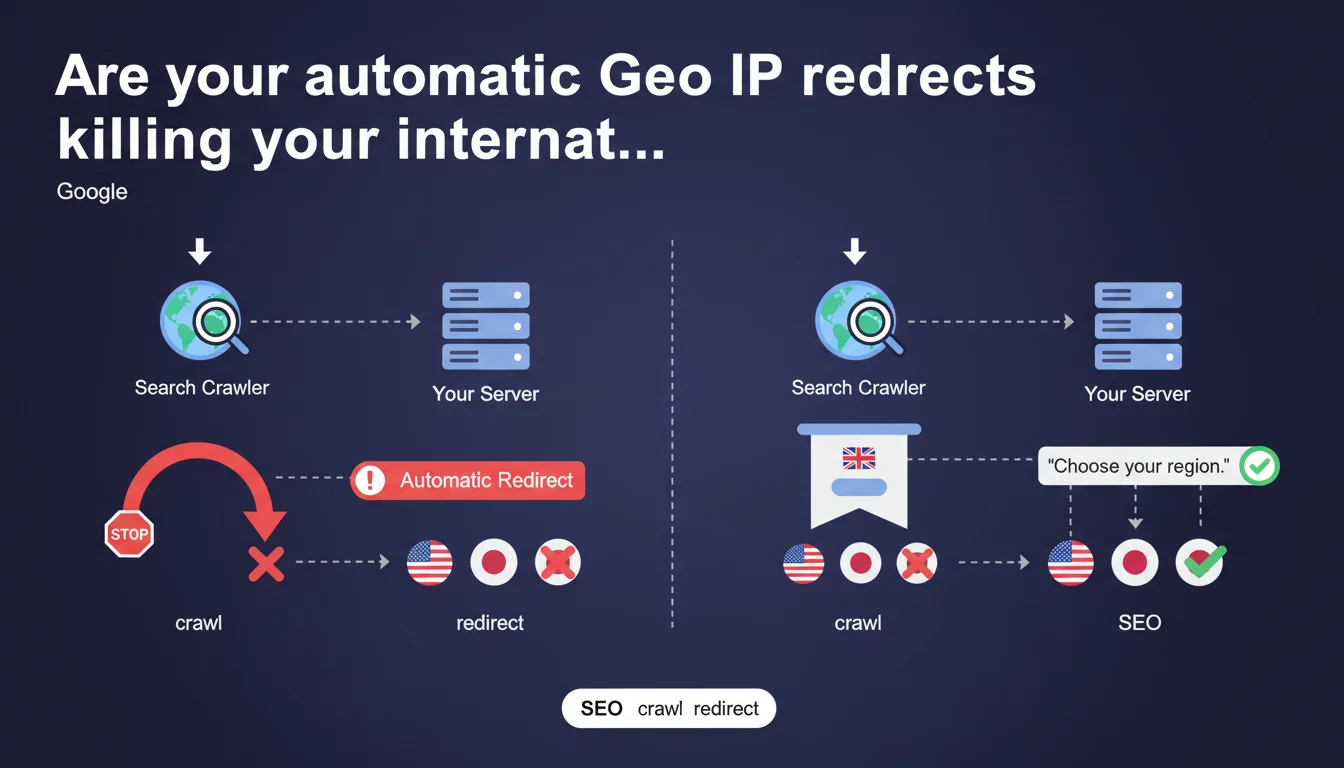
Google explicitly advises against automatic Geo IP redirects for multilingual or multi-regional sites. These redirects trap crawlers on a single site version, preventing proper indexing of alternatives. The recommended solution: banners or pop-ups that let users choose their preferred version.
What you need to understand
Why does Google oppose automatic Geo IP redirects?
Geolocation IP-based redirects create a structural indexing problem. When Googlebot crawls a site, it typically uses American IP addresses — and sometimes other datacenters distributed worldwide. If your site automatically redirects to /fr/ for a French IP, Googlebot will systematically be sent to this version and will never see the others.
Result: your /en/, /de/, /es/ versions won't be crawled, so they won't be indexed. You lose most of your international visibility. The search engine cannot understand that these versions exist if they are technically inaccessible from its crawl point.
What exactly happens with crawlers?
Search engine robots don't send usable Accept-Language headers to determine reliable language preference. They cannot "choose" their version the way a human would by clicking a language selector.
If you implement a 301 or 302 redirect based solely on IP, you create a closed crawl loop. Googlebot hits example.com, gets redirected to example.com/us/, and can no longer access other URLs. Even with perfectly configured hreflang tags, the search engine will never discover the alternative pages because it never reaches them.
What's the difference between forced redirect and user suggestion?
A forced redirect (HTTP 301/302) leaves no choice: the server unilaterally decides the final destination. A crawler — and a user — has no way to bypass this technical decision.
A banner or pop-up suggestion displays the requested page normally, then offers via JavaScript or a visible HTML element a link to the detected local version. The user (or crawler) can ignore this suggestion and continue on the initial version. Googlebot sees the page's actual content, indexes correctly, and understands hreflang signals.
- Automatic redirect = technical blocking of crawlers to a single version
- Suggestion banner = accessible page + optional change proposal
- Hreflang tags cannot compensate for a Geo IP redirect — they require all versions to be crawlable
- This rule applies to all search engines, not just Google
SEO Expert opinion
Is this recommendation really applied in practice?
Let's be honest: many sites continue using Geo IP redirects, especially large e-commerce and SaaS platforms. Some get away with it better than others — often because they've implemented exceptions for crawler user-agents. But this approach carries cloaking risks if poorly executed.
In practice, sites that strictly follow this directive see measurable improvements in international indexation. Those who persist with automatic redirects regularly encounter partial indexing issues, cannibalization between regional versions, or progressive deindexation of certain languages. [To verify]: some claim that Googlebot adapts its behavior across datacenters — no public data confirms this nuance.
What are the gray areas in this statement?
Google remains vague about conditional redirects based on User-Agent. Technically, you could redirect human visitors based on their IP while allowing crawlers through. But this practice borders on cloaking — serving different content to robots and users.
The risk? A manual or algorithmic penalty if Google considers you manipulating indexation. The boundary between "UX optimization" and "SEO manipulation" is never clearly defined in these cases. In 15 years of practice, I've seen sites penalized for less than this — and others flying under the radar for years.
In what cases does this rule really pose problems?
For sites with strict legal constraints (geo-blocked content, territorial licenses, GDPR applied differently by region), avoiding all automatic redirects can be complicated. Certain sectors — gambling, streaming, finance — don't really have a choice.
In these situations, the least risky solution remains to block access at content level (error message or alternative page) rather than redirect. Googlebot sees the page, understands it exists, but the end user is informed of regional unavailability. It's not ideal for UX, but it's crawlable.
Practical impact and recommendations
What should you concretely do for an international site?
First step: audit all your server redirects. Check your .htaccess files, nginx.conf, or your CDN (Cloudflare, Akamai) for Geo IP rules that automatically redirect to regional versions. If yes, disable them for crawlers — or better, for everyone.
Next, implement a language suggestion banner at the top of the page, detectable via client-side JavaScript. It displays after initial page load, doesn't interfere with crawling, and gives control to the user. Frameworks like Next.js or Nuxt allow you to handle this cleanly with locale detection and preference cookies.
How do you verify that my crawlers aren't blocked?
Use Google Search Console and verify indexation of all your regional versions. If certain languages or regions have abnormally low indexation rates, it's often a sign of problematic redirects.
Test manually with a VPN or proxy located in different regions, impersonating Googlebot (User-Agent: "Googlebot/2.1"). If you're being redirected when you shouldn't be, you've identified the problem. Tools like Screaming Frog in region-based crawl mode can also reveal these hidden redirects.
What mistakes should you absolutely avoid?
Never create permanent 301 redirects based on IP for language targeting reasons. A 301 tells Google "this page has permanently moved" — which makes no sense for a version that's simply different from the same resource.
Also avoid chained 302 redirects: IP detected → redirect to /fr/ → redirect to /fr/home/ → etc. Each hop slows crawling, dilutes PageRank, and increases indexing error chances. Keep architecture simple: one URL requested = one HTTP 200 response with the correct content.
- Remove all automatic Geo IP redirects (301, 302, 307) based solely on IP origin
- Implement a visible JavaScript or HTML banner allowing users to choose their version
- Properly configure hreflang tags on all language/regional versions
- Test accessibility of all versions with Googlebot User-Agent from different IPs
- Verify in Search Console that all versions are properly indexed
- Clearly document language suggestion logic for technical teams
- Avoid any content differences served by User-Agent (cloaking risk)
❓ Frequently Asked Questions
Puis-je rediriger automatiquement les utilisateurs tout en laissant passer Googlebot ?
Les redirections JavaScript côté client posent-elles le même problème ?
Est-ce que les balises hreflang suffisent sans redirection ?
Comment gérer les utilisateurs qui préfèrent rester sur la version par défaut ?
Les CDN comme Cloudflare peuvent-ils gérer ça correctement ?
🎥 From the same video 19
Other SEO insights extracted from this same Google Search Central video · published on 21/08/2024
🎥 Watch the full video on YouTube →
💬 Comments (0)
Be the first to comment.