
Official statement
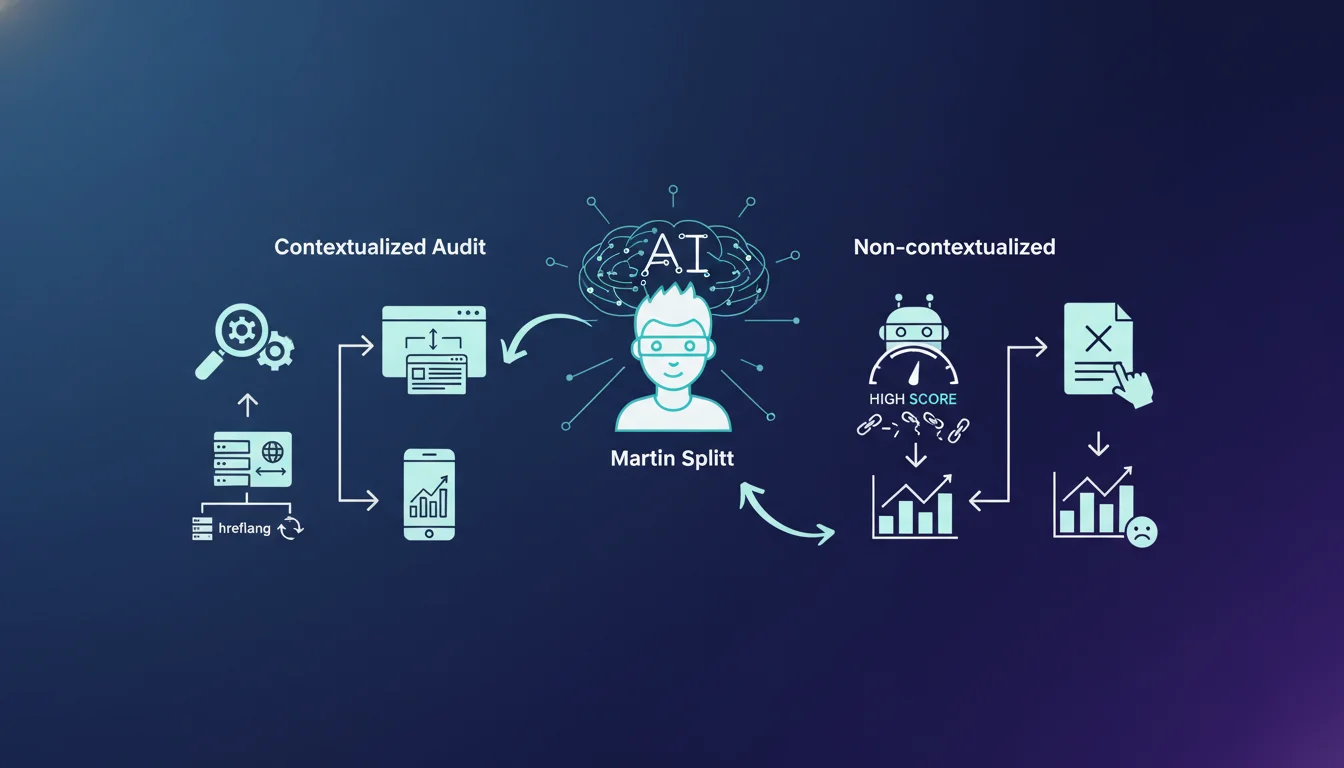
For example, the scores indicated do not always take context into account: an increase in 404 pages can be normal after deleting content. Only an unexplained increase represents a real warning signal. Furthermore, certain issues are specific to each site: an international site must audit its hreflangs, while a site based on a single language does not need to.
In short, Martin Splitt recommends avoiding generic checklists that can waste time on unnecessary corrections while masking major problems.
What you need to understand
Martin Splitt reminds us of an often-forgotten truth: an effective technical SEO audit cannot rely solely on automated metrics. Tools are useful, but they generate standardized reports that ignore the specific context of each site.
The main problem lies in the blind interpretation of scores and alerts. A tool may flag 500 404 errors as critical, when these pages were deliberately deleted as part of a redesign. Conversely, 10 unexplained 404 errors can reveal a major structural problem.
This contextualized approach involves understanding the technology, architecture, and business objectives of the site before applying recommendations. A multilingual e-commerce site will not have the same priorities as a monolingual blog.
- Automated scores do not always reflect the reality of SEO problems
- Business context determines which technical criteria are priorities
- Each site has its specificities: international, e-commerce, media, SaaS, etc.
- Generic checklists waste time on optimizations without real impact
- Certain warning signals are normal in certain contexts
SEO Expert opinion
This position from Google is totally consistent with what we observe in the field. Too many sites waste precious resources correcting "problems" identified by tools, with no measurable impact on their visibility.
The important nuance concerns the discovery phase. Automated tools remain excellent for establishing a quick initial diagnosis and identifying areas for investigation. The problem arises when their recommendations are applied without critical thinking.
A typical case: a tool recommends reducing page weight below 1MB. On a professional photography site, this constraint can degrade user experience and conversion rate. The trade-off between technical performance and business objectives must always take priority.
Practical impact and recommendations
Technical SEO auditing must become a strategic analysis process, not simply executing a checklist. Here's how to adapt your approach to obtain tangible results.
- Start by understanding the business model: e-commerce, lead generation, media, SaaS... Technical priorities differ radically
- Document the technical architecture before using tools: CMS, framework, CDN, internationalization, etc.
- Contextualize each alert: ask yourself "why is this metric changing?" before concluding there's a problem
- Prioritize according to business impact: a slow page generating 50% of revenue is more critical than 100 fast pages with no traffic
- Adapt criteria according to site type: only audit hreflang if the site is multilingual, product structured data only for e-commerce
- Measure real impact: test your corrections on a sample and measure organic traffic evolution before global deployment
- Create custom audits: develop checklists specific to your industry rather than using generic templates
- Train continuously: the ability to contextualize requires deep understanding of web technologies and how Google works
Implementing this contextualized approach requires advanced technical expertise and fine understanding of ranking signals. Between crawl analysis, metrics interpretation, and strategic prioritization of fixes, many sites underexploit their SEO potential. Engaging a specialized SEO agency allows you to benefit from expert insight capable of distinguishing high-impact optimizations from superfluous corrections, while adapting technical strategy to your specific business objectives.
💬 Comments (0)
Be the first to comment.