
Official statement
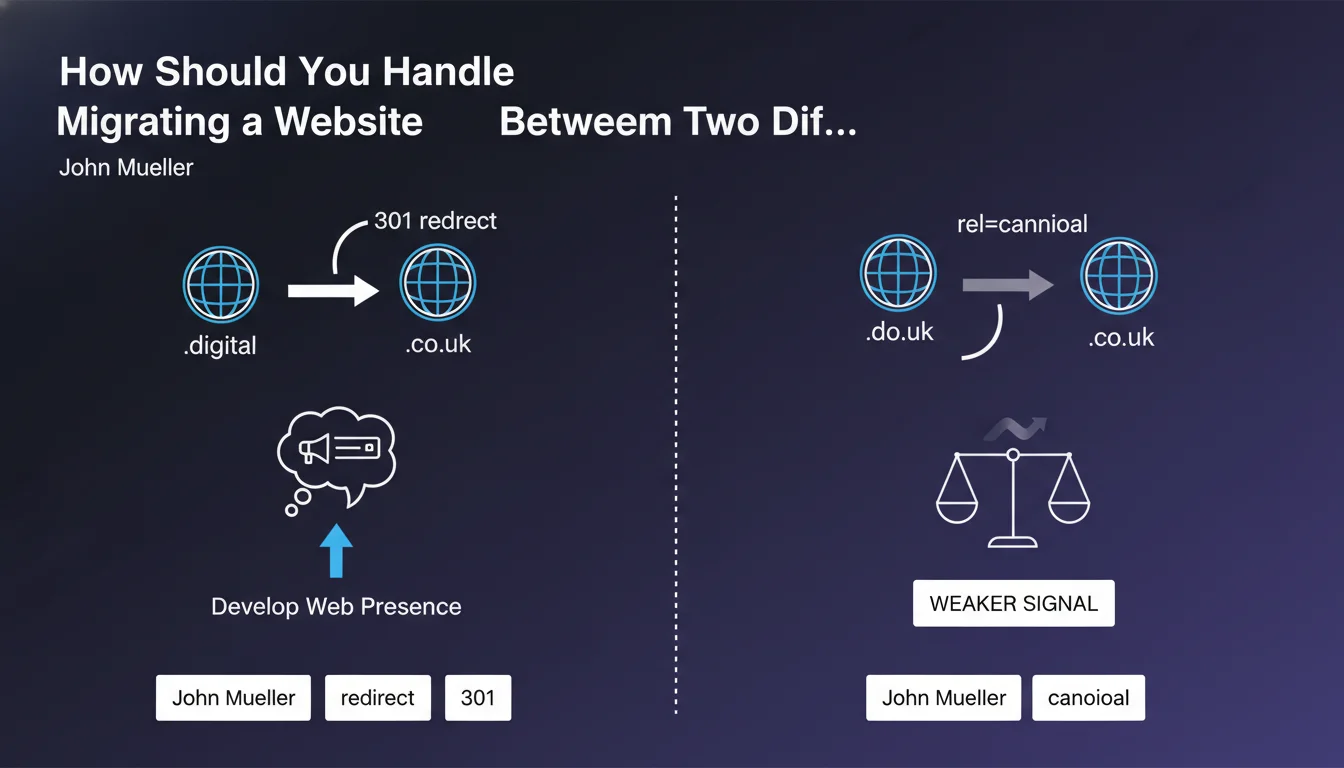
Here is John Mueller's advice: first, perform a migration from .digital to .co.uk using 301 redirects. Then, use the main domain name (.co.uk) to develop the web presence.
If the company wants to maintain two sites with identical content, it is also possible to use rel=canonical. However, this signal is weaker than a 301 redirect.
What you need to understand
This statement addresses a common scenario in SEO: a company wants to migrate its main site to a new domain name (in this case a .co.uk) while keeping the old domain (.digital) for specific marketing needs.
The main advice is clear: prioritize a complete migration with 301 redirects from the source domain to the target domain. This approach allows you to transfer most of the authority and rankings to the new domain.
If business constraints require maintaining two versions of the site with identical content, using the rel=canonical tag becomes an acceptable alternative, although less effective than a direct redirect.
- 301 Redirects: optimal solution for transferring SEO authority from one domain to another
- Consolidation on a main domain: recommended strategy for developing visibility
- Rel=canonical as an alternative: usable in case of business constraints, but weaker signal
- Avoid content duplication: major risk if no signal is implemented
SEO Expert opinion
This recommendation is perfectly consistent with SEO best practices observed for years. The hierarchy between 301 redirects and rel=canonical is clearly established: the former actually transfers the user and concentrates SEO signals, while the latter is only an indication given to Google.
An important nuance: in the case of a multi-country or multi-language strategy, this approach must be adapted. If the .co.uk specifically targets the United Kingdom and the .digital had an international reach, you would potentially need to maintain an hreflang structure rather than simple canonicalization.
Moreover, maintaining two sites with identical content, even with canonicals, dilutes marketing efforts and complicates management. This approach should only be a temporary solution, while completing the full transition.
Practical impact and recommendations
- Systematically prioritize 301 redirects for any domain migration, rather than maintaining multiple versions
- Implement a structured migration plan: preliminary audit, URL mapping, redirect implementation, monitoring in Search Console
- Concentrate SEO efforts on a single main domain to maximize authority and facilitate performance tracking
- If maintaining two domains is unavoidable, implement rel=canonical tags rigorously on all duplicated pages
- Declare both properties in Google Search Console and monitor coverage reports to detect potential duplication issues
- Avoid creating identical content: if possible, slightly differentiate the content between the two domains to address different intents
- Plan a complete transition: do not consider the coexistence of two domains as a sustainable solution
- Monitor authority transfer with position tracking tools and backlink analysis for at least 3 to 6 months post-migration
Migration between two domain extensions is a delicate SEO operation that can have significant impacts on your organic visibility if not perfectly executed.
301 redirects remain the most robust technical solution, while canonical tags are only an acceptable workaround in constrained situations. The key to success lies in meticulous planning and rigorous monitoring of each step.
Given the technical complexity of these migrations and the associated risks in terms of traffic and rankings, support from a specialized SEO agency can prove valuable. Expert insight helps anticipate potential problems, optimize every technical aspect of the migration, and ensure a smooth transition that preserves your acquired SEO capital.
💬 Comments (0)
Be the first to comment.