
Official statement
Other statements from this video 19 ▾
- □ Google indexe-t-il vraiment toutes les langues de la même manière ?
- □ Les liens nofollow et balises noindex nuisent-ils à votre référencement ?
- □ Les erreurs 404 pénalisent-elles vraiment le classement de votre site ?
- □ La vitesse de votre CDN d'images pénalise-t-elle vraiment votre référencement dans Google Images ?
- □ Peut-on réinitialiser les données Search Console d'un site repris ?
- □ Les sous-domaines régionaux suffisent-ils à cibler un marché géographique ?
- □ Pourquoi vos rich results affichent-ils la mauvaise devise et comment y remédier ?
- □ La transcription vidéo est-elle considérée comme du contenu dupliqué par Google ?
- □ Pourquoi Google refuse-t-il les avis agrégés dans les données structurées produit ?
- □ Google crawle-t-il les variations d'URL sans liens internes ou backlinks ?
- □ Pourquoi Googlebot persiste-t-il à crawler des pages 404 après leur suppression ?
- □ Le ratio texte/code est-il vraiment un facteur de classement Google ?
- □ Les paramètres UTM avec medium=referral tuent-ils vraiment la valeur SEO d'un backlink ?
- □ Faut-il absolument répondre aux commentaires de blog pour le SEO ?
- □ Faut-il s'inquiéter quand robots.txt apparaît comme soft 404 dans Search Console ?
- □ Faut-il vraiment s'inquiéter de l'absence de balises X-Robots-Tag et meta robots ?
- □ Pourquoi les redirections Geo IP automatiques sabotent-elles votre SEO international ?
- □ Modifier ses balises title et meta description peut-il vraiment faire bouger son classement Google ?
- □ Les liens ou le trafic de mauvaise qualité peuvent-ils nuire à la réputation de votre site ?
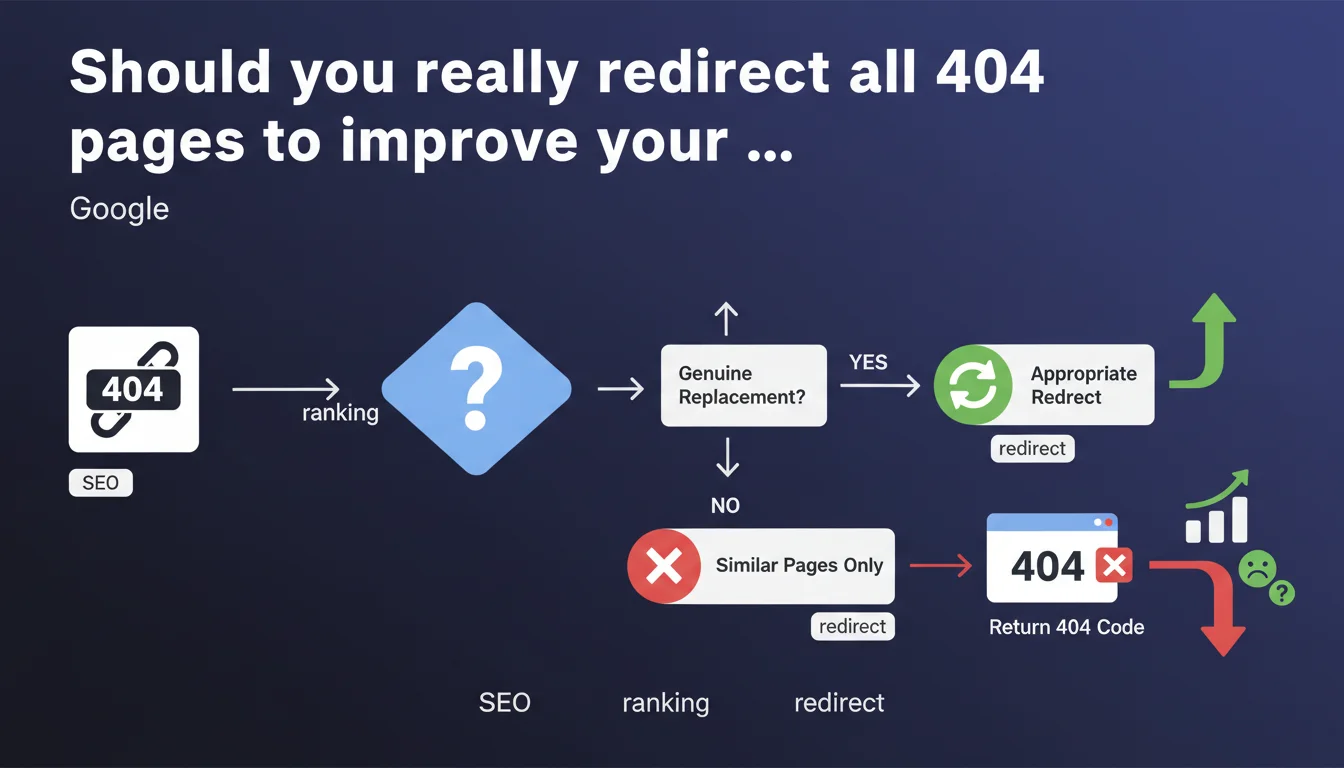
Google recommends only redirecting a 404 page if a genuine replacement product exists. In all other cases — pages that are merely similar or thematically close — it's better to return an honest 404 code. Redirects to irrelevant pages degrade user experience without providing any SEO benefit.
What you need to understand
Why does Google insist on redirect relevance?
Google's logic rests on a simple principle: a redirect must serve the user, not hide a technical problem. When someone searches for a specific product that no longer exists, redirecting them to a generic or vaguely similar page creates frustration.
On a technical level, Google detects patterns of massive redirects to catch-all pages. These practices — common a few years ago — aimed to avoid 404s by redirecting everything to the homepage or a category. The search engine now considers them soft spam.
What counts as a "genuine replacement" according to Google?
The wording is intentionally vague. A genuine replacement is a product or service that answers the same intent with comparable features. Concrete example: a discontinued shoe model replaced by its N+1 version.
By contrast, redirecting a discontinued smartphone product page to "All smartphones" is not a replacement. It's URL manipulation that provides nothing to a user arriving via an old link or bookmark.
Does a 404 code really hurt your SEO?
No. This is one of the most persistent SEO myths. A 404 code is a legitimate HTTP response that simply indicates a resource no longer exists. Google applies no penalty for 404s as long as their proportion remains reasonable.
The real problem occurs when strategic pages — those with traffic and strong backlinks — disappear without an alternative. There, yes, you lose link juice. But the solution isn't redirecting anywhere: it's providing a genuine replacement page or accepting the 404.
- Redirects must serve the user, not hide missing content
- A genuine replacement = same intent, comparable features
- 404s don't penalize your SEO if they're justified
- Massive redirects to generic pages are detected as spam
- Prioritize transparency: a clean 404 beats a frustrating redirect
SEO Expert opinion
Is this recommendation consistent with real-world observations?
Absolutely. Sites that cleaned up abusive redirect chains — particularly e-commerce sites with rotating catalogs — often saw improvements in crawl budget efficiency. Google wastes less time following redirects to poorly relevant pages.
Let's be honest: for years, the opposite approach was recommended. Systematic 301 redirects, "similar products" pages serving as catch-alls… Google still tolerates these patterns, but values them less and less. The transition toward accepted 404s requires a cultural shift at some organizations.
Are there cases where this rule doesn't apply strictly?
A few nuances deserve attention. If a product page generated significant SEO traffic and has solid external backlinks, leaving it as a 404 means losing that equity. In this specific case, redirecting to the parent category can be justified — provided you substantially enrich that category to truly meet user expectations.
Another case: site migrations or information architecture redesigns. Here, redirects are essential, even if the match isn't perfect. But be careful: Google distinguishes a legitimate migration from a permanent patch. If your 301s stay active for 3 years, they become suspicious.
[To verify]: Google never quantifies what it means by "too many irrelevant redirects." The threshold remains subjective and likely depends on the ratio of redirects to total pages, as well as the bounce rate post-redirect.
What are the risks if you ignore this recommendation?
The main risk isn't a brutal algorithmic penalty — Google has never confirmed a dedicated filter. It's rather gradual erosion: high bounce rates on destination pages, degraded user signals, less efficient crawling.
And there's a domino effect: a user frustrated by a fake redirect won't come back. Your UX metrics deteriorate, which indirectly impacts rankings. Google picks up these signals via Chrome, Analytics, and its own tools.
Practical impact and recommendations
What should you do concretely when a product is discontinued?
First step: evaluate the SEO potential of the URL. If the page has few backlinks, little organic traffic, and minimal ranking history, leave it as a 404 with a clean error page offering relevant alternatives.
If the page has weight — quality backlinks, strong historical positions — find an exact replacement. Not "roughly close." If no replacement exists, two options: create a temporary transition page explaining the discontinuation and suggesting similar products, or redirect to the parent category while substantially enriching it.
How do you audit existing redirects to detect abuse?
Use Screaming Frog or Sitebulb to map all your redirects. Filter those pointing to pages with high bounce rates (> 70%) or short time on page (< 10 seconds). These metrics often signal a mismatch between expectation and destination.
Then cross-reference with Google Search Console: check 404 URLs that still generate clicks from the SERP. If Google displays them despite their disappearance, they have strong history. There, an intelligent redirect may be justified — but only if the destination page truly answers the original query.
What mistakes must you absolutely avoid?
Never default to redirecting toward the homepage. It's the worst possible practice: you dilute the signal, confuse the user, and waste crawl budget. Google interprets these redirects as content camouflage.
Also avoid temporary redirects (302) to hide permanent deletions. A 302 tells Google "this page will come back," which keeps the URL in the index. If the product won't return, it's a 301 or 404 — nothing else.
- Audit existing redirects using a crawler and identify those pointing to high-bounce pages
- For each deleted page, assess its SEO equity (backlinks, traffic, historical rankings)
- Only redirect if an exact replacement exists — otherwise, accept the 404
- Customize your 404 page with relevant suggestions based on the original category
- Avoid any redirects to the homepage or generic catch-all pages
- Document each strategic redirect to justify its relevance
- Monitor bounce rates post-redirect to detect inadequacies
Managing redirects and 404s requires a nuanced analysis of each URL's SEO equity. This task — seemingly simple — demands technical expertise, understanding of user metrics, and the ability to decide between preservation and deletion.
For complex sites or volatile catalogs, this optimization can quickly become time-consuming. A professional audit identifies toxic redirects, prioritizes actions by impact, and establishes sustainable processes. If your team lacks time or resources for this type of analysis, working with a specialized SEO agency ensures a methodical approach and measurable results.
❓ Frequently Asked Questions
Une redirection 301 vers une catégorie parent est-elle acceptable si aucun remplacement exact n'existe ?
Combien de pages 404 peut-on avoir sans impacter le SEO ?
Faut-il supprimer les redirections 301 anciennes qui fonctionnent encore ?
Quelle différence entre une page 404 et une page « produit indisponible » en 200 ?
Comment personnaliser une page 404 sans nuire au SEO ?
🎥 From the same video 19
Other SEO insights extracted from this same Google Search Central video · published on 21/08/2024
🎥 Watch the full video on YouTube →
💬 Comments (0)
Be the first to comment.