
Official statement
Other statements from this video 19 ▾
- □ Does Google really index all languages the same way?
- □ Do 404 errors really hurt your site's search rankings?
- □ Should you really redirect all 404 pages to improve your SEO?
- □ Does your image CDN speed really penalize your ranking in Google Images?
- □ Can you really reset Search Console data when you take over a website?
- □ Are regional subdomains enough to target a specific geographic market?
- □ Why are your rich results displaying the wrong currency and what's the fix?
- □ Does Google really penalize you for publishing video transcriptions as text on your website?
- □ Why does Google reject aggregated reviews in product structured data?
- □ Does Google really crawl URL variations that have no internal links or backlinks pointing to them?
- □ Why does Googlebot keep crawling 404 pages long after they've been deleted?
- □ Is the text-to-code ratio really a Google ranking factor?
- □ Do UTM parameters with medium=referral really kill the SEO value of a backlink?
- □ Do you really need to reply to every blog comment to boost your SEO?
- □ Should you worry when robots.txt shows up as a soft 404 in Search Console?
- □ Do you really need to worry about missing X-Robots-Tag and meta robots tags?
- □ Are your automatic Geo IP redirects killing your international SEO performance?
- □ Can modifying your title tags and meta descriptions really shift your Google rankings?
- □ Can poor quality links or traffic harm your site's reputation?
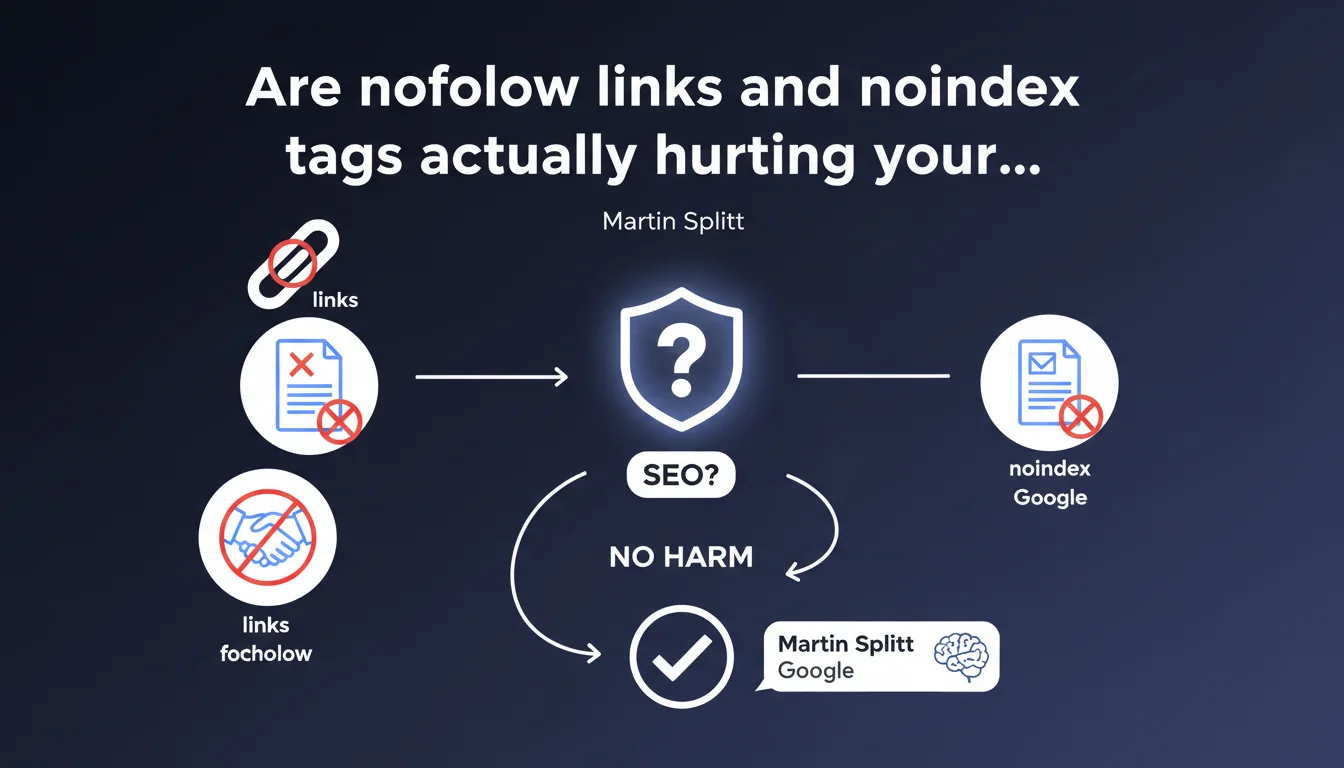
Martin Splitt states that using the nofollow attribute extensively on internal links or the noindex tag on numerous pages does not signal to Google that your site contains low-quality content. These directives simply indicate your indexation and PageRank propagation preferences, without triggering any algorithmic quality-related penalty.
What you need to understand
Why is this Google clarification so important?
For years, some SEO practitioners have feared that heavy use of internal nofollow or noindex sends a negative signal to Google. The underlying idea: if you're blocking the indexation of many pages or not passing PageRank to certain sections, it must be because that content is weak.
Martin Splitt clears things up. These directives are technical instructions, not admissions of mediocrity. Google interprets them as legitimate editorial choices — you don't want to index your member area, your thank-you pages, or your infinitely faceted URLs. Nothing suspicious there.
What types of pages typically involve these directives?
Noindex commonly applies to utility pages: login, shopping cart, internal search results, paginated pages without unique content, intentionally duplicate content (printable versions). None of these pages are meant to appear in SERPs.
Internal nofollow has lost much of its relevance since Google began treating link attributes as hints rather than directives (March 2020). But some still use it on links to sections of lesser editorial importance — widgets, bloated footers, internal promotional links.
Can Google detect manipulation through these attributes?
Yes, but Splitt is talking about legitimate use here. If you're noindexing 80% of your site because you know it's auto-generated low-quality content, Google won't penalize the noindex itself. It will penalize the poor quality of the remaining indexed content, if that content doesn't hold up.
The nofollow attribute or noindex tag are not shields against quality evaluation. Google judges what it indexes. What it doesn't index, it ignores — but it doesn't draw negative conclusions simply from the fact that you've excluded it.
- Noindex and nofollow are technical instructions, not quality signals
- Their massive use does not penalize the rest of the site if indexed content is solid
- Google evaluates quality on what it can index, not on what you block
- These directives remain index management tools, not admissions of weakness
SEO Expert opinion
Is this statement consistent with real-world observations?
Overall, yes. We've never observed a direct correlation between the volume of noindexed pages and ranking drops on the rest of the site. E-commerce sites noindex thousands of filter combinations without issue. SaaS platforms exclude hundreds of admin pages without visible impact.
But — and this is where it gets tricky — the statement says nothing about indirect effects. If you're noindexing 90% of your content because it's mediocre, you end up with a 100-page site where only 10 are crawlable. Google will judge those 10 pages… and if they're weak too, your site will sink. Noindex isn't the culprit, it's the symptom.
Does internal nofollow even make sense in 2025?
Honestly? Very little. Since Google started treating nofollow as a hint (not a directive), sculpting PageRank through nofollow has become risky. Google can choose to follow these links anyway to discover content or understand site structure.
Some SEOs still nofollow links to low-value SEO pages (terms of service, repeated legal mentions internally). It probably doesn't hurt, but the real impact on PageRank distribution is uncertain. [Needs verification] based on your own testing — real-world feedback varies.
When does this rule not apply?
If you're using noindex to hide internal spam or content violating guidelines (doorway pages, auto-generated content with no value), Google can very well detect the manipulation elsewhere. Noindex doesn't whitewash a poor site, it just hides part of the problem.
Another edge case: noindexing pages that receive quality external backlinks. You lose the benefit of those links — and if that's systematic, you're sabotaging your own authority. Google won't penalize you for noindex, but you're shooting yourself in the foot.
Practical impact and recommendations
What should you concretely do with these directives?
Use noindex without guilt on pages that have no business appearing in SERPs: member areas, shopping carts, infinite e-commerce filters, thank-you pages, tracking URLs. This is legitimate housekeeping, not a weakness signal.
For internal nofollow, ask yourself: is this really necessary? If you want to avoid diluting PageRank, it's better to delete the link or make it less prominent (discrete footer, JavaScript) than to rely on an attribute Google might ignore.
What mistakes should you absolutely avoid?
Don't noindex pages with quality content and external backlinks just because you think they're underperforming. You're losing SEO juice for nothing. Optimize them instead.
Don't noindex out of architectural laziness. If your site generates 10,000 poor URLs because of mismanaged parameters, fix the architecture. Noindex is a bandage, not a lasting solution.
Avoid nofolowing all your internal links to secondary categories hoping to concentrate juice on your star product pages. Google understands a site's natural structure — forcing the issue with massive nofollow can create inconsistencies in your link graph.
How do you audit the use of these directives on your site?
Crawl your site with Screaming Frog or Botify. Identify all noindexed pages and verify they don't have quality external backlinks (cross-reference with Ahrefs/Majestic). If they do, reassess: maybe they should be indexed.
For internal nofollow, extract all links with this attribute and ask yourself: does this link still need to exist? Can we remove it, move it, or lift the nofollow? If you don't know why it's there, it's probably legacy clutter to clean up.
- Audit your noindexed pages and cross-reference with your external backlinks
- Verify that noindexed pages don't contain strategically indexable content
- Clean up unnecessary or obsolete internal nofollow
- Document your noindex choices to prevent future errors (e.g., accidental noindex on a category)
- Monitor the indexed pages/crawled pages ratio in Search Console
❓ Frequently Asked Questions
Le nofollow interne a-t-il encore un impact sur le PageRank ?
Puis-je noindexer la majorité de mon site sans risque ?
Le noindex empêche-t-il totalement une page d'être prise en compte par Google ?
Faut-il nofollow les liens vers les pages noindex ?
Un concurrent peut-il nuire à mon site en créant des backlinks vers mes pages noindex ?
🎥 From the same video 19
Other SEO insights extracted from this same Google Search Central video · published on 21/08/2024
🎥 Watch the full video on YouTube →
💬 Comments (0)
Be the first to comment.